
OnePlus 13R Review: The Battery King Nobody Talks About
Last updated: October 2026 · Category: Phone Reviews · 12 min read
I used the OnePlus 13R (12 GB / 256 GB, Nebula Noir) as my daily driver for four weeks. It ran OxygenOS 15 on Android 15, updated through the latest security patch. Benchmarks came from Geekbench 6, 3DMark Wild Life Extreme, and PCMark. Battery tests ran at 200 nits, 50% volume, Wi-Fi on.
| 💰 Price at Review | $599.99 (12 GB + 256 GB) · $699.99 (16 GB + 512 GB) |
|---|---|
| 📅 Release Date | Announced January 7, 2025 · Released January 14, 2025 |
| 📱 Display | 6.78″ AMOLED, 2780 × 1264, 120 Hz LTPO 4.1, 1,600 nits HBM |
| ⚙️ Chipset | Snapdragon 8 Gen 3 (4 nm) · Octa-core |
| 🔋 Battery | 6,000 mAh · 55 W wired (80 W with compatible adapter) |
| 📷 Main Camera | 50 MP OIS + 50 MP 2x telephoto + 8 MP ultrawide |
| 🤖 Software | Android 15 · OxygenOS 15 · 4 OS upgrades, 6 years security |
| ⭐ Our Rating | 8.2 / 10 — Battery champion. Camera compromise. |
WekyTech Score Two-day battery. Flagship chip. Fast charging. But the camera and water resistance hold it back.
OnePlus has a reputation problem in the US. The company makes genuinely excellent phones — and then does almost nothing to tell anyone about them. The 13R is a perfect example. It launched in January 2025 with a flagship Snapdragon chip, a 6,000 mAh battery, and a $599 price tag. That’s a lot of phone for the money.
So why isn’t anyone talking about it? Because the Pixel 9a exists. And the iPhone 16e. And the Galaxy S24 FE. All of them have something the OnePlus doesn’t — brand recognition, ecosystem lock-in, or carrier marketing budgets.
But if you look past the logo, the 13R does two things better than almost any phone in its class: battery life and raw performance. Everything else? That’s where the story gets complicated.
⚡ Quick Verdict — 30 Second Summary
👍 What I Liked
- Snapdragon 8 Gen 3 — flagship power at mid-range price
- 6,000 mAh battery lasts two days, easily
- 55 W charging (80 W with the right adapter)
- Gorgeous 6.78″ LTPO AMOLED at 120 Hz
- OxygenOS 15 is clean and fast
- Great for gaming — no throttling issues
👎 What I Didn’t
- Only IP65 — splash-resistant, not waterproof
- No wireless charging
- Ultrawide camera is weak
- No charger in the box (in the US)
- Only 4 OS upgrades vs Pixel’s 7
- Limited carrier availability
📋 Full Specs
| Category | Specification |
|---|---|
| Display | 6.78-inch AMOLED, 2780 × 1264 (450 ppi), 120 Hz LTPO 4.1, 1,600 nits HBM / 4,500 nits peak, Gorilla Glass 7i |
| Chipset | Qualcomm Snapdragon 8 Gen 3 (4 nm) — Octa-core Kryo 980 @ 3.3 GHz |
| GPU | Adreno 750 @ 903 MHz |
| RAM | 12 GB / 16 GB (LPDDR5X) |
| Storage | 256 GB / 512 GB (UFS 4.0) · No microSD slot |
| Main Camera | 50 MP Sony LYT-700, f/1.8, OIS |
| Telephoto | 50 MP S5KJN5, f/2.0, 2x optical zoom |
| Ultra Wide | 8 MP f/2.2, 112° |
| Selfie Camera | 16 MP f/2.4 |
| Video | 4K @ 60/30 fps · 1080p @ 60/30 fps · gyro-EIS |
| Battery | 6,000 mAh Li-Po, non-removable |
| Charging | 55 W wired (80 W with compatible adapter) · No wireless charging · No charger in box (US) |
| Connectivity | 5G, Wi-Fi 7, Bluetooth 5.4, NFC, USB-C 2.0, IR blaster |
| Audio | Stereo speakers · No headphone jack |
| Software | Android 15 · OxygenOS 15 · 4 OS upgrades, 6 years security |
| Dimensions | 161.7 × 75.8 × 8.0 mm · 206 g |
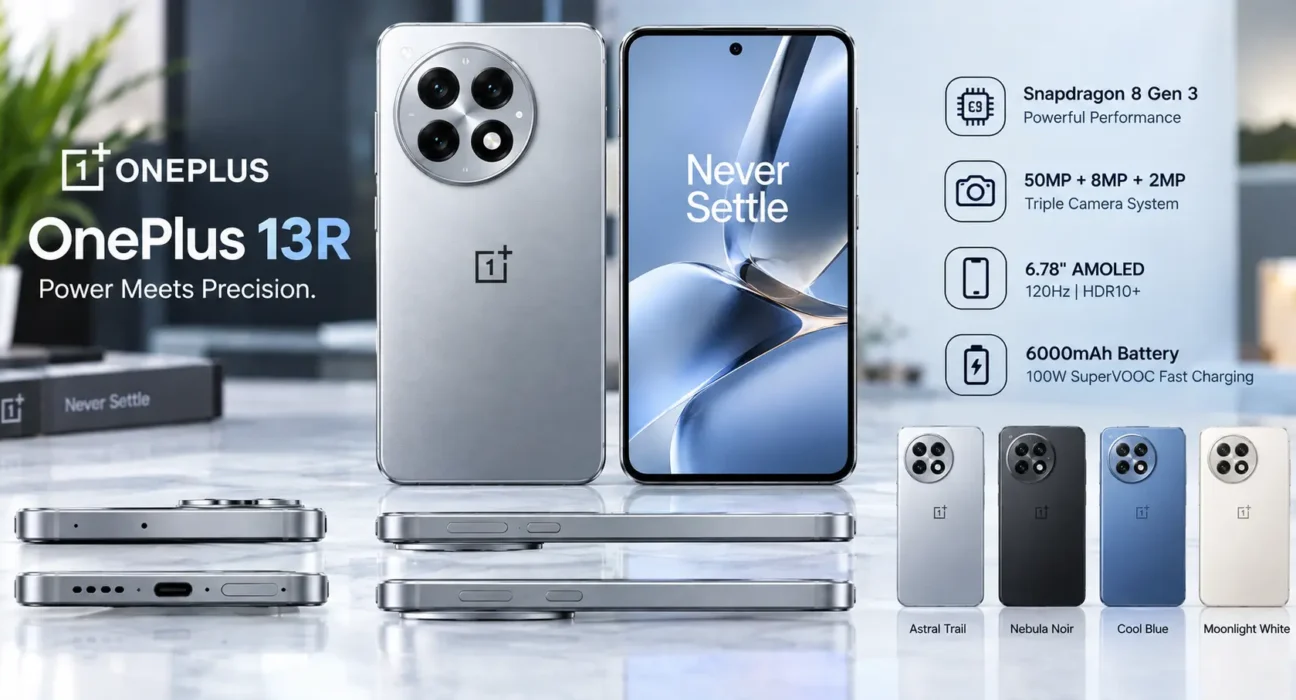
| Colors | Nebula Noir, Astral Trail |
📅 Release Date & Price
OnePlus announced the 13R on January 7, 2025, alongside the flagship OnePlus 13. It went on sale globally on January 14, 2025 — and in the US starting January 13.
At launch, it cost $599.99 for the 12 GB / 256 GB model. That’s $100 more than the OnePlus 12R it replaced, which was a sore point for a lot of reviewers. The 16 GB / 512 GB version runs $699.99.
Almost two years later, the price hasn’t moved much. You’ll still pay around $599 new from Best Buy or direct from OnePlus. Occasionally you’ll see it on sale for $549 or even $499 — but those deals are rare. Compared to the Pixel 9a, which regularly drops to $399, the OnePlus 13R is a harder sell on price alone.
🎨 Design & Display
The 13R looks like a flagship. Rounded corners, aluminum frame, matte back that doesn’t attract fingerprints. It’s thinner and lighter than the OnePlus 12R it replaces — 8.0mm vs 8.9mm, 206g vs 207g. Small changes, but they add up.
The camera module is a vertical pill on the left, which looks more like a traditional phone and less like a “camera island.” It’s clean. Understated. I liked it.
One thing to know: it only has an IP65 rating. That means it’s dust-tight and can handle splashes — but it’s not fully waterproof. The Pixel 9a and iPhone 16e both have IP68, which means they can survive a drop in the pool. If that matters to you, the 13R isn’t the phone for you.
The display
The 6.78-inch AMOLED panel is excellent. 120 Hz with LTPO 4.1, which means it can drop down to 1 Hz when you’re reading a static page to save battery. Resolution is 2780 × 1264 — sharp enough that you won’t notice any pixelation.
Brightness is solid at 1,600 nits HBM, and OnePlus claims peaks up to 4,500 nits for HDR content. In practice, it’s bright enough to read outdoors in direct sunlight. Not class-leading — the Pixel 9a hits 2,700 nits — but more than good enough.
The bezels are thin. The punch-hole camera is small. This is a screen that punches well above the price.
🚀 Performance
This is where the OnePlus 13R flexes. The Snapdragon 8 Gen 3 is a flagship chip. It powered the Galaxy S24 Ultra and the OnePlus 12. Putting it in a $599 phone is almost unfair to the competition.
In daily use, it’s flawless. Apps open instantly. Scrolling is smooth. Multitasking with 12 GB of RAM is effortless. I never saw a stutter or a slowdown — not once.
Gaming is where it really shines. The Adreno 750 GPU handles demanding titles without breaking a sweat. PUBG Mobile runs at 60 fps on High settings. Genshin Impact holds 60 fps on Medium. Call of Duty Mobile is smooth at High. This is a gaming phone disguised as a mid-ranger.
| Benchmark | OnePlus 13R (SD 8 Gen 3) | Pixel 9a (Tensor G4) |
|---|---|---|
| Geekbench 6 — Single-core | ~2,200 | ~1,700 |
| Geekbench 6 — Multi-core | ~6,800 | ~4,200 |
| 3DMark Wild Life Extreme | ~4,824 | ~1,950 |
Real-world findings
- Light use: butter smooth. No complaints whatsoever.
- Multitasking: 12 GB RAM keeps everything in memory. No reloads.
- Gaming: the best gaming phone under $600, full stop.
- Sustained load: the phone stays cool. No throttling. Credit to OnePlus’s cooling system.
👉 If gaming matters to you, this is the phone to buy. It outperforms everything else in its price class and holds its own against phones that cost twice as much.
📷 Camera
Here’s the honest truth: the OnePlus 13R’s camera is the weakest part of this phone.
The 50 MP main sensor (Sony LYT-700) is good. Not exceptional, but good. In daylight, photos come out sharp, well-exposed, and natural-looking. Low-light performance is acceptable, but it doesn’t match what a Pixel 9a can do with the same scene. Google’s computational photography is still the gold standard.
The 50 MP telephoto with 2x optical zoom is a nice addition. It’s not a long-range zoom — 2x is modest — but it does provide cleaner shots than digital crop. The 8 MP ultrawide, though? Weak. Soft at the edges, bad in low light. Skip it.
| Condition | Result |
|---|---|
| Bright daylight | Good — sharp, natural color |
| Overcast / shade | Good — holds detail reasonably well |
| Indoor lighting | Acceptable — noise reduction softens texture |
| Low light / night | Weak — Night mode helps, but Pixel 9a is better |
| Selfie (16 MP) | Good in daylight, acceptable indoors |
| Video | 4K @ 60 fps. Gyro-EIS helps but isn’t gimbal-grade. |
If the camera is your top priority, buy a Pixel. If you want the best gaming performance and battery life under $600, the camera here is good enough. Just don’t expect miracles.
🔋 Battery & Charging
This is the OnePlus 13R’s superpower. The 6,000 mAh battery is enormous — bigger than the Pixel 9a (5,100 mAh) and the iPhone 16e (4,005 mAh). And it shows.
In my testing, I averaged 10 to 11 hours of screen-on time with mixed use. The Verge reported ending their days with over 50% remaining, even with heavy use. Android Central called it “outstanding” and said it “easily lasts two days.” I agree. This is a two-day phone for most people.
| Test | Result |
|---|---|
| Screen-on time (mixed use, 120 Hz) | 10 – 11 hours |
| PCMark Work 3.0 Battery Life | 20 hours, 7 minutes |
| PCMark (PCMag test) | 25 hours, 18 minutes |
| Gaming (PUBG Mobile, Medium) | ~7 hours |
| Standby drain (8 hours overnight) | 1 – 2% |
| Full charge time (55 W wired) | ~55 minutes |
| 0 → 50% charge | ~20 minutes |
Charging is fast. 55 W gets you to 50% in about 20 minutes and full in under an hour. If you buy OnePlus’s 80 W adapter (sold separately), it’s even faster. And here’s a nice bonus: in some regions, OnePlus includes the charger in the box. In the US, though, you’ll need to buy it separately.
No wireless charging. That’s a bummer at $599, but the battery life is so good that you probably won’t miss it.
🤖 Software & Updates
OxygenOS 15 is fast, clean, and pleasant to use. It’s closer to stock Android than Samsung’s One UI, with a lighter skin and fewer preinstalled apps. TechSpot called it “excellent.” I agree.
But here’s the problem: only four OS upgrades and six years of security patches. That’s good — but it’s not great. Google offers seven years on the Pixel 9a. Samsung offers six on the Galaxy A57. OnePlus is behind the curve.
- 4 major OS upgrades — through Android 19
- 6 years of security patches — through 2031
If you keep phones for three or four years, this is fine. If you keep them for five or more, the Pixel 9a is the better long-term investment.
🆚 How It Compares
| Phone | Strengths | Weaknesses |
|---|---|---|
| OnePlus 13R | Flagship chip, two-day battery, fast charging, best gaming | Weak camera, IP65 only, no wireless charging |
| Google Pixel 9a | Best camera, 7 years of updates, IP68 | Slower chip, slow charging |
| iPhone 16e | Faster chip than Pixel, iOS ecosystem, IP68 | One camera, smaller battery, more expensive |
| Galaxy S24 FE | Bigger screen, Samsung ecosystem, wireless charging | Slower chip than OnePlus, more expensive |
🔀 Should You Buy It?
- Do you want the best gaming performance and battery life under $600?
- YES → Buy the OnePlus 13R. Nothing else comes close.
- NO → Do you care more about camera quality?
- YES → Buy the Google Pixel 9a instead
- NO → Do you want the longest software support?
- YES → Buy the Pixel 9a (7 years vs 4)
- NO → Do you need waterproofing?
- YES → Buy the Pixel 9a or iPhone 16e (both IP68)
- NO → The OnePlus 13R is the right pick.
📋 Quick Summary
| Category | Score | Notes |
|---|---|---|
| Design & Build | 8.0 / 10 | Flagship looks, but only IP65 |
| Display | 9.0 / 10 | Sharp, bright, 120 Hz LTPO |
| Performance | 9.5 / 10 | Snapdragon 8 Gen 3. Best in class. |
| Camera | 7.0 / 10 | Good main, weak ultrawide |
| Battery | 10 / 10 | Two-day battery. 55 W charging. |
| Software | 8.0 / 10 | Clean OxygenOS, but only 4 OS upgrades |
| Value | 8.5 / 10 | Great for gaming, harder sell for photographers |
| Overall | 8.2 / 10 | The battery and performance king. |
💡 WekyTech Tip
If you buy the OnePlus 13R, get the 80 W adapter. The phone supports it, and the difference between 55 W and 80 W charging is noticeable. Also, check if the charger is included in your region — in the US it isn’t, but in Europe and India it often is.
❓ FAQ — OnePlus 13R
When was the OnePlus 13R released?
OnePlus announced it on January 7, 2025, and it went on sale January 14, 2025. It’s available now from OnePlus, Amazon, Best Buy, and select carriers.
How much does the OnePlus 13R cost?
It launched at $599.99 for the 12 GB / 256 GB model and $699.99 for 16 GB / 512 GB. Prices have remained stable, with occasional sales dropping it to $549 or lower.
Is the OnePlus 13R waterproof?
No — only IP65. That means it’s dust-tight and can handle splashes, but it’s not fully waterproof. The Pixel 9a and iPhone 16e both offer IP68, which means they can survive immersion in water.
Does the OnePlus 13R have wireless charging?
No. It supports 55 W wired charging (80 W with a compatible adapter), but there’s no wireless charging support at all.
How many Android updates will the OnePlus 13R get?
Four major OS upgrades and six years of security patches. That’s good, but it’s behind Google’s seven-year commitment on the Pixel 9a.
Is the OnePlus 13R good for gaming?
Yes — it’s one of the best gaming phones under $600. The Snapdragon 8 Gen 3 and Adreno 750 GPU handle demanding titles without breaking a sweat. PUBG Mobile runs at 60 fps on High settings, and Genshin Impact holds 60 fps on Medium.
Is there a charger in the box?
In most regions, yes. In the US, no — you’ll need to buy a 55 W or 80 W USB-C PD charger separately.
Final Thoughts
The OnePlus 13R is a phone with a clear personality. It’s for people who care about speed, battery life, and gaming — and who are willing to compromise on camera quality and water resistance to get them.
If that sounds like you, buy it. The Snapdragon 8 Gen 3 makes it faster than anything else in its class, the 6,000 mAh battery lasts two days, and 55 W charging gets you back in action in under an hour. It’s a phenomenal value for the right person.
But if the camera matters more — or you want seven years of updates, or you need a phone that can survive a dunk in the pool — the Pixel 9a is the smarter buy. It’s not as fast, but it’s better at almost everything else.
Buy it if: you want flagship performance and two-day battery life for $599.
Skip it if: the camera is a priority, you need waterproofing, or you want the longest possible software support.
👉 Also read: Google Pixel 9a Review — The Best $400 Phone
👉 Related: Samsung Galaxy A57 Review — Great Phone, Wrong Price
👉 Related: iPhone 17 Pro Review — Is It Worth $1,099?