
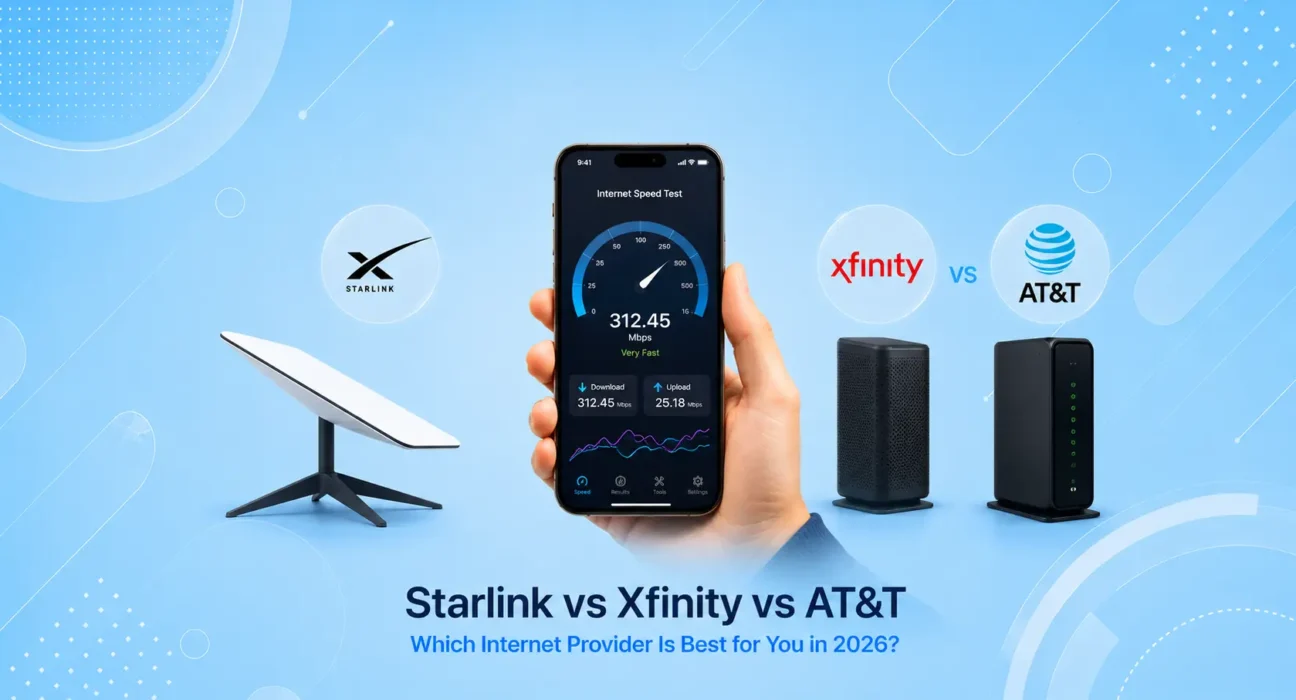
Choosing a home internet provider used to be simple — you picked whatever cable company served your area and called it a day. In 2026, that’s no longer the case. Starlink has matured into a legitimate option for millions of households, AT&T Fiber has expanded aggressively across the US, and Xfinity remains the largest broadband provider in the country.
So which one should you actually choose?
I’ve looked closely at real-world performance data, pricing structures, contract terms, and user feedback across all three to give you the clearest answer possible — not the answer the marketing teams want you to hear.
⚡ Quick Verdict
Choose Starlink if:
- You live in a rural or suburban area with no fiber access
- You travel frequently or need portable internet (RV, boat, remote cabin)
- Cable and DSL options in your area are unreliable or slow
- You’re willing to pay a higher upfront cost for independence from legacy infrastructure
Choose Xfinity if:
- You live in an urban or suburban area where Xfinity is available
- You want low entry-level pricing with flexible plan tiers
- You’re bundling internet with TV or mobile service
- You need the widest availability of WiFi hotspots while traveling in the US
Choose AT&T Fiber if:
- AT&T Fiber is available at your address (check first — availability varies widely)
- You want the most consistent, reliable speeds with the lowest latency
- You prefer no data caps and straightforward pricing
- Long-term value matters more to you than the lowest monthly bill
✅ What Actually Works — Full Comparison Table
| Category | Starlink | Xfinity | AT&T Fiber |
|---|---|---|---|
| Starting Price | $120/mo | $30/mo (promo) | $55/mo |
| Top Speed | 220 Mbps avg | 1,200 Mbps | 5,000 Mbps |
| Latency (avg) | 25–60ms | 10–20ms | 5–10ms |
| Data Caps | None | 1.2 TB (some plans) | None |
| Contract Required | No | No (varies) | No |
| Equipment Cost | $349–$599 upfront | $15/mo rental | $10/mo rental |
| Availability | Near-nationwide (US/Canada) | 40+ US states | Select US cities |
| Best For | Rural/remote users | Urban households | Fiber-available areas |
| Reliability | Weather-dependent | Generally stable | Excellent |
Pricing: What You Actually Pay
This is where the marketing numbers get misleading. Let’s break down the real cost over 12 months.
Starlink:
- Hardware: $349–$599 one-time (depending on kit)
- Monthly service: $120/month (Residential)
- Year 1 total: ~$1,789–$2,039
- No contracts, cancel anytime
Xfinity:
- Promotional rate: $30–$50/month (first 12 months, new customers only)
- After promo: $60–$90/month
- Equipment rental: $15/month
- Year 1 total: ~$540–$780 | Year 2+ total: ~$900–$1,260
- Watch for price increases after the intro period
AT&T Fiber:
- Base plan (300 Mbps): $55/month
- Mid tier (500 Mbps): $65/month
- Gigabit: $80/month
- Equipment: $10/month
- Year 1 total: ~$780–$1,080
- Pricing stays consistent — no promotional cliff
Bottom line on price: Xfinity looks cheapest upfront, but the post-promo jump catches many users off guard. AT&T Fiber is the most transparent. Starlink costs more than both but may be your only real option depending on where you live.
Speed: Numbers vs. Reality
On paper, Xfinity and AT&T offer far higher speeds than Starlink. But raw speed numbers don’t tell the whole story.
Starlink averages 150–220 Mbps download in most US and Canadian locations in 2026 — more than enough for 4K streaming, video calls, and working from home. Upload speeds average 15–30 Mbps, which is noticeably lower than fiber. For most households, Starlink’s speeds are completely sufficient. The ceiling, however, is real — you won’t be pushing gigabit speeds.
Xfinity advertises up to 1,200 Mbps, but those speeds require the right plan and hardware, and real-world performance during peak hours (evenings and weekends) frequently drops to 30–50% of advertised speeds in congested neighborhoods. The infrastructure is shared among neighbors, meaning your speeds fluctuate based on how many people around you are online.
AT&T Fiber consistently delivers speeds closest to what’s advertised. Because fiber connections are dedicated per household — not shared like cable — you get consistent speeds even during peak hours. If AT&T Fiber is available at your address, it’s the most reliable performer of the three.
Speed Winner: AT&T Fiber for consistency | Starlink for rural areas where it’s the only real option
Latency: The Number That Matters for Gaming and Video Calls
Download speed gets all the attention, but latency — the delay between your device sending a request and receiving a response — matters enormously for video calls, gaming, and responsive browsing.
- AT&T Fiber: 5–10ms — excellent for gaming, video calls, and real-time applications
- Xfinity: 10–20ms — good for all uses, minor lag in competitive gaming
- Starlink: 25–60ms — acceptable for video calls and streaming, noticeable in competitive online gaming
Starlink has improved dramatically from its early days (100ms+), but it still can’t match ground-based fiber or cable for latency-sensitive tasks. If you’re a serious gamer or do frequent video conferencing, this is worth factoring in.
Latency Winner: AT&T Fiber, followed closely by Xfinity
Reliability: The Factor Most Reviews Ignore
Starlink is weather-dependent. Heavy snow can obstruct the dish; severe rain causes signal degradation. In most normal weather conditions it’s stable, but it’s not as rock-solid as ground infrastructure. Outages are typically short (minutes, not hours), but they happen.
Xfinity has a mixed reliability record. In many areas it’s stable and consistent. In others — particularly older infrastructure markets — outages and slowdowns during storms are common. Customer service satisfaction scores are consistently among the lowest of any major US ISP, which compounds the problem when something does go wrong.
AT&T Fiber consistently ranks among the most reliable ISPs in the US. Fiber lines are far less susceptible to weather, interference, and physical degradation than coaxial cable. Outages are rare, and when they occur, AT&T’s response times are generally faster than Xfinity’s.
Reliability Winner: AT&T Fiber
Availability: The Factor That Decides Everything
None of this matters if the provider isn’t available at your address.
- Xfinity covers about 40 states and serves roughly 110 million US homes — by far the widest availability
- AT&T Fiber is expanding but remains concentrated in cities and suburbs — check att.com/internet to confirm availability at your specific address
- Starlink is available across nearly all of the US and Canada, making it uniquely valuable for rural and remote areas that have no fiber or reliable cable option
For Canadian readers: Starlink is fully available nationwide; AT&T does not operate in Canada; and the equivalent comparison would be Starlink vs Rogers vs Bell, depending on your province.
Availability Winner: Xfinity (sheer coverage) | Starlink (for rural and remote)
Who Should Choose What — The Honest Breakdown
Rural homeowners and remote workers: Starlink is likely your best or only real option. The upfront hardware cost is the biggest barrier, but the service itself is reliable and the speeds are genuinely usable for full-time work-from-home.
Urban and suburban households with AT&T Fiber available: Choose AT&T Fiber without hesitation. It’s the most consistent, reliable, and transparently priced of the three. Check availability first at att.com/internet.
Urban and suburban households without AT&T Fiber: Xfinity is a solid choice, especially if you catch a promotional rate. Just be prepared for the price increase after month 12, and know that customer service is a weak point.
Frequent travelers or RV/boat users: Starlink’s portable and roaming options are genuinely useful here — no other major ISP offers comparable flexibility.
📋 Final Scorecard
| Category | Winner |
|---|---|
| Lowest Monthly Price | Xfinity (promo) |
| Best Long-Term Value | AT&T Fiber |
| Fastest Speeds | AT&T Fiber |
| Best Latency | AT&T Fiber |
| Best for Rural Areas | Starlink |
| Most Reliable | AT&T Fiber |
| Widest Availability | Xfinity |
| Most Flexible (no contract, portable) | Starlink |
| Best Customer Service | AT&T Fiber |
Overall winner for most US households: AT&T Fiber — if it’s available at your address.
Runner-up for everyone else: Xfinity in urban/suburban areas, Starlink everywhere else.
❓ FAQ — Starlink vs Xfinity vs AT&T
Q: Is Starlink worth the $349 upfront cost in 2026?
If you live in a rural area with no fiber access and your current internet is slow or unreliable, absolutely yes. The hardware pays for itself quickly when you factor in the improved speeds and reliability versus legacy DSL or satellite options. If AT&T Fiber or strong cable is available at your address, it’s harder to justify.
Q: Does Xfinity have data caps?
Most Xfinity plans include a 1.2 TB monthly data cap. For average households that’s sufficient, but heavy streamers and remote workers can hit it. Xfinity charges $10–$30/month extra for unlimited data, or you can pay $25/month upfront to add unlimited to any plan.
Q: Is AT&T Fiber faster than Xfinity?
In consistent real-world performance, yes — even when Xfinity’s advertised speeds are technically higher. AT&T Fiber delivers speeds closer to advertised because it’s a dedicated line, not shared infrastructure.
Q: Can Starlink handle working from home full time?
Yes, for most remote work use cases — video calls, cloud apps, file transfers. The main limitation is upload speed (15–30 Mbps) and occasional latency spikes. For most professionals, it’s completely workable.
Q: How do I check if AT&T Fiber is available at my address?
Go to att.com/internet and enter your address. Fiber availability is expanding but remains patchy — some streets have it while neighboring streets don’t.
Q: Which ISP has the best customer service?
AT&T Fiber consistently scores higher than both Xfinity and Starlink in customer satisfaction surveys. Xfinity has historically scored among the lowest of any major US ISP. Starlink is entirely online-based support — no phone line — which works well for straightforward issues but is frustrating for complex problems.
Q: Is Starlink available in Canada?
Yes — Starlink operates nationwide in Canada and is particularly popular in provinces with limited cable infrastructure. Monthly pricing is approximately $140–$165 CAD depending on the plan.
Final Thoughts
In 2026, there’s no single “best” home internet provider — the right choice depends entirely on where you live and how you use the internet. AT&T Fiber is the gold standard when available. Xfinity is the practical choice for most urban and suburban households. And Starlink has genuinely changed the game for rural and remote users who had no real options before.
Check availability at your address first. Then pick the provider that matches your budget, usage, and location — not the one with the best commercials.
Related articles:
- Why Is My Internet So Slow? 9 Fixes That Actually Work
- How to Fix Xfinity Internet Keeps Dropping
- Best WiFi Routers for Large Homes — Tested and Ranked 2026
Author Bio Placeholder: [Raouf Osman] covers broadband, home networking, and ISP comparisons across the US and Canada. He/she monitors real-world speed data and pricing changes across major providers to keep recommendations accurate and current.