
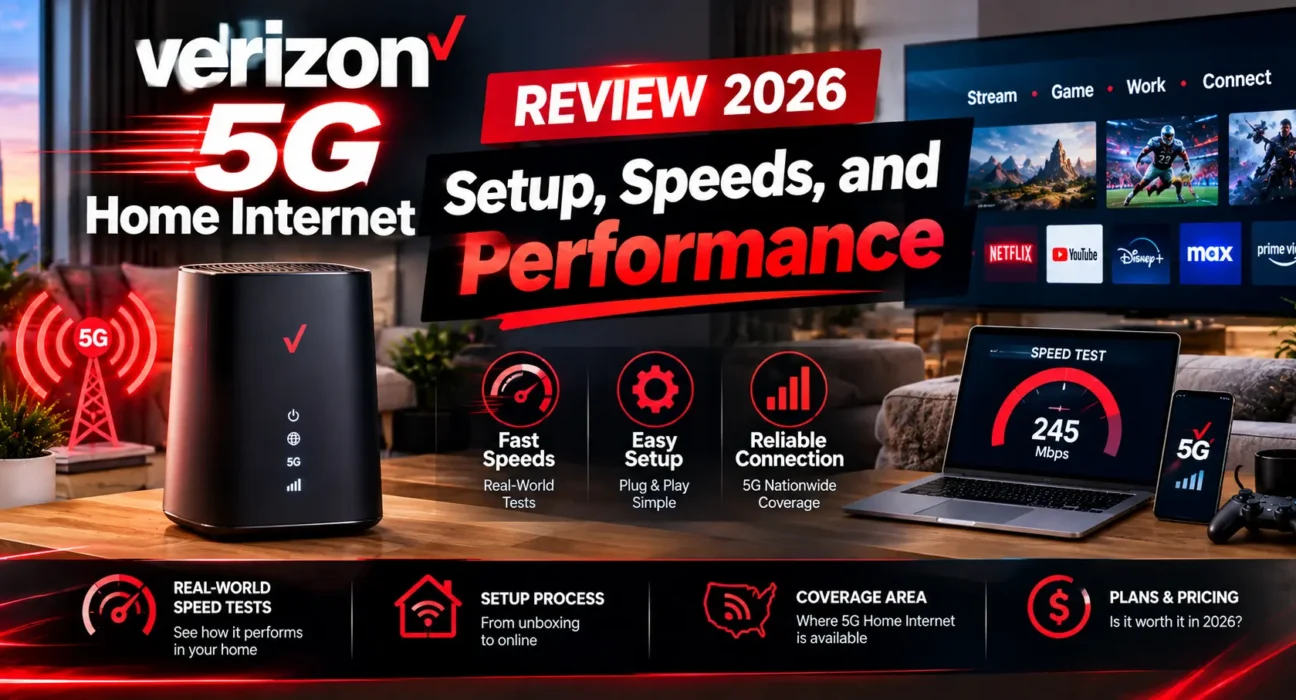
Deciding whether to sign up? Our in-depth Verizon 5G Home Internet review evaluates real setup, real speeds, pricing, and recent performance trends to help you decide if it’s worth it in 2026.
Review based on Verizon’s published plan details, U.S. News’ 2026 consumer survey, Allconnect and HighSpeedInternet.com customer data, and recent quarterly speed-trend reporting.
Verizon 5G Home Internet Plans
| Plan | Advertised Speed | Starting Price |
|---|---|---|
| Home Internet Lite | Data capped at 150GB, then reduced speed | $35/mo (bundled) |
| 5G Home | Up to 300 Mbps | $35-50/mo |
| 5G Home Plus | Up to 1,000 Mbps | Higher tier |
| 5G Home Ultimate | Up to 1,000+ Mbps (best signal areas) | Highest tier |
The lowest advertised price requires bundling with a qualifying Verizon mobile plan; standalone pricing runs closer to $50/month. All standard plans (excluding Home Internet Lite) come with no data caps, no annual contract, no equipment fees, and a price lock guarantee lasting 3-5 years depending on the current promotion.

Setup: What Actually Happens
1. Check availability at your address
Verizon’s app or website shows your specific address’s signal strength before you order, so you know roughly what performance tier to expect before committing.
2. The Gateway ships to your door
Verizon includes a 5G Home Internet Gateway – a combined modem and Wi-Fi 6 router – at no extra equipment cost, typically arriving within a few days.
3. Self-install near a window
Place the Gateway near a window or unobstructed area facing outward, plug it in, and follow the app’s setup prompts. Most users report being online within 15-30 minutes, with no technician visit required.
4. Add Whole-Home Wi-Fi extenders if needed
For larger homes or spots with weak signal, Verizon offers optional Whole-Home Wi-Fi extenders to fill in coverage gaps – worth considering if your house is on the larger side or has a challenging layout.
Real-World Speeds
Verizon’s own peer-reviewed median sits around 245 Mbps download on the base 5G Home plan, climbing to roughly 442 Mbps on 5G Home Plus in strong-signal areas. Independent testing has found similar results – one hands-on test reported 245-360 Mbps with over a dozen devices connected simultaneously, with upload speeds in the 20-30 Mbps range, comparable to typical cable internet uploads.
Pros and Cons
What Works Well
- Genuinely easy self-install, no technician needed
- No annual contract, no data caps on standard plans
- Multi-year price lock guarantee
- Wi-Fi 6 router included at no extra cost
- Strong discount when bundled with a Verizon mobile plan
Worth Considering
- Availability limited to select coverage areas (around 34 states with fixed wireless)
- Speeds vary meaningfully by location and time of day
- 2025-2026 has seen declining customer satisfaction relative to T-Mobile and AT&T
- Some markets reporting a downward speed trend through 2026
- Upload speeds well below what fiber offers
Verizon 5G Home Internet vs. the Competition
| Provider | Typical Speed | Starting Price | Key Difference |
|---|---|---|---|
| Verizon 5G Home | ~245 Mbps median | $35-50/mo | Strong bundle discount with Verizon mobile |
| T-Mobile 5G Home Internet | 72-245 Mbps | $35-50/mo | Wider mid-band coverage overall |
| AT&T Internet Air | Varies by area | ~$50-60/mo | Backed by AT&T’s low-band reach |
| Fiber (average) | 300 Mbps – 2 Gbps+ | ~$60-65/mo | Fastest, most consistent, where available |
For the full breakdown of how T-Mobile’s fixed wireless service compares, see our T-Mobile 5G Home Internet vs. Fiber comparison, and check 5G Home Internet vs. Cable if a traditional wired option is also on your shortlist.
Who Should Buy It?
Consider Verizon 5G Home Internet if: Fiber isn’t available at your address, you already have a Verizon mobile plan and want the bundle discount, and your household’s needs fit comfortably under 300-500 Mbps for streaming, browsing, and video calls.
Look elsewhere if: You need consistently high upload speeds above 100 Mbps for serious remote work, you’re a competitive gamer sensitive to latency variability, or recent speed-decline reports in your specific market give you pause – checking your address’s current signal strength in Verizon’s app before signing up is worth the two minutes either way.
❓ FAQ — Verizon 5G Home Internet Review
Q: How fast is Verizon 5G Home Internet in real-world use?
Verizon’s own peer-reviewed median is around 245 Mbps on the base plan, and up to roughly 442 Mbps on 5G Home Plus in strong-signal areas – below the advertised “up to” ceiling but still solid for most households.
Q: Is Verizon 5G Home Internet easy to set up?
Yes. The Gateway ships to your door, and most users are online within 15-30 minutes of plugging it in near a window – no technician visit required.
Q: Does Verizon 5G Home Internet have data caps?
The standard 5G Home, Home Plus, and Home Ultimate plans have no data caps. The lower-cost Home Internet Lite plan does cap at 150GB before reducing speed.
Q: Have Verizon 5G Home Internet speeds gotten slower in 2026?
Some markets have reported declining median speeds through 2026, linked to network capacity strain. Verizon’s Starry acquisition and an upcoming 2027 C-band spectrum auction are both expected to help address this over time.
Q: Is Verizon 5G Home Internet cheaper with a mobile plan?
Yes. Bundling with a qualifying Verizon wireless plan can bring the starting price down to around $35/month, compared to roughly $50/month standalone.
Q: Is Verizon or T-Mobile better for 5G home internet?
They’re fairly close in typical performance – Verizon’s median tends to run slightly higher, while T-Mobile’s mid-band network reaches more of the country overall. Check availability and signal strength at your specific address to decide.
Final Verdict: Verizon 5G Home Internet Review
To conclude our Verizon 5G Home Internet review: it remains a solid, budget-friendly option for households that don’t have fiber available and want a fast, no-contract setup process – the self-install experience and price-lock guarantee are genuine strengths. That said, 2026 hasn’t been Verizon’s smoothest year on this front: declining year-over-year satisfaction and some regional speed softening are worth factoring in. Check your address’s real signal strength before signing up, and it remains a reasonable pick, especially if you’re already a Verizon mobile customer.
👉 Read next: 5G Home Internet vs. Cable
👉 Also useful: How to Speed Up Your 5G Home Internet