
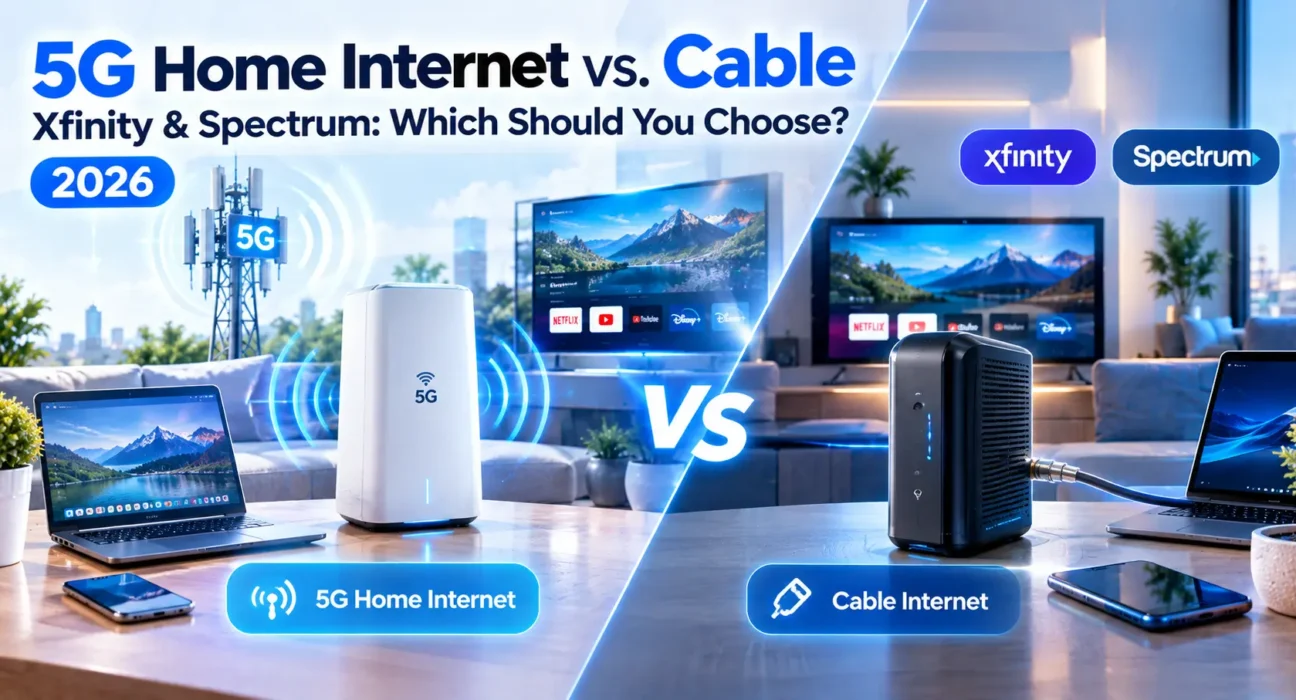
5G home internet vs cable isn’t really a question of which technology is “better” in the abstract – cable from Xfinity or Spectrum is faster and more consistent, full stop. The real question is whether that extra consistency is worth paying more for, dealing with contracts, and waiting on a technician – or whether 5G’s simplicity and flat pricing wins for how you actually use the internet.
Comparison based on published plans from Xfinity, Spectrum, T-Mobile, and Verizon, plus independent reporting from HighSpeedInternet.com and Reviews.org as of 2026.
5G Home Internet vs. Cable: Head-to-Head
| Category | 5G Home Internet (T-Mobile/Verizon) | Cable (Xfinity/Spectrum) |
|---|---|---|
| Speed Range | 72-500 Mbps (varies by location) | 75 Mbps – 2 Gbps |
| Upload Speed | Modest, 10-30 Mbps typical | Generally faster and more consistent |
| Reliability | Varies with congestion, weather can affect signal | Very stable in good and bad weather |
| Setup | Self-install, plug in near a window | Often requires a technician visit |
| Contract | None, typically | Often requires a term agreement for best pricing |
| Data Caps | None on standard plans | Often capped (e.g., 1.2TB on Xfinity) |
| Starting Price | ~$35-50/mo | ~$25-50/mo (promotional) |
| Availability | Wide, especially suburban/rural | Excellent in cabled areas, weaker in rural regions |
Speed and Reliability: Cable’s Clear Advantage
Cable internet uses the same coaxial lines that deliver cable TV, and that dedicated physical infrastructure is exactly why it stays faster and more consistent than any wireless connection can manage. Xfinity offers speed tiers reaching up to 2 Gbps, and Spectrum offers no-contract cable starting at 300 Mbps for around $50/month – both deliver speeds that hold steady during peak evening hours, bad weather, and heavy simultaneous use in a way fixed wireless structurally can’t match, since 5G speeds fluctuate based on how many people are using the same local cell tower at once.
5G home internet’s speed range is genuinely wide depending on your specific location – T-Mobile runs roughly 72-245 Mbps in typical conditions (up to 500 Mbps advertised), while Verizon’s median sits around 245 Mbps, climbing higher in strong-signal areas. Both are perfectly capable for most households’ everyday needs, but neither matches cable’s consistency when the network gets busy.
Setup and Convenience: 5G’s Clear Advantage
This is where 5G home internet earns back a lot of ground. Setup is genuinely just plugging in a gateway device near a window – no technician visit, no scheduling window, no waiting around for an installer. Cable, by contrast, often requires a professional installation, especially for a first-time setup at a new address, which can mean days of waiting and a multi-hour appointment window.
5G providers also tend to be more transparent on pricing: no annual contracts, no data caps on standard plans, and no equipment rental fees baked into the bill. Cable plans, while sometimes cheaper on paper through promotional pricing, often come loaded with contract terms, equipment fees, and price increases once the promotional period ends – the kind of details that show up as an unpleasant surprise a year in.
Choose 5G Home Internet If:
- You want the simplest possible setup with no technician visit
- You’re renting or need flexibility with no long-term contract
- Your household mainly streams and browses, not heavy uploading
- Cable isn’t available or is significantly more expensive at your address
Choose Cable If:
- You need the fastest, most consistent speeds available
- You have a large household with many devices active simultaneously
- You do serious gaming, video editing, or need strong upload speeds
- Reliability during peak hours matters more than setup convenience
Price: Closer Than the Marketing Suggests
On paper, cable promotions can look cheaper than 5G home internet – Xfinity has advertised rates starting under $25/month, and Spectrum’s no-contract 300 Mbps plan runs around $50/month. But those cable rates are often promotional, jumping significantly after the first 12 months, and may not include equipment or installation fees. 5G home internet’s $35-50/month pricing tends to be the actual long-term price, backed by multi-year price lock guarantees from both T-Mobile and Verizon – what you sign up for is closer to what you’ll still be paying two years later.
Which Should You Choose?
| Your Situation | Better Choice |
|---|---|
| Gaming, video editing, or heavy upload needs | Cable |
| Renting, want flexibility, no contract | 5G Home Internet |
| Large household, many devices at once | Cable |
| Want the simplest, fastest setup | 5G Home Internet |
| Cable isn’t available at your address | 5G Home Internet |
| Want to avoid surprise price increases | 5G Home Internet (price lock) |
Curious how each 5G provider performs individually? See our full reviews of Verizon 5G Home Internet and T-Mobile 5G Home Internet vs. Fiber.
❓ FAQ — 5G Home Internet vs. Cable
Q: Is 5G home internet as reliable as cable?
Generally no – cable’s dedicated physical infrastructure delivers more consistent speeds during peak hours and bad weather. 5G performance can fluctuate based on local cell tower congestion, though it’s improved significantly and works well for most everyday households.
Q: Is 5G home internet cheaper than cable?
It depends on timing. Cable promotions can look cheaper upfront, but often increase significantly after the first year. 5G home internet’s pricing tends to stay closer to what you signed up for, thanks to multi-year price lock guarantees.
Q: Can I try 5G home internet without a long-term commitment?
Yes. Both T-Mobile and Verizon offer no-contract plans, so you can test the service for a few weeks and cancel penalty-free if performance doesn’t meet your needs.
Q: Is 5G home internet good enough for streaming?
Yes, as long as your plan delivers at least 100 Mbps, which is more than sufficient for lag-free streaming across multiple devices simultaneously.
Q: Does cable internet have data caps?
Some do – Xfinity’s cable plans, for example, include a 1.2TB data cap (equivalent to roughly 515 hours of HD streaming), while its fiber plan and most 5G home internet plans don’t impose caps.
Q: Will cable using coaxial cable eventually match fiber speeds?
Possibly. DOCSIS 4.0 upgrades to existing coaxial infrastructure aim to deliver fiber-competitive speeds without laying new cable, with early deployments expected through 2026 and broader availability in 2027.
Final Verdict
If raw speed, upload performance, and consistency under heavy use matter most, cable from Xfinity or Spectrum is still the stronger technical choice. If you value simple setup, transparent no-contract pricing, and flexibility – especially if you’re renting or cable isn’t well-priced at your address – 5G home internet from T-Mobile or Verizon is a genuinely competitive alternative for most everyday households. The good news either way: with no-risk trial periods available, you don’t have to guess – test the one you’re leaning toward and see how it actually performs at your address.
👉 Read next: T-Mobile 5G Home Internet vs. Fiber
👉 Also useful: How to Speed Up Your 5G Home Internet