
Analysis based on carrier network announcements from AT&T, Verizon, and T-Mobile, plus independent reporting from Fierce Network, LightReading, and DatacenterDynamics through October 2026. Coverage of 5G standalone network US availability, device readiness, and the NSA-to-SA transition across all three major US carriers.
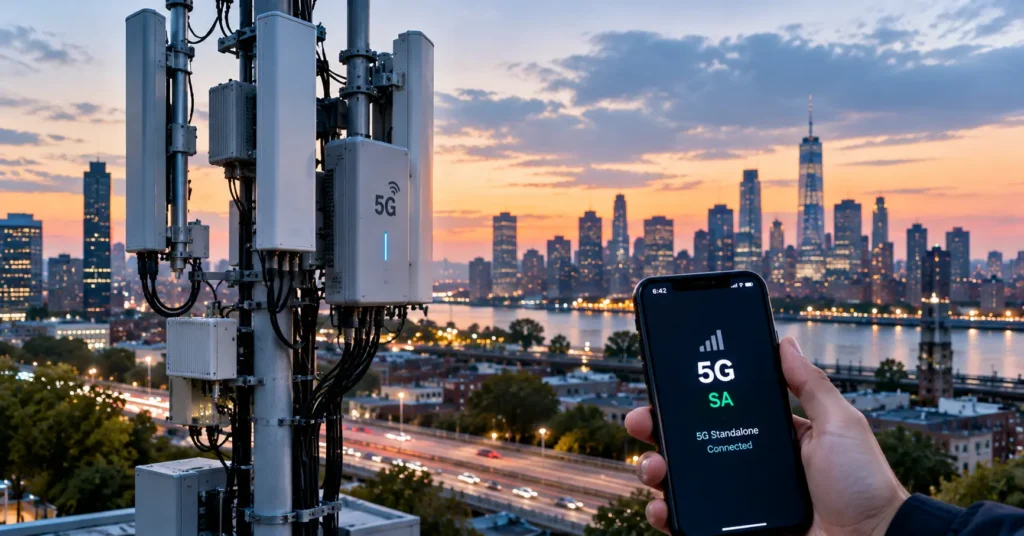
You’ve probably never consciously thought about whether your 5G is “Standalone” or not — and for most of 5G’s history in the US, that was kind of the point. It worked the same either way, more or less. But 2026 is the year that stopped being quite as true, with all three major carriers now claiming a nationwide 5G standalone network in the US. The gap between the one that’s had it since 2020 and the two that just got there is still showing up in real-world performance.
5G Standalone matters because it changes what’s actually happening under the hood of your connection, not just how fast a speed test number looks. Lower latency, better battery life, and features like network slicing all depend on it — and whether you’re actually getting any of that still depends heavily on which carrier you’re with.
If you’re looking for a broader overview before diving in, start with our Ultimate Guide to 5G Networks in the US.
Work through this guide in order and you’ll know exactly where each carrier stands, and whether your own phone is even capable of taking advantage of it.
⚡ Quick Answer — The Short Version
If you only read one section:
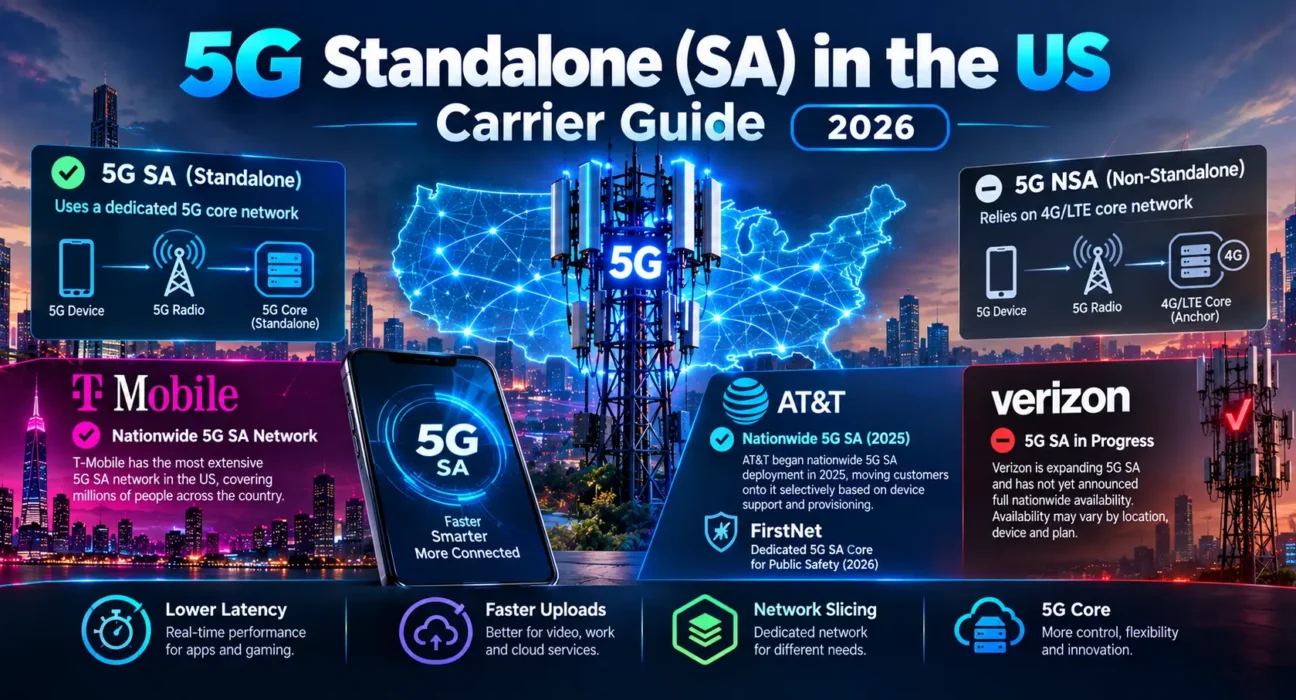
- T-Mobile has run a nationwide 5G standalone network in the US since 2020 — it’s the most mature deployment by a wide margin, both on the network side and in device support.
- AT&T declared its 5G SA network nationwide in 2025, years behind T-Mobile, with Elbaz (AT&T’s network CTO) saying “millions” of customers are already riding on it.
- Verizon says its 5G SA rollout is “nationwide” too, but execs have been noticeably more cautious, specifically flagging that device support still needs to catch up to the network.
All three carriers can now technically claim a nationwide 5G standalone network US, but “nationwide” and “mature” aren’t the same thing. T-Mobile is still the one that’s had years to work out the kinks.
🔍 NSA vs. SA — What’s Actually Different
| Factor | 5G NSA (Non-Standalone) | 5G SA (Standalone) |
|---|---|---|
| Core Network | Relies on 4G LTE core | Runs entirely on a 5G core |
| Latency | Higher, limited by 4G signaling | Meaningfully lower |
| Upload Speeds | Limited by 4G | Noticeably faster |
| Battery Life | Normal | Improved, less signaling overhead |
| Network Slicing | Not possible | Supported |
| US Availability (2026) | Still used as fallback everywhere | Nationwide claimed by all 3 major carriers |
To understand how spectrum bands impact these networks, read our guide on mmWave vs. Sub-6GHz 5G.
✅ Carrier SA Deployments — Ranked by Maturity
Ranked based on launch date, network depth, and device-support maturity as reported by Fierce Network, LightReading, and DatacenterDynamics.
| Carrier | SA Launch | Maturity in 2026 | Notable Capability |
|---|---|---|---|
| T-Mobile | 2020 (nationwide) | Most mature — network and device support | First US carrier with commercial VoNR; advanced uplink features |
| AT&T | 2025 (nationwide claim) | Still catching up on device support | RedCap IoT services nationwide |
| Verizon | 2022 start, “nationwide” by 2025-26 | Caveated — carrier itself flags device gaps | Network slicing for first responders |
T-Mobile: The Carrier That Got There First
T-Mobile switched on its nationwide 5G standalone network in the US back in August 2020. It ran first on its low-band 600 MHz spectrum, then extended SA to its 2.5 GHz mid-band (Ultra Capacity) network in November 2022.
That five-year head start isn’t just a bragging point — it shows up in real capability. T-Mobile was the first US carrier to offer commercial VoNR (Voice over New Radio, which handles calls natively over 5G SA instead of falling back to older voice technology). It currently leads the industry in advanced uplink features like FDD+TDD carrier aggregation and uplink MIMO.
In plain terms: if you’re on T-Mobile in 2026, you’re very likely already benefiting from 5G SA without having thought about it once. The network has had years to iron out early-deployment rough edges that newer SA networks are still working through.
AT&T: Caught Up, Mostly on the Network Side
AT&T made its 5G standalone network in the US official in 2025, years after first switching on 5G itself back in late 2018 running Non-Standalone.
The carrier’s network CTO Yigal Elbaz said AT&T is actively moving customers onto the SA network “every day,” with millions of subscribers already connected as of the announcement. AT&T has backed this with real infrastructure investment, including a $14 billion Open RAN contract with Ericsson. Furthermore, it has used its SA core to roll out nationwide RedCap service — a lighter-weight 5G variant built for IoT devices that don’t need full smartphone-level bandwidth.
What AT&T hasn’t done yet, compared to Verizon, is launch network slicing — the feature that lets carriers carve out dedicated network lanes for specific uses. Elbaz’s announcement hinted at more coming, but as of now it’s infrastructure without that particular feature switched on yet.
Verizon: Nationwide, With an Asterisk
Verizon’s path to nationwide SA has been the most publicly hedged of the three. At the Mobile Future Forward 2025 conference, Verizon Consumer Group CEO Sowmyanarayan Sampath said the network itself is nationwide. However, he specifically cautioned against overpromising because device support is still catching up — a notably more careful framing than AT&T’s.
Verizon has, however, actually shipped something AT&T hasn’t: two live network slicing services built on its SA core, including a dedicated priority slice for first responders.
Verizon’s SA rollout has leaned heavily on its substantial C-band mid-band investment. The carrier’s cloud-native, containerized SA core (built on Verizon Cloud Platform) is architecturally modern. The caveat is really about how consistently and completely devices across Verizon’s customer base can actually take advantage of it yet. For more on this, check out What Is 5G C-Band?.
⚠️ WORTH KNOWING
“Nationwide” doesn’t have a strict industry definition that all carriers meet the same way. Analysts have pointed out that Verizon previously claimed a “nationwide” SA network when it was reportedly live in only three states. Treat carrier SA announcements as directional progress markers, not guarantees of full coverage at your specific address.
How to Tell If You’re Actually on 5G SA
Most phones don’t show a dedicated “SA” icon the way they show “5G UC” or “5G UW.” The most reliable way to check:
- On Android (most models): Dial
*#*#4636#*#*to open a hidden testing menu, then check Phone Information for network type details. (Note: this varies by manufacturer and isn’t available on all devices). - Third-party apps: Network-monitoring apps like Network Cell Info Lite can show NR (New Radio) connection details, including whether you’re on an SA or NSA registration.
- The practical shortcut: If you’re on T-Mobile in 2026, assume you’re on SA most of the time. If you’re on AT&T or Verizon, it’s increasingly likely but less certain depending on your specific device and location.
📋 Quick Summary Table
| Carrier | SA Status (2026) | Best For |
|---|---|---|
| T-Mobile | Most mature nationwide SA | Lowest latency, best battery efficiency today |
| AT&T | Nationwide, network-side complete | IoT/RedCap use cases, catching up overall |
| Verizon | Nationwide claimed, device gap acknowledged | Network slicing features (first responders) |
💡 WekyTech Tip
Don’t shop for a phone or plan based on “5G SA support” as a checkbox — nearly every 5G phone sold in the US since 2022 supports SA on a technical level. What actually varies is the network’s maturity, which is a carrier question, not a phone question. If latency and battery life matter most to you specifically, T-Mobile’s five-year head start is the more meaningful signal than any spec sheet. You can also compare their broader coverage in our T-Mobile vs. Verizon 5G breakdown.
❓ FAQ — 5G Standalone in the US
Q: What is the difference between 5G NSA and 5G SA?
5G NSA (Non-Standalone) still relies on a 4G LTE core network behind the scenes to manage things like call setup. 5G SA (Standalone) runs entirely on a 5G core with no 4G dependency — unlocking lower latency, better battery efficiency, and features like network slicing that NSA can’t support.
Q: Which US carrier has the best 5G standalone network in 2026?
T-Mobile remains the most mature, having launched nationwide SA back in 2020 — five years ahead of AT&T and Verizon’s 2025-2026 nationwide claims. It also leads on device support and advanced features like commercial VoNR. For a detailed head-to-head, read our T-Mobile vs. Verizon 5G comparison.
Q: Do I need a special phone for 5G SA?
Most 5G phones sold since 2022 support SA on a hardware level, but how well they actually connect to a given carrier’s SA network can still vary. Carrier network maturity matters more day to day than your phone’s raw spec sheet.
Q: Does 5G SA actually improve battery life?
Yes, generally. Because SA doesn’t need to maintain a simultaneous 4G LTE connection in the background, devices on a mature SA network tend to see improved battery efficiency compared to NSA.
Q: What is network slicing and why does it matter?
It’s a feature only possible on 5G SA that lets carriers create dedicated, isolated “lanes” of network capacity for specific uses. Verizon’s first-responder priority slice is a live example. It’s a capability NSA networks simply can’t offer.
Q: Is Verizon’s 5G SA network really nationwide?
Verizon says yes, though the carrier itself has been cautious about overpromising, specifically noting device support still needs to catch up in some areas. This is worth keeping in mind compared to the more confident tone of AT&T’s 2025 announcement.
Final Thoughts
5G Standalone is the part of the 5G story that doesn’t show up in a quick speed test but genuinely changes what your connection is capable of — lower latency, better battery life, and features that simply don’t exist on the older NSA architecture.
All three major US carriers can now claim a 5G standalone network in the US, but “nationwide” has turned out to mean different things depending on who’s saying it. T-Mobile’s five-year head start still shows in both network maturity and device support, while AT&T and Verizon are both real, if newer, players in the same race.
👉 Also read: What Is 5G C-Band?
👉 Read next: mmWave vs. Sub-6GHz 5G
👉 Also useful: T-Mobile vs. Verizon 5G
About the Author
Raouf Osman is a tech writer at WekyTech specializing in US wireless carriers and 5G network architecture. He tracks carrier infrastructure announcements and independent network testing data to separate real deployment progress from marketing claims.