
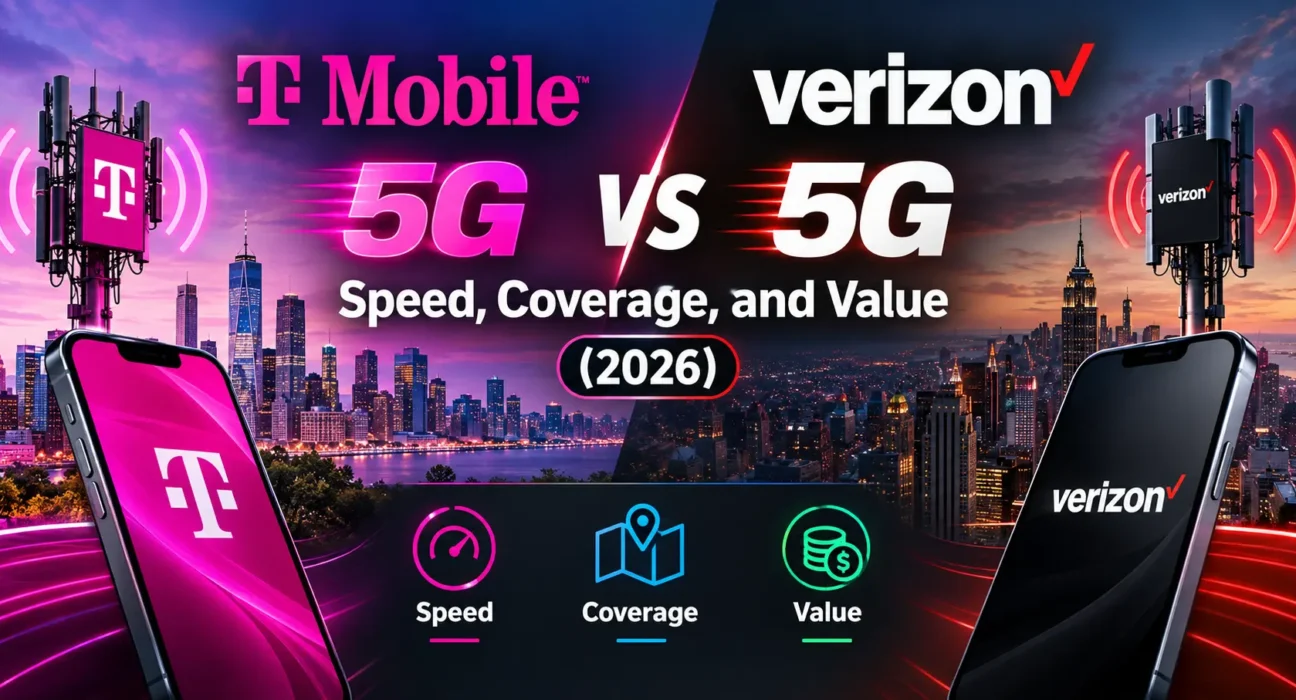
T-Mobile vs Verizon 5G comes down to a pretty simple trade-off once you strip away the marketing: T-Mobile covers more ground with consistently solid mid-band speeds, while Verizon’s smaller high-band footprint hits genuinely blistering peaks in the exact spots it reaches. Which one actually wins depends less on the carrier and a lot more on your zip code.
Comparison based on Ookla Speedtest Intelligence data, OpenSignal Mobile Network Experience reports, and both carriers’ published network coverage figures for 2026.
T-Mobile vs Verizon 5G: Head-to-Head
| Category | T-Mobile | Verizon |
|---|---|---|
| 5G Coverage (% of US) | ~53% | ~13% |
| Average 5G Download Speed | ~252 Mbps | ~170 Mbps |
| Peak Speed (in high-band range) | Up to ~300 Mbps typical | Over 1 Gbps in mmWave hotspots |
| Overall Network Experience Score (OpenSignal) | 8.9/10 | 9.6/10 |
| Rural / 4G LTE Reach | ~62% of the country | ~70% of the country |
| Satellite Connectivity | T-Satellite (Starlink partnership) | Not yet widely available |
| 5G Standalone (SA) | Nationwide SA since 2023 | Expanding, less complete |
Speed: Who’s Actually Faster?
On paper, T-Mobile wins this one clearly – its average nationwide 5G download speed sits around 252 Mbps compared to Verizon’s roughly 170 Mbps, according to recent Ookla data. That gap comes down to how each carrier built its network. T-Mobile leaned hard into mid-band spectrum (the 2.5GHz frequencies it inherited from Sprint), which strikes a strong balance between speed and range – you get 200-300 Mbps across entire neighborhoods, not just city blocks.
Verizon went a different direction, betting heavily on high-band mmWave and C-band spectrum for its Ultra Wideband service. When you’re standing within a few blocks of one of those towers – think stadiums, downtown plazas, dense urban corners – you can genuinely see speeds north of 1 Gbps. Walk a few blocks away, though, and you’re back to something closer to 4G-like performance. It’s a classic speed-versus-range trade-off, and T-Mobile’s approach simply covers more real-world situations for most people.
Coverage: Where Each Network Actually Reaches
This is where the story flips depending on what “coverage” means to you. If you’re asking “where does 5G actually work,” T-Mobile wins by a wide margin – its 5G network reaches roughly 53% of the country versus Verizon’s 13%. That’s not a typo; it’s the direct result of T-Mobile’s mid-band strategy scaling out to suburbs and secondary cities in a way Verizon’s high-band-heavy approach hasn’t matched.
But if you’re asking “where does my phone get a usable signal at all,” including older LTE coverage, Verizon edges ahead – about 70% of the country versus T-Mobile’s 62%. Verizon’s decades of rural network investment still shows up here, particularly across the Western half of the US where T-Mobile’s coverage thins out considerably outside of California.
Choose T-Mobile If:
- You live in or near a city, suburb, or major highway corridor
- Consistent 200+ Mbps matters more than occasional peak speed
- You want satellite texting as a backup in dead zones (T-Satellite)
- Budget-friendly plans and included perks matter to you
Choose Verizon If:
- You live in or frequently travel through rural areas
- You need the most reliable connection above all else
- You’re often in dense downtown areas near Ultra Wideband towers
- You value a la carte plan customization
Network Technology: SA vs. NSA, and Why It Matters
A quieter but genuinely important difference in 2026 is 5G Standalone, or SA. Early 5G networks ran in “Non-Standalone” mode, meaning they still leaned on a 4G LTE connection behind the scenes to manage things like call setup. T-Mobile moved to a fully nationwide Standalone network back in 2023, which unlocks lower latency and features like network slicing. Verizon’s SA rollout has continued expanding but remains less complete nationwide, which can show up as a small but real difference in responsiveness for things like cloud gaming or video calls, even when raw download speed looks similar on paper.
Want the deeper technical breakdown of how each carrier’s spectrum actually works? See our full guide to mmWave vs. Sub-6GHz 5G and our explainer on T-Mobile Ultra Capacity vs. Verizon Ultra Wideband.
Price and Value
Both carriers sit at similar price points once you account for taxes and fees, but T-Mobile tends to edge out Verizon slightly on value, especially once you factor in multi-line discounts and included perks like streaming subscriptions on higher tiers. Verizon’s a la carte plan-building approach appeals to people who want to pay only for what they actually use, but that flexibility usually comes at a modest premium compared to T-Mobile’s bundled tiers.
If price is your main concern rather than brand loyalty, it’s worth knowing that MVNOs running on these same networks – Mint Mobile on T-Mobile’s network, or Visible on Verizon’s – can get you the same towers for roughly half the monthly cost.
Which Should You Choose?
| Your Situation | Better Choice |
|---|---|
| City or suburban resident | T-Mobile |
| Rural resident or frequent rural traveler | Verizon |
| Heavy downtown/urban core user near mmWave towers | Verizon (for peak speed) |
| Budget-conscious, wants included perks | T-Mobile |
| Wants maximum plan customization | Verizon |
| Needs satellite backup in dead zones | T-Mobile (T-Satellite) |
❓ FAQ — T-Mobile vs Verizon 5G
Q: Is T-Mobile or Verizon faster for 5G?
T-Mobile is faster on average nationwide, with roughly 252 Mbps compared to Verizon’s 170 Mbps. Verizon can hit much higher peak speeds – over 1 Gbps – but only within close range of its high-band Ultra Wideband towers.
Q: Which carrier has better 5G coverage?
T-Mobile covers significantly more of the country with 5G specifically – about 53% versus Verizon’s 13%. Verizon still leads on overall LTE/legacy coverage reach, especially in rural areas.
Q: What is 5G Standalone and does it matter for everyday use?
It’s a network architecture that doesn’t rely on 4G LTE in the background, enabling lower latency and features like network slicing. T-Mobile has run a fully nationwide Standalone network since 2023; Verizon’s rollout is still expanding.
Q: Is Verizon better than T-Mobile in rural areas?
Generally yes. Verizon’s broader LTE coverage (about 70% of the country versus T-Mobile’s 62%) gives it an edge in rural and remote areas, even though T-Mobile’s 5G-specific coverage is larger overall.
Q: Can I get T-Mobile or Verizon’s network for cheaper through another provider?
Yes. MVNOs like Mint Mobile (T-Mobile’s network) and Visible (Verizon’s network) offer the same towers at roughly half the typical monthly cost.
Q: Does T-Mobile or Verizon have satellite connectivity?
T-Mobile’s T-Satellite, built on a partnership with Starlink, provides texting and select app connectivity in areas with no traditional coverage. Verizon doesn’t yet offer a comparably widespread satellite feature.
Final Verdict
For most people living in or near a city or suburb, T-Mobile is the stronger overall pick in 2026 – broader 5G reach, faster average speeds, and generally better value. Verizon remains the safer choice if reliable coverage in rural or remote areas matters more to you than raw 5G speed, and it still wins in short bursts near its highest-capacity towers. Neither carrier is a bad choice; the right one really is the one that actually performs well where you live, work, and travel most.
👉 Read next: T-Mobile Ultra Capacity vs. Verizon Ultra Wideband
👉 Also useful: Best Prepaid & MVNO 5G Plans in the US