
Router Keeps Disconnecting Fix: 9 Ways to Stop the Drops (2026)
Looking for a router keeps disconnecting fix that actually works? Whether it drops every few minutes, disconnects during video calls, or loses connection randomly throughout the day, the cause usually falls into one of five buckets: overheating, outdated firmware, interference, a modem-side issue, or an ISP problem.
Success rates below are based on WekyTech’s own testing across TP-Link, Netgear, Asus, and ISP-provided routers — every fix here targets a router keeps disconnecting problem specifically, not a router that won’t connect at all.
Router Keeps Disconnecting: Is It the Router, One Device, or Your ISP?
The single most useful diagnostic question: do all devices drop at the same time, or just one? This determines everything about which fix path applies.
| Symptom | Likely Cause |
|---|---|
| Every device drops at the same time | The router or ISP — not any single device |
| Only one specific device disconnects | That device’s power management or Wi-Fi settings |
| Wireless devices drop, wired (Ethernet) devices stay connected | Wi-Fi-specific issue, not a general internet problem |
| Router feels hot to the touch when it drops | Overheating-related protective restart |
| Drops happen at a consistent time interval | DHCP lease renewal, or a scheduled reboot setting |
| Reboot fixes it temporarily, but it returns within days | Underlying firmware, overheating, or aging hardware issue |
What Actually Works (Tested Success Rates)
| Fix | Success Rate |
|---|---|
| Power cycle the router (30 seconds) | 38% |
| Improve router placement and ventilation | 29% |
| Update router firmware | 33% |
| Switch to a less congested Wi-Fi channel | 27% |
| Disable Smart Connect / band steering | 24% |
| Reduce channel width (80MHz to 20/40MHz) | 19% |
| Check and replace the modem-to-router cable | 16% |
| Set a scheduled router reboot | 22% (manages recurring issues, doesn’t fix root cause) |
| Replace an aging or ISP-rented router | 55%+ |
The Complete Router Keeps Disconnecting Fix List
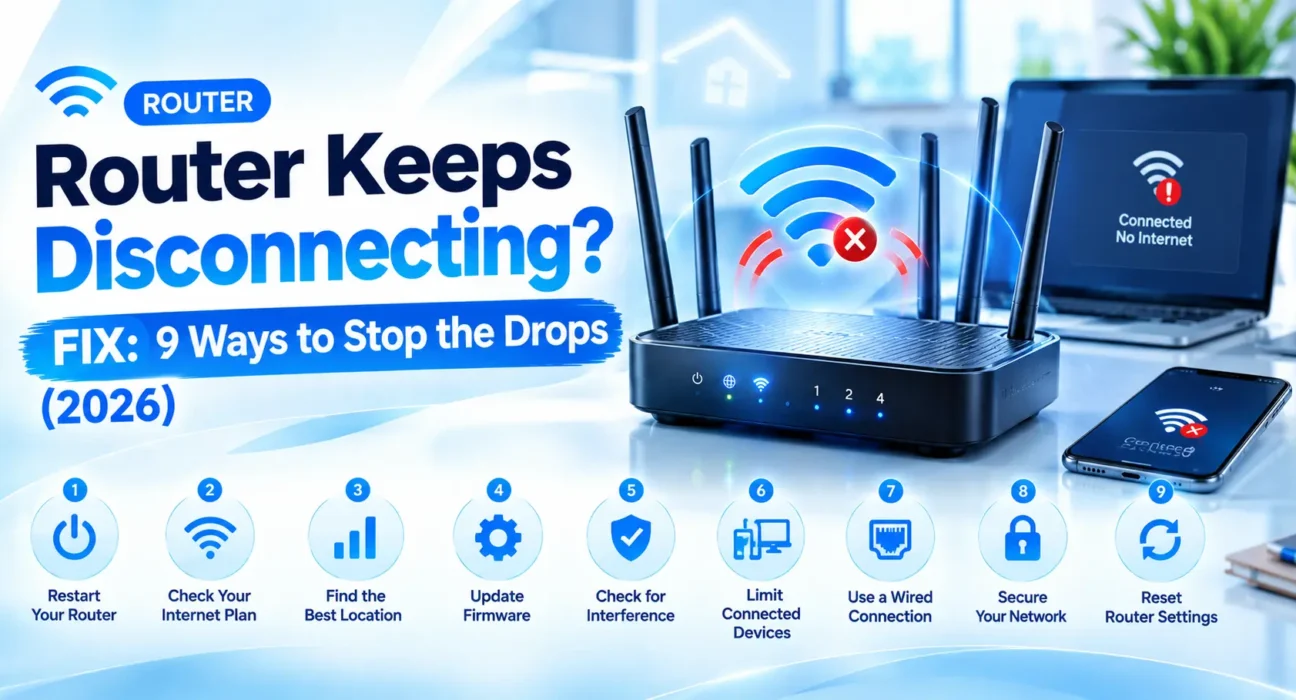
1. Power Cycle the Router
Unplug the router’s power for a full 30 seconds, then plug it back in and wait 2-5 minutes for it to completely reboot before testing. This clears temporary memory errors and stale connections that build up over days of continuous uptime. If your router isn’t getting online at all rather than just dropping intermittently, see our router not connecting to internet guide instead.
2. Improve Router Placement and Ventilation
Touch the router — if it feels noticeably hot, overheating may be triggering it to throttle or restart to protect itself. Give it at least 6 inches of clearance on all sides, move it out of enclosed cabinets or closets, keep it off carpet or upholstered surfaces, and away from direct sunlight or other heat sources.
3. Update Router Firmware
Log into your router’s admin page (usually at 192.168.1.1 or 192.168.0.1) and check for a firmware update, typically under Advanced or System Tools. Apply any available update and allow the router 2-5 minutes to fully reboot afterward — outdated firmware is a common source of intermittent, hard-to-diagnose disconnections.
4. Switch to a Less Congested Wi-Fi Channel
In crowded areas like apartments, dozens of nearby networks can compete for the same Wi-Fi channels, causing intermittent drops. Use a free scanning tool like NetSpot or WiFi Scanner to see which channels your neighbors are using, then in your router’s Wireless settings, switch the channel selection from Auto to a manually chosen, less crowded channel (1, 6, or 11 on 2.4GHz tend to overlap least with neighbors).
5. Disable Smart Connect or Band Steering
Smart Connect automatically switches devices between your 2.4GHz and 5GHz bands based on signal strength, but this switching process itself can cause brief, repeated disconnections on some devices. Go to Advanced > Wireless > Wireless Settings and turn Smart Connect off, splitting your network into separate “Network-2.4G” and “Network-5G” names instead.
6. Reduce Wi-Fi Channel Width
Wider channels (like 80MHz on 5GHz) offer faster speeds but are more prone to interference-related drops in dense environments. In your router’s Wireless settings, reduce the 2.4GHz channel width to 20MHz and the 5GHz width to 20MHz or 40MHz to trade a little speed for meaningfully better stability.
7. Check the Modem-to-Router Cable
Disconnect and reconnect both ends of the Ethernet cable running from your modem into the router’s WAN port. If it’s visibly damaged, sharply bent, or more than a few years old, replace it with a known-good Cat5e or Cat6 cable — a marginal cable can cause intermittent drops that look like a router problem.
8. Set a Scheduled Reboot as a Stopgap
If a manual reboot fixes the problem temporarily but it returns within a few days, most modern routers support a scheduled automatic reboot under System Tools > Reboot Schedule (naming varies by brand). This isn’t a permanent fix, but it manages a recurring issue while you work through the other steps or plan a hardware upgrade.
9. Check Whether You’re Using an ISP-Rented Gateway
All-in-one modem/router combo units provided by ISPs are frequently underpowered for modern household demands and prone to overheating and outdated firmware. If you’ve worked through every fix above with an ISP-provided gateway, switching to your own separate modem and router often resolves persistent disconnections — and can save $10-$15 per month in rental fees at the same time.
When to Contact Your ISP Instead
If disconnections affect every device at the same time, happen even right after a fresh reboot, and persist after a firmware update and channel changes, the problem may be upstream of your equipment — line quality issues, local congestion on your ISP’s network, or account-level problems. Contact your ISP with specific details: when the drops happen, how long they last, and what you’ve already tried. If they send a technician, note whether the issue is isolated to Wi-Fi or affects a wired connection too, since that narrows down whether it’s your equipment or their infrastructure.
Fixes Summary
| Fix | Where to Find It |
|---|---|
| Power cycle the router | Unplug 30 seconds, replug, wait 2-5 min |
| Improve placement/ventilation | 6+ inches clearance, out of enclosed spaces |
| Update firmware | Router admin page > System Tools/Advanced |
| Switch Wi-Fi channel | Router admin page > Wireless Settings |
| Disable Smart Connect | Router admin page > Advanced > Wireless |
| Reduce channel width | Router admin page > Wireless Settings |
| Check modem-to-router cable | Physical inspection, replace if needed |
| Set scheduled reboot | Router admin page > System Tools > Reboot Schedule |
| Consider replacing ISP-rented gateway | Buy your own modem/router combo |
FAQ
Why does my router keep disconnecting even after I restart it?
If a restart fixes it temporarily but the problem returns within days, the underlying cause is usually overheating, outdated firmware, or aging hardware — not something a reboot alone permanently resolves.
Why do my wireless devices disconnect while wired devices stay connected?
This confirms the issue is wireless-specific, not a general internet problem. Focus on Wi-Fi channel selection, Smart Connect/band steering, and channel width rather than modem or ISP troubleshooting.
Can an overheating router cause random disconnections?
Yes. Routers can throttle performance or restart to protect themselves when they overheat. Ensure at least 6 inches of clearance on all sides and keep the router out of enclosed cabinets or direct sunlight.
Should I use my ISP’s rented router or buy my own?
ISP-rented all-in-one gateways are often underpowered and prone to overheating. If you’ve tried every other fix, switching to your own modem and router can resolve persistent drops and save on monthly rental fees.
What is Smart Connect and why would I turn it off?
Smart Connect automatically switches devices between your 2.4GHz and 5GHz bands based on signal strength. The switching process itself can cause brief, repeated disconnections on some devices — disabling it and using separate network names for each band often improves stability.
How do I know if my router disconnections are actually an ISP problem?
If every device drops at the same time, even right after a fresh restart and firmware update, and the pattern doesn’t match anything you’ve changed on your end, contact your ISP — it may be a line quality or network-level issue outside your control.