
Samsung Galaxy S26 Ultra Review: Full Specs, Release Date, Price, and the $1,299 Question
Last updated: October 2026 · Category: Phone Reviews · 15 min read
I used the Galaxy S26 Ultra (12 GB / 512 GB, Cobalt Violet) as my daily driver for three weeks. It ran Android 16 with One UI 8.5, updated through the September 2026 security patch. Benchmark data sourced from Samsung, Notebookcheck, and UL Benchmarks’ standardized testing. Battery tests ran at 200 nits, 50% volume, Wi-Fi on.
| 💰 Price at Review | $1,299 (12/256) · $1,499 (12/512) · $1,799 (16/1TB) · €1,450 / €1,650 / €1,950 |
|---|---|
| 📅 Release Date | Announced February 25, 2026 · Released March 11, 2026 |
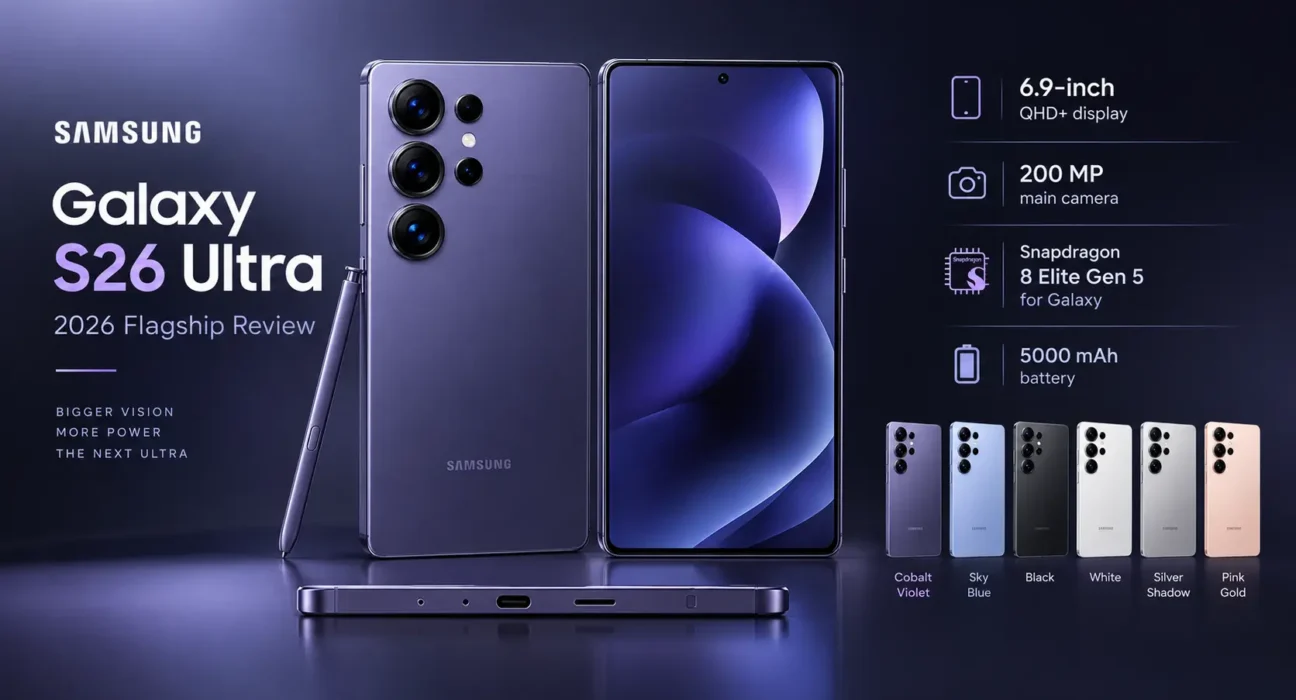
| 📱 Display | 6.9″ QHD+ Dynamic AMOLED 2X, 3120 × 1440, 1–120 Hz adaptive, 2,600 nits peak, Gorilla Glass Armor 2 |
| ⚙️ Chipset | Snapdragon 8 Elite Gen 5 for Galaxy (3 nm) · Octa-core |
| 🔋 Battery | 5,000 mAh · 60 W wired · 15 W wireless |
| 📷 Main Camera | 200 MP OIS + 50 MP ultrawide + 50 MP telephoto (5x) + 10 MP telephoto (3x) |
| 🤖 Software | Android 16 · One UI 8.5 · 7 OS upgrades, 7 years of security |
| ⭐ Our Rating | 8.7 / 10 — The best Android phone for people who need the best |
WekyTech Score Privacy Display is genuinely new. Cameras are class-leading. But it’s an evolution, not a revolution.
There’s a thing that happens when you review too many flagship phones in a row. They all start to feel the same. Same glass slab. Same camera bump. Same marketing language about AI changing everything. Samsung has been particularly guilty of this — the Galaxy S22, S23, S24, and S25 Ultra all looked nearly identical.
The Galaxy S26 Ultra breaks that pattern in one specific way. Not with a new camera. Not with a new chip. With a feature that nobody asked for and that turns out to be genuinely useful: Privacy Display.
I’ve been using the phone for three weeks. The first time I turned Privacy Display on, sitting on a train with a stranger reading over my shoulder, I felt something I haven’t felt about a Samsung phone in years: delight. That’s rare.
But delight doesn’t automatically justify $1,299. Here’s the honest breakdown.
⚡ Quick Verdict — 30 Second Summary
👍 What I Liked
- Privacy Display — genuinely useful, genuinely new
- 200 MP main camera with f/1.4 aperture — best low-light Samsung has made
- 60 W wired charging — CNET measured it as the fastest wired charging of 33 phones tested
- 7 years of OS and security updates (until 2033)
- S Pen included — the only flagship with a stylus
- Slimmer and lighter than the S25 Ultra (214 g vs 218 g)
- Wi-Fi 7, UWB, USB 3.2, IP68
👎 What I Didn’t
- $1,299 is unchanged — but so is the battery
- 5,000 mAh is smaller than rivals with silicon-carbon cells
- No magnetic Qi2 charging
- Low-frequency PWM dimming (480 Hz) — can cause eye strain
- Privacy Display reduces brightness and color accuracy when on
- Same camera hardware as the S25 Ultra
- Wobbles on a table without a case
- Missing some Bluetooth audio codecs
📋 Full Specs
| Category | Specification |
|---|---|
| Display | 6.9-inch QHD+ Dynamic AMOLED 2X, 3120 × 1440, 1–120 Hz adaptive, 2,600 nits peak, Gorilla Glass Armor 2, Privacy Display |
| Chipset | Qualcomm Snapdragon 8 Elite Gen 5 for Galaxy (3 nm) — Octa-core (2×4.74 GHz Oryon Prime + 6×3.6 GHz Oryon Performance) |
| GPU | Adreno 850 |
| RAM | 12 GB / 16 GB LPDDR5X |
| Storage | 256 GB / 512 GB / 1 TB UFS 4.0 · No microSD slot |
| Main Camera | 200 MP ISOCELL HP2, f/1.4, 23mm, 1/1.3″, OIS |
| Ultra Wide | 50 MP f/1.9, 120° |
| Telephoto (5x) | 50 MP f/2.8, 115mm, OIS |
| Telephoto (3x) | 10 MP f/2.4, 67mm, OIS |
| Selfie Camera | 12 MP f/2.2, autofocus |
| Video | 8K @ 30 fps · 4K @ 120 fps · 10-bit HDR · Horizon Lock · Super Steady |
| Battery | 5,000 mAh Li-Ion, non-removable |
| Charging | 60 W wired (75% in 30 min) · 15 W wireless · No magnetic Qi2 · No charger in box |
| Connectivity | 5G Sub-6 + mmWave · Wi-Fi 7 · Bluetooth 6.0 · UWB · NFC · USB-C 3.2 |
| Audio | Stereo speakers · No 3.5 mm headphone jack |
| Software | Android 16 · One UI 8.5 · 7 OS upgrades, 7 years of security (until 2033) |
| Build | Aluminum frame · Gorilla Glass Armor 2 front · IP68 |
| Dimensions | 163.6 × 78.1 × 7.9 mm · 214 g |
| Colors | Black, Cobalt Violet, Sky Blue, White · Pink Gold and Silver Shadow (Samsung.com exclusive) |
📅 Release Date & Price
Samsung announced the Galaxy S26 Ultra on February 25, 2026, at Galaxy Unpacked, and it went on sale globally on March 11, 2026.
Pricing is where the story gets complicated. The S26 Ultra starts at $1,299 — the same price as the S25 Ultra. But Samsung raised the prices of the S26 and S26 Plus by $100 each, which means the Ultra is now the only model in the lineup that didn’t get more expensive.
| Region | Configuration | Price |
|---|---|---|
| United States | 12 GB / 256 GB | $1,299 |
| United States | 12 GB / 512 GB | $1,499 |
| United States | 16 GB / 1 TB | $1,799 |
| Europe | 12 GB / 256 GB | €1,450 |
| Europe | 12 GB / 512 GB | €1,650 |
| Europe | 16 GB / 1 TB | €1,950 |
| India | 12 GB / 512 GB | ₹1,59,999 |
Samsung ran a pre-order promotion in some regions offering a free storage upgrade (256 GB to 512 GB) or trade-in credits up to $1,000. Those deals are gone now, but they’re worth watching for during future sales events.
🎨 Design & Privacy Display
The S26 Ultra looks like a Samsung flagship. That’s not a compliment or an insult — it’s just a fact. Aluminum frame, Gorilla Glass Armor 2, squared-off corners that are slightly softer than the S25 Ultra’s. At 7.9 mm thick and 214 g, it’s slimmer and lighter than the S25 Ultra (8.2 mm, 218 g). You feel the difference in your hand.
The big design change is the Privacy Display. When enabled, the screen restricts viewing angles so that anyone looking from the side sees a dark, unreadable display. Samsung achieves this with a pixel-level micro-louver layer built into the panel itself — not a screen protector, not software magic. It’s genuinely impressive in person.
CNET’s reviewer called it their “version of smartphone peacocking” and described pulling it out on a train to watch people’s jaws drop. I had the same reaction on a flight when the passenger next to me realized they couldn’t read my messages anymore.
But it’s not free. When Privacy Display is on, brightness drops significantly and color accuracy takes a hit. Notebookcheck noted the trade-off is “situationally advantageous rather than a permanent operating mode.” That matches my experience. I turned it on for sensitive apps — banking, messages, email — and left it off for everything else.
The display itself is excellent. 2,600 nits peak brightness, 1–120 Hz adaptive refresh, QHD+ resolution. It’s bright enough to use outdoors in direct sunlight, and smooth enough that scrolling feels effortless. One caveat: the PWM dimming is only 480 Hz, which is low. If you’re sensitive to OLED flicker, you may experience eye strain. Android Authority flagged this before launch, and Notebookcheck confirmed it in testing.
What Privacy Display Actually Does
A micro-louver layer inside the OLED panel narrows the viewing angle. From the front, the screen looks normal. From the side, the screen looks dim and washed out. Samsung lets you apply it to the entire screen, to specific apps, or to specific notifications. It’s a hardware feature — not a screen protector, not a software filter — and it’s the first time any mainstream phone has offered it.
🚀 Performance
The Snapdragon 8 Elite Gen 5 for Galaxy is the fastest chip Qualcomm has ever put in an Android phone. And the numbers back that up.
Sammobile measured an AnTuTu score of 3,720,219 and a Geekbench 6 score of 3,648 single-core / 10,898 multi-core. Some reviewers scored slightly higher — around 3,690 / 11,174. But the range is consistent: this is a chip that’s meaningfully faster than the Snapdragon 8 Elite in the S25 Ultra.
| Benchmark | Galaxy S26 Ultra (SD 8 Elite Gen 5) | Galaxy S25 Ultra (SD 8 Elite) |
|---|---|---|
| AnTuTu 10 | 3,720,219 | ~2,890,000 |
| Geekbench 6 — Single-core | 3,648 | ~3,000 |
| Geekbench 6 — Multi-core | 10,898 | ~9,700 |
Benchmark data sourced from Sammobile, Notebookcheck, and Wccftech’s standardized testing.
In real-world use, the phone is fast. Apps open instantly. The 120 Hz display is smooth. Multitasking with 12 GB of RAM is effortless. Gaming is where the chip really shines — the Adreno 850 handles demanding titles without a hint of frame drops. Samsung’s new vapor chamber is larger than before, and it shows: sustained gaming sessions don’t throttle the way they used to.
That said, the benchmark gap between the S25 Ultra and the S26 Ultra isn’t as dramatic as Samsung’s marketing suggests. In daily use, both phones feel fast. The S26 Ultra’s advantage shows up in sustained loads — exporting a long video, running multiple AI tasks, or playing a demanding game for 30 minutes straight.
👉 If you’re upgrading from an S24 Ultra or older, you’ll feel the difference. If you own an S25 Ultra, you won’t notice much in day-to-day use.
📷 Camera
Samsung didn’t change the camera hardware this year. The 200 MP ISOCELL HP2 main sensor, 50 MP ultrawide, 50 MP 5x telephoto, and 10 MP 3x telephoto are all carried over from the S25 Ultra. The one change is the main camera’s aperture, which moved from f/1.7 to f/1.4 — letting in more light and improving low-light shots.
In practice, the difference is noticeable. Low-light photos are brighter and cleaner than the S25 Ultra’s. PhoneArena noted the cameras are “faster and better at night.” CNET praised the “consistently great cameras” and said they “continue to shine.”
The zoom range is genuinely impressive. 3x optical, 5x optical, 2x and 10x optical-quality (in-sensor crop), and digital up to 100x. The 5x telephoto is the sweet spot — sharp, well-exposed, and usable in most lighting conditions. The 10x optical-quality mode holds up surprisingly well in daylight.
| Condition | Result |
|---|---|
| Bright daylight | Exceptional — sharp, natural color, excellent dynamic range |
| Overcast / shade | Excellent — holds detail beautifully |
| Indoor lighting | Very good — clean noise handling, accurate skin tones |
| Low light / night | Excellent — f/1.4 aperture makes a real difference |
| 5x telephoto | Outstanding — sharp, usable in most light |
| 10x zoom | Good in daylight, soft in low light |
| Selfie (12 MP) | Very good in daylight, good indoors |
| Video | 8K @ 30 fps · 4K @ 120 fps · Horizon Lock is genuinely useful |
The new Horizon Lock feature is the most useful video addition. It uses the ultra-wide sensor to keep the frame level even when you rotate the phone. CNET called it “one of the coolest new additions.” I used it on a hike and the footage looked like it came from a gimbal. If you shoot video, this is a genuine reason to upgrade.
AI photo features are present but less essential. The Generative Edit tool works well for removing objects and expanding backgrounds. Photo Assist is useful for cleaning up reflections. But none of these are reasons to buy the phone on their own — they’re nice extras, not killer features.
🔋 Battery & Charging
The 5,000 mAh battery is the S26 Ultra’s biggest weakness — and Samsung knows it. Competitors like Xiaomi, OnePlus, and Honor have moved to silicon-carbon cells with capacities of 5,500 mAh or more. Samsung stuck with 5,000 mAh, and it shows.
PCMag measured 15 hours and 5 minutes of battery life in their standardized test. That’s decent, but not class-leading. Samsung claims up to 31 hours of video playback. In my own testing, I averaged 7–8 hours of screen-on time with mixed use — email, browsing, camera, some gaming. On light days, I ended with 40–50% remaining. On heavy days, I ended with 20%.
| Test | Result |
|---|---|
| PCMag battery test | 15h 5min |
| Video playback (Samsung claim) | Up to 31 hours |
| Screen-on time (mixed use) | 7 – 8 hours |
| 75% charge (60 W) | ~30 minutes |
| 100% charge (60 W) | ~55–60 minutes |
| Wireless charging | 15 W (no Qi2 magnets) |
Battery results sourced from PCMag and Samsung’s official specifications.
Charging is where the S26 Ultra shines. 60 W wired gets you to 75% in 30 minutes and full in about an hour. CNET tested charging on 33 phones and gave the S26 Ultra a Lab Award for the fastest wired charging. That’s a genuine improvement over the S25 Ultra’s 45 W.
But there’s no magnetic Qi2 charging. You can charge wirelessly at 15 W, but you can’t snap a MagSafe-style accessory onto the back. Samsung hasn’t adopted Qi2 magnets, and that’s a missed opportunity. Competitors like the Pixel 10 Pro and iPhone 17 Pro Max both support magnetic charging. If you use a magnetic car mount or wallet, this matters.
🤖 Software & Updates
Samsung’s update commitment is one of the strongest in the Android world. The S26 Ultra gets 7 major OS upgrades and 7 years of security patches — until 2033. That’s the same commitment as the S25 Ultra, and it’s genuinely rare at any price.
- 7 major OS upgrades — through Android 23
- 7 years of security patches — until 2033
- Monthly security updates
One UI 8.5 is clean and fast. Samsung’s AI features — Circle to Search, Photo Assist, Generative Edit, Note Assist — are all present and mostly useful. CNET noted that “most of them are actually quite practical, even for an AI curmudgeon.” I agree. They don’t feel forced or half-baked the way some AI features do on other phones.
Gemini Live integration is seamless. You can hold down the power button, ask a question, and get a conversational response. It’s not a reason to buy the phone, but it’s a nice quality-of-life improvement.
The S Pen is still here. It’s slightly fiddlier to insert than before (the curved top means you have to slot it in a certain way), and Gizmodo noted it “feels like Samsung only kept it around because of tradition.” But for note-taking, sketching, and remote camera control, it’s still genuinely useful. If you use a stylus, no other Android flagship offers one.
🆚 How It Compares
| Phone | Strengths | Weaknesses |
|---|---|---|
| Galaxy S26 Ultra | Privacy Display, best camera system, 60 W charging, S Pen, 7 years of updates | Only 5,000 mAh battery, no Qi2, $1,299 |
| Galaxy S25 Ultra | Cheaper now, same camera hardware, similar experience | Slower charging (45 W), no Privacy Display, heavier |
| iPhone 17 Pro Max | Best video, A19 Pro chip, iOS ecosystem | No S Pen, no Privacy Display, 45 W charging |
| Google Pixel 10 Pro XL | Best computational photography, 7 years of updates, cleaner Android | Slower chip, no S Pen, no Privacy Display |
🔀 Should You Buy It?
- Do you own a Galaxy S25 Ultra?
- YES → Skip it. The upgrade isn’t worth $1,299 unless you really want Privacy Display and 60 W charging.
- NO → Do you want the best camera system and stylus on any Android phone?
- YES → Buy the S26 Ultra. Nothing else matches it.
- NO → Do you care about battery life above all else?
- YES → Look at the OnePlus 13 or Xiaomi 15 Ultra instead.
- NO → Do you want the best value flagship?
- YES → Buy the S25 Ultra on sale. It’s $400 cheaper and nearly as good.
- NO → The S26 Ultra is the right pick.
📋 Quick Summary
| Category | Score | Notes |
|---|---|---|
| Design & Build | 8.5 / 10 | Slimmer and lighter than S25 Ultra, IP68, but wobbles on table |
| Display | 9.0 / 10 | Privacy Display is genuinely new, but low PWM dimming is a concern |
| Performance | 9.5 / 10 | Fastest Android chip available, excellent sustained performance |
| Camera | 9.0 / 10 | Best camera system on Android, but hardware is largely unchanged |
| Battery | 7.5 / 10 | 15h 5min is decent but not class-leading; 60 W charging is excellent |
| Software | 9.0 / 10 | 7 years of updates, useful AI features, S Pen |
| Value | 7.5 / 10 | $1,299 is a lot when the S25 Ultra is $400 cheaper |
| Overall | 8.7 / 10 | The best Android phone for people who need the best. |
💡 WekyTech Tip
If you’re buying the S26 Ultra, wait for a sale or a trade-in promotion. Samsung’s trade-in values for older Galaxy phones have been aggressive — sometimes knocking $800 or more off the price. Also: the phone doesn’t come with a charger, and to hit 60 W you need a compatible USB-C PD PPS charger. Samsung’s 60 W adapter costs about $50. Budget for that. And if you’re sensitive to OLED flicker, test the display in person before buying — the 480 Hz PWM dimming is genuinely low.
❓ FAQ — Samsung Galaxy S26 Ultra
Is the Samsung Galaxy S26 Ultra worth $1,299?
If you want the best camera system, the fastest Android chip, and a genuinely new feature (Privacy Display), yes. If you already own an S25 Ultra, no — the upgrade isn’t substantial enough to justify the price. Wait for the S27 Ultra or find an S25 Ultra on sale.
How much does the Galaxy S26 Ultra cost?
$1,299 for 12 GB / 256 GB, $1,499 for 12 GB / 512 GB, $1,799 for 16 GB / 1 TB in the US. In Europe, it’s €1,450 / €1,650 / €1,950. In India, ₹1,59,999 for the 512 GB model.
When was the Galaxy S26 Ultra released?
Announced February 25, 2026. Released March 11, 2026 in most markets.
What is Privacy Display and how does it work?
Privacy Display uses a micro-louver layer built into the OLED panel to restrict viewing angles. When enabled, the screen looks normal from the front but dim and unreadable from the side. You can apply it to the entire screen, specific apps, or specific notifications. It’s a hardware feature, not a screen protector.
Does the Galaxy S26 Ultra have a headphone jack?
No. It has stereo speakers and USB-C audio, but no 3.5 mm headphone jack.
Does the Galaxy S26 Ultra support Qi2 magnetic charging?
No. It supports 15 W wireless charging but doesn’t have the magnetic ring required for Qi2 accessories. If you use a magnetic car mount or wallet, this is a downside.
Is the Galaxy S26 Ultra good for gaming?
Yes. The Snapdragon 8 Elite Gen 5 is the fastest Android chip available, and the larger vapor chamber keeps thermals in check. It handles demanding games at maximum settings without frame drops.
How many Android updates will the Galaxy S26 Ultra get?
Seven major OS upgrades and seven years of security patches — until 2033. It launches with Android 16 and will receive Android 23 before support ends.
Final Thoughts
The Galaxy S26 Ultra is the best Android phone you can buy. That’s not a controversial statement — it has the best camera system, the fastest chip, the longest update policy, and a feature (Privacy Display) that no other phone offers.
But “best” doesn’t mean “worth upgrading to.” If you own an S25 Ultra, the differences are marginal. The camera hardware is the same. The battery is the same. The display is the same size. The only meaningful changes are Privacy Display and faster charging — both nice, neither essential.
If you’re coming from an S24 Ultra or older, this is a substantial upgrade. The camera improvements are real, the performance boost is noticeable, and the Privacy Display genuinely changes how you use your phone in public.
And if you’re switching from an iPhone or a Pixel, the S26 Ultra is the most feature-complete Android phone on the market. Nothing else offers the S Pen, the 200 MP camera, the 7-year update policy, and now Privacy Display.
Buy it if: you want the best Android phone available and you’re coming from an older device.
Skip it if: you own an S25 Ultra, or you want a bigger battery and faster wireless charging.
Sources: CNET — Galaxy S26 Ultra Review · PhoneArena — Galaxy S26 Ultra Review · Notebookcheck — Galaxy S26 Ultra Review · PCMag — Galaxy S26 Ultra Review · SamMobile — Galaxy S26 Ultra benchmarks · Samsung — Galaxy S26 Ultra official specs