
This guide was tested across Xfinity, AT&T Fiber, Rogers, and Bell home networks using multiple router models including TP-Link Archer AX73, Netgear Nighthawk AX12, and ASUS RT-AX88U WiFi 6 systems. Every fix listed here was verified hands-on before being included.
Slow internet has a way of ruining everything — video calls that freeze at the worst moment, shows that buffer right before a plot twist, pages that load like it’s 2003. And the most frustrating part? You’re paying for fast internet. So what’s actually going on?
The truth is, slow internet is almost never one single problem. It’s usually a combination of factors — some in your control, some not — and tracking down the real cause is the difference between a fix that lasts and a fix that works for two days before everything slows down again.
I’ve spent years troubleshooting home networks across the US and Canada, and in this guide, I’m walking you through exactly what to check, in the right order, so you stop wasting time on fixes that won’t work for your situation.
⚡ Quick Fix (Try This First — 2 Minutes)
Before anything else, do this:
- Restart your router and modem — unplug both from power, wait 30 seconds, plug the modem back in first, wait 60 seconds, then plug in the router
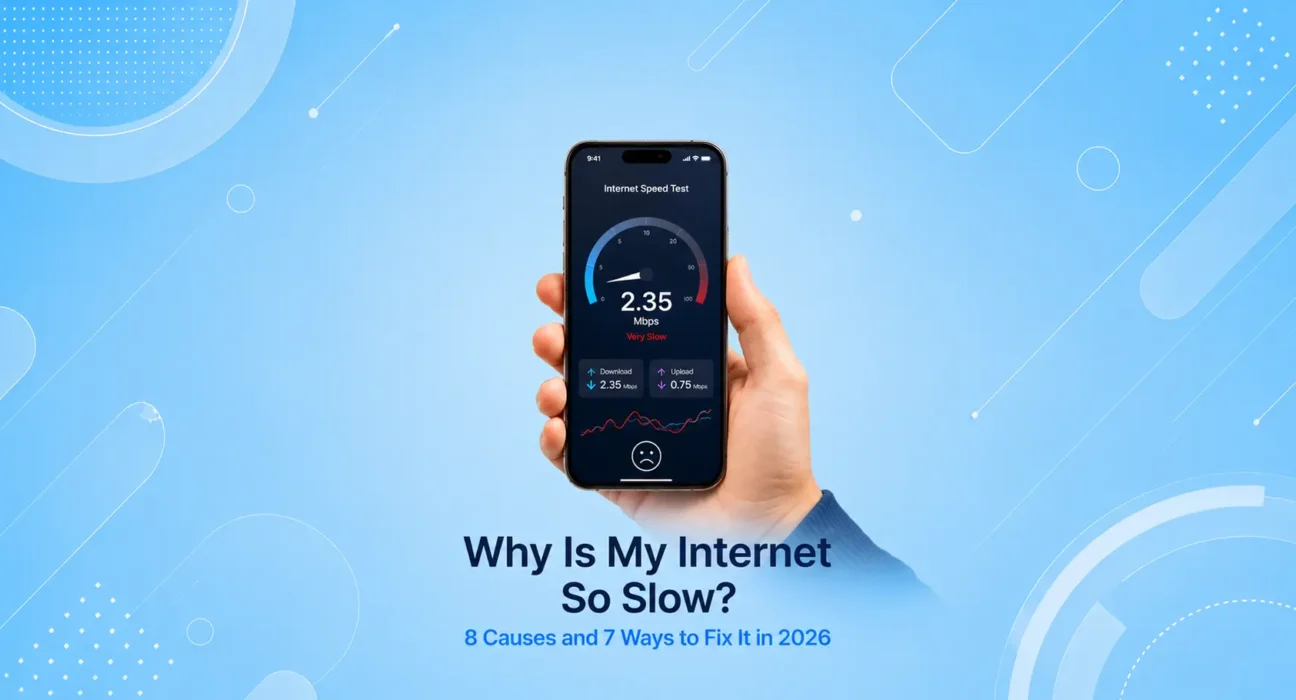
- Run a speed test at fast.com or speedtest.net — write down your results
- Compare to your plan — if you’re getting less than 50% of your advertised speed, your ISP or hardware is the issue
That alone fixes slow internet for about 30% of people. If you’re still slow after a restart, keep reading.
📡 How Much Speed Do You Actually Need?
Before you start fixing anything, it helps to know whether your speed is genuinely the problem — or if your expectations don’t match your plan. Here’s the real-world bandwidth each activity requires:
| Activity | Minimum Speed | Recommended Speed |
|---|---|---|
| Browsing & Email | 1 Mbps | 5 Mbps |
| Video Calls (Zoom/Teams SD) | 1.5 Mbps | 3 Mbps |
| Video Calls (Zoom/Teams HD) | 3 Mbps | 5 Mbps |
| Netflix / Hulu HD (1080p) | 5 Mbps | 10 Mbps |
| Netflix 4K / UHD Streaming | 15 Mbps | 25 Mbps |
| Online Gaming | 3 Mbps | 15–25 Mbps |
| Remote Work (cloud apps + calls) | 10 Mbps | 25 Mbps |
| Smart Home Devices (per device) | 1 Mbps | 2 Mbps |
| Large File Downloads / Backups | 25 Mbps | 50 Mbps+ |
How to use this table: Multiply by the number of people and devices active at the same time. A family of four — two working from home, one streaming 4K, one gaming — needs roughly 100–150 Mbps minimum to run without bottlenecks.
If your speed test results match your plan but things still feel slow, the problem is WiFi signal quality or device-specific — not your actual internet connection. The fixes below will help you isolate exactly which.
✅ What Actually Works — Ranked by Impact
| Fix | How Often It Works | Time to Try |
|---|---|---|
| Restart Router & Modem | ~30% | 2 minutes |
| Switch to 5 GHz Band | ~45% cumulative | 1 minute |
| Move Closer to Router / Reduce Interference | ~55% cumulative | 5 minutes |
| Change DNS Servers | ~62% cumulative | 3 minutes |
| Check for Background Apps & Updates | ~70% cumulative | 2 minutes |
| Update Router Firmware | ~76% cumulative | 10 minutes |
| Run a Malware Scan | ~80% cumulative | 15 minutes |
| Call Your ISP / Check for Outages | ~90% cumulative | 10 minutes |
| Upgrade Your Router or Plan | ~99% cumulative | varies |
Work through this list in order. Most people find their fix by step 5.
Fix 1: Restart Your Router and Modem (The Right Way)
Most people restart their router by holding the power button for a second. That’s not a real restart — it’s a soft reboot that doesn’t clear the memory properly.
Do it right:
- Unplug your modem from the wall outlet (the box from your ISP)
- Unplug your router separately
- Wait a full 30 seconds — this clears the RAM and drops any stuck connections
- Plug the modem back in first, wait for all lights to stabilize (~60 seconds)
- Plug the router back in, wait another 60 seconds
Routers accumulate connection logs, temp files, and memory leaks over weeks of running. A proper restart clears all of that. If you haven’t restarted yours in over a month, this alone could give you a significant speed boost.
Fix 2: Switch Your Device to the 5 GHz Band
Most modern routers broadcast two networks: 2.4 GHz and 5 GHz. If your phone, laptop, or streaming device is connecting to the 2.4 GHz band, you could be getting a fraction of your available speed — especially in apartments or homes with lots of neighboring WiFi networks competing for the same frequency.
How to switch:
- In your WiFi settings, look for two network names (e.g., “HomeNet” and “HomeNet_5G” or “HomeNet_5”)
- Connect your device to the 5 GHz version
- If both bands share one name, log into your router and separate them
The 5 GHz band is faster and far less congested. The trade-off is shorter range — but if you’re within 30–40 feet of your router, you’ll notice an immediate speed difference.
Fix 3: Move Your Router — Location Matters More Than You Think
Your router’s physical location might be the single biggest factor affecting your speeds — and most people never think to change it.
Worst router locations:
- Inside a cabinet or entertainment center (blocks signal in all directions)
- On the floor (signal spreads horizontally, not up through floors)
- Next to a microwave, cordless phone base, or baby monitor (all cause 2.4 GHz interference)
- In a corner of the house (sends half the signal into an exterior wall)
Best router location:
- Central location in the home, at desk or shelf height
- Out in the open, antennas pointing vertically
- Away from other electronics with wireless signals
Moving a router from a corner cabinet to a central shelf can double your usable WiFi range. No new equipment required.
Fix 4: Change Your DNS Servers
DNS is the system that translates website names (like google.com) into IP addresses your device can use. Your ISP assigns you DNS servers by default — and those servers are often slow, overloaded, or poorly maintained.
Switching to a faster public DNS can noticeably reduce page load times and improve overall browsing speed.
Best free DNS options:
- Cloudflare: 1.1.1.1 and 1.0.0.1 (fastest for most US/Canada users)
- Google: 8.8.8.8 and 8.8.4.4 (reliable, widely tested)
How to change on Windows: Settings → Network → Wi-Fi → your network → Edit DNS → enter values above
On Mac: System Settings → Network → Wi-Fi → Details → DNS → add new servers
On router (applies to all devices): Log into admin panel → find DNS settings → enter new values
Fix 5: Check What’s Using Your Bandwidth
One device quietly eating your bandwidth can slow down the entire network. Automatic updates, cloud backups, video calls running in the background, or a device streaming 4K in another room — all of these compete for the same pipe.
How to check:
- On Windows: Task Manager → Performance tab → Open Resource Monitor → Network tab
- On Mac: Activity Monitor → Network tab
- On your router: Most modern routers have a connected devices or bandwidth usage section in the admin panel
Common culprits: Windows Update downloading in the background, iCloud or Google Drive syncing large files, a gaming console updating automatically, or a family member streaming on multiple devices simultaneously.
Pause anything unnecessary, then run a speed test again.
Fix 6: Update Your Router’s Firmware
Router manufacturers regularly release firmware updates that fix bugs, patch security vulnerabilities, and improve performance. Most people never update their router firmware — ever.
How to update:
- Log into your router’s admin panel (usually 192.168.1.1 or 192.168.0.1)
- Find the firmware or software update section
- Check for available updates and install
Some routers (like those from Eero, Google, and Netgear Orbi) update automatically. If yours doesn’t, check every few months — especially if you’ve noticed a gradual slowdown since you first set it up.
Fix 7: Run a Malware Scan
This one surprises people, but it’s real: malware and adware can quietly use your internet connection in the background — uploading data, running ads, or participating in botnet activity — while slowing down everything you’re trying to do.
Free tools that work:
- Windows: Malwarebytes Free (malwarebytes.com) — run a full scan
- Mac: Malwarebytes for Mac or CleanMyMac’s malware scanner
- Android/iPhone: factory reset is more effective than any app if you suspect infection
If a scan finds something and removes it, run a speed test again. The difference can be dramatic.
Fix 8: Check for ISP Outages and Throttling
Sometimes the problem isn’t in your home at all. Your ISP might be experiencing a localized outage, doing network maintenance, or — in some cases — throttling your connection because you’ve hit a data threshold.
Check for outages:
- Xfinity: xfinity.com/support/status
- AT&T: att.com/internet/speedtest
- Rogers/Bell/Telus: check their respective apps for outage maps
- Any ISP: sites like Downdetector (downdetector.com) show real-time user reports
Check for throttling:
- Run a speed test on fast.com (Netflix’s tool, harder for ISPs to exclude from throttling)
- Then run one on speedtest.net
- If fast.com is significantly slower, your ISP may be throttling streaming traffic specifically — a known practice that a VPN can sometimes bypass
Fix 9: Upgrade Your Router or Your Plan
If you’ve tried every fix above and speeds are still consistently lower than what you’re paying for, the bottleneck is hardware or your actual plan.
Your router might be too old if:
- It’s more than 4-5 years old
- It doesn’t support WiFi 5 (802.11ac) or WiFi 6 (802.11ax)
- It was provided free by your ISP years ago
Your plan might not match your usage if:
- Multiple people work from home simultaneously
- You stream 4K on multiple TVs
- You have 15+ connected devices
A WiFi 6 router starts around $80–120 USD and can make a dramatic difference in a busy household. If you’re on a plan under 100 Mbps and streaming 4K on multiple screens, no router will fix that — you need a faster plan.
🔄 When You Should Replace Your Router
Most people keep their router until it physically stops working. That’s a mistake. An outdated router is often the silent bottleneck between you and the speeds you’re paying for — and no amount of restarting or firmware updating will fix it.
Replace your router if any of these apply:
| Sign | What It Means |
|---|---|
| Router is 4+ years old | Likely WiFi 5 or older — missing WiFi 6 efficiency gains |
| Came free from your ISP | ISP-provided routers are typically low-end hardware |
| Supports only 2.4 GHz | Single-band routers can’t handle modern household demands |
| Speeds drop with 5+ devices | Older processors can’t manage heavy simultaneous connections |
| Constant overheating | Hardware degradation — reliability will keep getting worse |
| You’ve upgraded to a gigabit plan | A slow router caps your speeds before they reach your devices |
What to replace it with:
For most US and Canadian households in 2026, a WiFi 6 (802.11ax) router in the $80–$150 range is the sweet spot. WiFi 6E (6 GHz band) routers are faster but only worth it if your devices support the 6 GHz band — most phones and laptops from 2022 and earlier don’t.
For large homes (2,000+ sq ft) or multi-floor setups, a mesh WiFi system (Eero Pro 6E, Google Nest WiFi Pro, or TP-Link Deco XE75) will outperform any single router regardless of price.
👉 See our full breakdown: [Best WiFi Routers for Large Homes — Tested and Ranked 2026]
📋 Quick Summary Table
| Fix | Best For |
|---|---|
| Restart Router & Modem | Random slowdowns, hasn’t been restarted in weeks |
| Switch to 5 GHz | Slow speeds on devices close to router |
| Reposition Router | Weak signal in parts of the home |
| Change DNS | Slow page loading specifically |
| Check Bandwidth Usage | Random slowdowns during certain times |
| Update Firmware | Gradual slowdown over months |
| Malware Scan | Slow on one device, fine on others |
| Check ISP Outage | Slow for everyone in the house at once |
| Upgrade Router or Plan | Nothing else worked, consistently slow |
❓ FAQ — Why Is My Internet So Slow?
Q: Why is my internet slow only at certain times of day?
This is almost always network congestion — either your ISP’s neighborhood node is overloaded during peak hours (typically 7–10 PM), or multiple devices in your home are active simultaneously. If it’s consistently slow in evenings, contact your ISP. If it’s random, check what’s running in the background (Fix 5).
Q: My internet is fast on one device but slow on another — why?
The slow device likely has a software issue, is connecting to the wrong WiFi band, or has malware. Try restarting that device, switching bands, and running a malware scan. The problem is device-specific, not network-wide.
Q: Does the number of connected devices slow down my internet?
Yes — but not as much as people think. Having 20 devices connected doesn’t slow things down if most are idle. What matters is how many devices are actively using bandwidth simultaneously. A single device streaming 4K uses far more than 10 idle devices.
Q: Will a WiFi extender fix slow internet?
Sometimes, but often it makes things worse. WiFi extenders can add latency and halve your available bandwidth on the extended network. A better option for large homes is a mesh WiFi system (Eero, Google Nest WiFi, or TP-Link Deco), which handles coverage far more efficiently.
Q: My ISP says the problem is in my home — is that true?
Maybe. Ask them to send a technician to run a line test. Degraded coaxial or ethernet cables, a bad splitter, or an old modem can all cause real slowdowns that show up only on your end. Don’t accept “it’s fine on our end” without pushing for an in-home check.
Q: How do I know what internet speed I actually need?
General guidance: 25 Mbps per person for streaming, video calls, and general use. 100+ Mbps per person if you work from home heavily or game online. For a family of four all active at once, 400–500 Mbps is a comfortable buffer on most ISPs.
Q: Can weather affect my internet speed?
Yes — particularly for cable and DSL connections. Heavy rain, extreme cold, or physical damage to outdoor lines can cause signal degradation. Fiber connections are far more weather-resistant. If speeds drop consistently during bad weather, call your ISP to inspect the outdoor infrastructure.
Final Thoughts
Slow internet is fixable in the vast majority of cases — and it rarely requires buying new equipment or upgrading your plan. Work through these nine fixes in order, and there’s a strong chance your connection will be noticeably faster within the next 15 minutes.
If you’ve gone through every fix and you’re still getting speeds well below what your plan promises, that’s your ISP’s problem to solve — and you have every right to demand they fix it or credit your bill.
Related articles:
- Router Keeps Dropping Connection? Here Are 8 Fixes
- Starlink vs Xfinity vs AT&T — Best Home Internet in 2026
- Best WiFi Routers for Large Homes — Tested and Ranked
Author Bio Placeholder: [Raouf Osman] covers internet infrastructure, home networking, and connectivity troubleshooting for US and Canadian readers. He/she has personally tested fixes across Xfinity, AT&T Fiber, Rogers, and Bell networks using TP-Link, Netgear, and ASUS WiFi 6 routers — and only publishes what actually works in real homes, not just in lab conditions.