
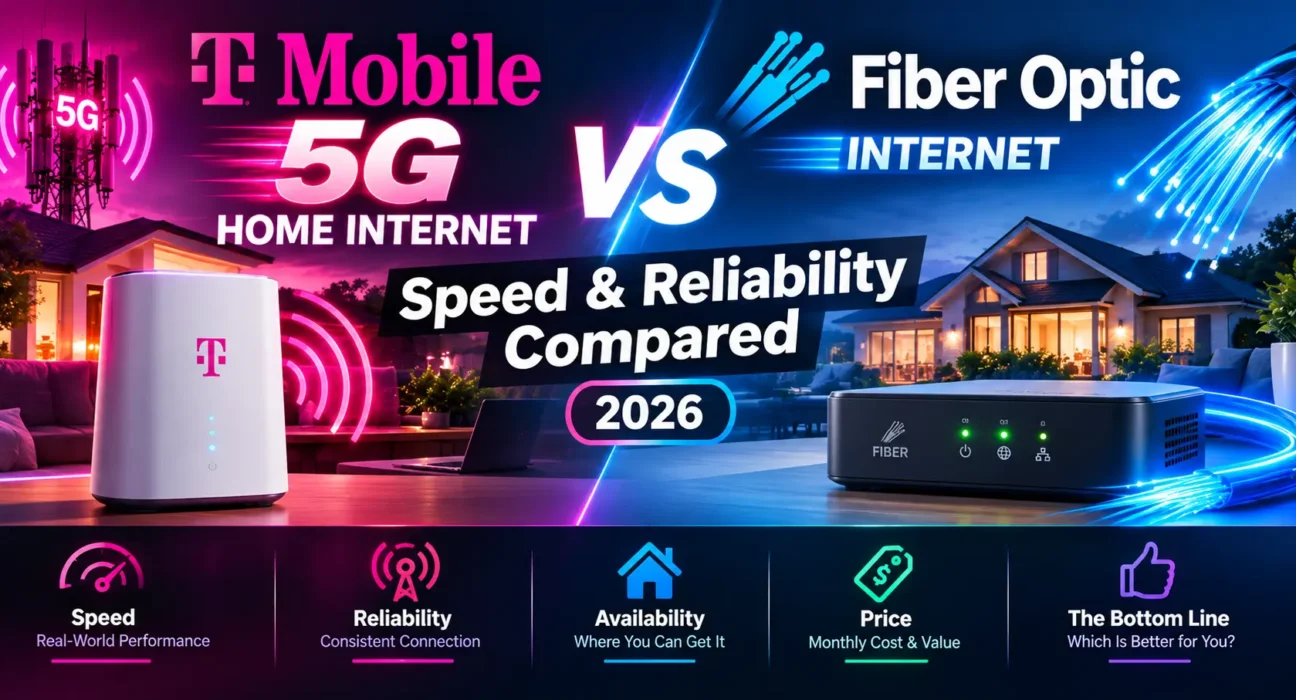
Deciding between T-Mobile 5G Home Internet vs fiber comes down to a simple question: do you want the cheapest, easiest setup, or the fastest, most consistent connection? T-Mobile’s fixed wireless service is genuinely good for the price, but it isn’t pretending to be fiber – and interestingly, T-Mobile itself now sells both, which tells you a lot about where each one actually fits.
Comparison based on T-Mobile’s published plan details, over 189,000 real-world speed test results from HighSpeedInternet.com, and industry-wide fiber performance data as of 2026.
T-Mobile 5G Home Internet vs Fiber: Head-to-Head
| Category | T-Mobile 5G Home Internet | Fiber Optic |
|---|---|---|
| Typical Download Speed | 72-245 Mbps (up to 498 Mbps advertised) | 300 Mbps – 2 Gbps+ |
| Upload Speed | Asymmetrical, often 10-20 Mbps | Symmetrical – matches download |
| Latency | ~34-40ms typical | Consistently lower, more stable |
| Reliability | Varies with network congestion and weather | Very stable, unaffected by weather |
| Starting Price | $35-50/mo | ~$60-65/mo (varies by provider) |
| Setup | Self-install, plug-and-play gateway | Professional installation required |
| Availability (2026) | Wide, especially suburban/rural | ~60%+ of US homes wired |
| Data Caps | None | None (typically) |
| Contract | None | Varies by provider |

Speed: Advertised vs. Real-World
T-Mobile advertises 5G Home Internet speeds up to 498 Mbps, but real-world results tell a more nuanced story. An analysis of over 189,000 speed tests found that only 48% of results actually met or exceeded T-Mobile’s advertised range – still a strong showing compared to Verizon and AT&T’s competing fixed wireless services, but well short of “up to 498” in a lot of everyday conditions. Expect something closer to 72-245 Mbps depending on your location and how much network traffic is competing for the same tower.
Fiber doesn’t have this problem in the same way. Because it’s a dedicated physical connection rather than a shared wireless signal, fiber providers routinely deliver speeds at or very close to what’s advertised, with far less variability throughout the day. If a fiber plan says 500 Mbps, you’re going to get something very close to 500 Mbps, consistently – something T-Mobile’s shared cellular infrastructure structurally can’t guarantee in the same way.
Latency and Gaming: Where Fiber Pulls Ahead
Latency is where the gap matters most for anyone who games, video calls frequently, or works with real-time applications. T-Mobile 5G Home Internet typically runs around 34-40ms of latency – genuinely fine for most casual gaming and video calls, and testers report no real issues with slower-paced titles. But for competitive, fast-paced games or anything latency-sensitive like VR, that extra wireless-network variability becomes noticeable in a way it wouldn’t over fiber, which delivers lower and far more consistent latency thanks to its dedicated physical connection.
Choose T-Mobile 5G Home Internet If:
- Fiber isn’t available at your address yet
- You want the simplest possible self-install setup
- Your household mainly streams, browses, and does light work-from-home tasks
- You want no contracts and a 5-year price lock guarantee
Choose Fiber If:
- It’s available at your address for a comparable price
- You’re a competitive gamer or need low, stable latency
- You work from home and need reliable upload speeds above 20 Mbps
- You regularly have 10+ devices streaming or working simultaneously
Price and Value
T-Mobile 5G Home Internet starts at $35-50/month with AutoPay, depending on whether you bundle a T-Mobile phone line, backed by a 5-year price lock guarantee, no contracts, no data caps, and no equipment fees. Fiber typically runs a bit higher – around $60-65/month on average nationally – though pricing varies significantly by provider and region. Interestingly, T-Mobile itself now sells both services directly: T-Mobile Fiber starts around $60-75/month for its 500 Mbps tier and roughly $70/month for a 2-gig plan in select markets, also backed by long-term price guarantees. That T-Mobile is selling fiber alongside its own 5G Home Internet is a pretty clear signal about which technology it considers the premium tier.
Reliability: Weather, Congestion, and Consistency
Fiber-optic cable uses light signals traveling through glass strands, which makes it immune to the electromagnetic interference and weather sensitivity that can affect wireless signals. T-Mobile 5G Home Internet, by contrast, depends on the same cellular towers your phone uses, which means its performance can dip during peak usage hours in your neighborhood, and its 4G fallback kicks in automatically when 5G congestion gets bad enough – a good safety net, but a sign the underlying connection isn’t as steady as a dedicated fiber line.
Worth noting: T-Mobile Home Internet has consistently topped customer satisfaction surveys among non-fiber providers, including leading scores in the American Customer Satisfaction Index. Customers clearly value the price and simplicity even when they know it’s not matching fiber-level consistency.
Which Should You Choose?
| Your Situation | Better Choice |
|---|---|
| Fiber isn’t available at your address | T-Mobile 5G Home Internet |
| Both are available at similar prices | Fiber |
| Competitive gaming or VR | Fiber |
| Basic streaming and browsing household | T-Mobile 5G Home Internet |
| Remote work needing reliable uploads | Fiber |
| Want the fastest possible self-setup | T-Mobile 5G Home Internet |
Not sure whether either technology beats what you already have? See our comparison of 5G Home Internet vs. Cable, or check our guide on how to speed up 5G home internet if you’re already a T-Mobile customer looking to improve performance.
❓ FAQ — T-Mobile 5G Home Internet vs Fiber
Q: Is T-Mobile 5G Home Internet as fast as fiber?
No. While T-Mobile advertises speeds up to 498 Mbps, real-world results typically land between 72-245 Mbps, and only about 48% of tests meet the advertised range. Fiber delivers speeds much closer to what’s advertised, consistently.
Q: Is T-Mobile 5G Home Internet good enough for gaming?
For casual and slower-paced games, generally yes – testers report no major issues. For competitive, fast-paced titles or VR gaming, fiber’s lower and more consistent latency makes it the safer choice.
Q: Why does T-Mobile sell both 5G Home Internet and Fiber?
They serve different needs and different areas. 5G Home Internet works virtually anywhere T-Mobile has cellular coverage; Fiber requires physical cable buildout but delivers meaningfully faster, more consistent performance where it’s available.
Q: Is fiber internet always available?
No. As of 2026, roughly 60% of US homes are wired for fiber, meaning a significant share of the country still relies on cable, DSL, or fixed wireless options like T-Mobile 5G Home Internet instead.
Q: Does weather affect T-Mobile 5G Home Internet?
It can, along with network congestion during peak hours, since it relies on wireless cellular signals. Fiber’s physical glass cabling is immune to this kind of interference.
Q: Is T-Mobile 5G Home Internet cheaper than fiber?
Generally yes – it typically starts around $35-50/month compared to fiber’s roughly $60-65/month national average, though exact pricing varies by provider and region.
Final Verdict: T-Mobile 5G Home Internet vs Fiber
To summarize our T-Mobile 5G Home Internet vs fiber comparison: if fiber is available at your address for a price you’re comfortable with, it’s the better-performing choice in nearly every measurable way – faster, lower latency, and far more consistent. But “available” is doing a lot of work in that sentence, since a meaningful share of the country still can’t get it. For everyone else, T-Mobile 5G Home Internet is a genuinely strong alternative to cable or DSL: cheap, simple to set up, and backed by a long price-lock guarantee – just go in knowing it won’t match fiber’s ceiling.
👉 Read next: 5G Home Internet vs. Cable
👉 Also useful: How to Speed Up Your 5G Home Internet