
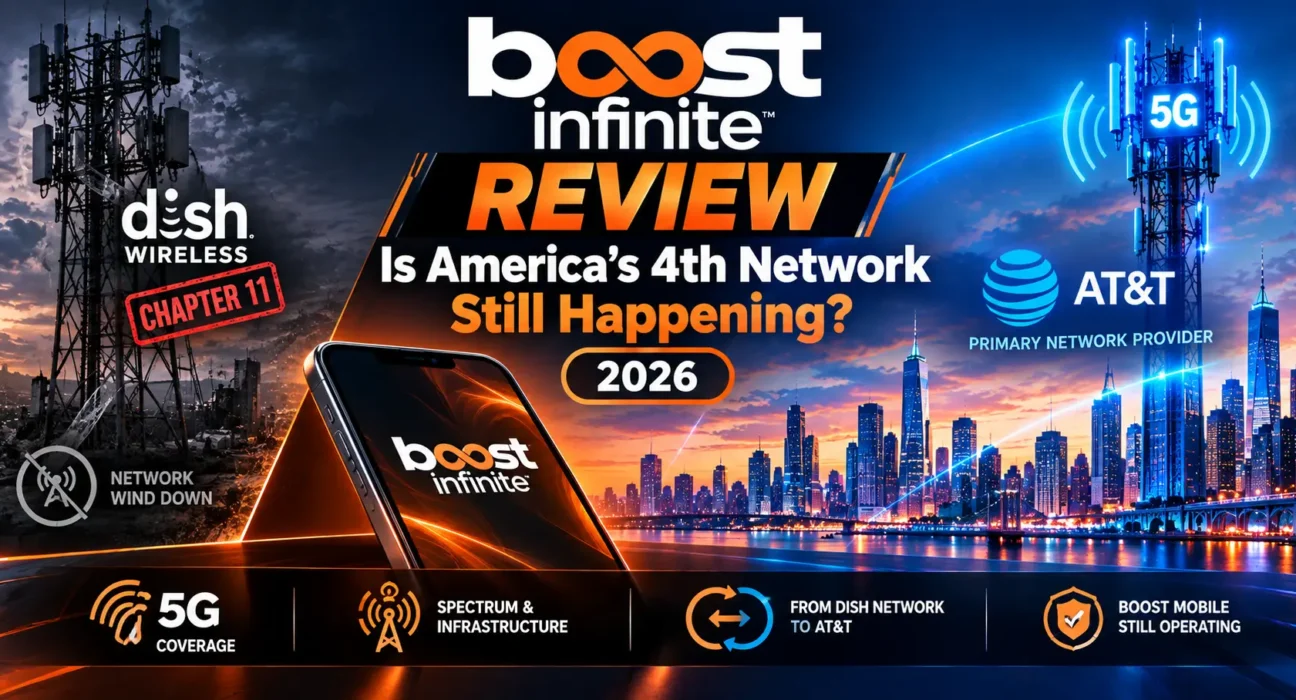
In this detailed Boost Infinite 5G network review, we examine how Boost Infinite was supposed to become America’s 4th nationwide carrier—built and owned by Dish/EchoStar instead of leased. As of 2026, that specific plan has effectively ended. Here is what actually happened, what Boost Infinite is today, and whether the $25/month plan is still worth it on its own merits.
Review based on Boost Infinite’s current published plan details, EchoStar’s 2026 FCC and bankruptcy filings, and third-party coverage data from AT&T’s and T-Mobile’s networks.
Quick Verdict: Boost Infinite 5G Network Review
The “build our own 4th network” story that once made Boost Infinite genuinely interesting from an industry standpoint is over. What’s left is a straightforward budget MVNO running on AT&T’s network – and judged purely as that, it’s a decent, not exceptional, value play. The $25/month price-locked-for-life plan is competitive with Visible and other budget options, but Boost no longer has the differentiator of owning meaningful independent spectrum.

What Happened to Dish’s “4th Network” Plan?
Back in 2020, as part of the FCC-approved T-Mobile/Sprint merger, Dish Network was handed a path to become a genuine fourth major US carrier – the deal specifically required Dish to build out its own facilities-based 5G network rather than just reselling access to someone else’s. Dish launched Project Genesis and later Boost Infinite as the customer-facing brands for that ambition, and for a few years it looked like it might actually happen, with Dish reporting real 5G coverage progress toward FCC-mandated population targets.
Then the buildout ran into serious financial trouble. Meeting the deadlines and coverage requirements proved far more expensive than Dish anticipated, and by mid-2025, EchoStar (Dish’s parent company following a 2023 merger) began selling off large chunks of its wireless spectrum instead of continuing to build on it – roughly $23 billion worth to AT&T and $17 billion to SpaceX. That sale, combined with the June 2026 Chapter 11 filing for Dish DBS and Dish Wireless, closed the door on the independent 4th-network plan. Boost’s cellular brands survive, but as a hybrid operator leaning on AT&T and T-Mobile rather than a standalone network builder.
Network and Coverage Today
| Network | Role | Agreement Through |
|---|---|---|
| AT&T | Primary network for most Boost customers | 2031 |
| T-Mobile | Secondary network access in select areas | 2027 |
| Dish/EchoStar’s own spectrum | Greatly reduced after 2025-2026 spectrum sales | Being wound down |
In practice, our Boost Infinite 5G network review shows that customers today get coverage that closely tracks AT&T’s nationwide 4G LTE and 5G footprint – which is genuinely solid, reaching around 99% of Americans on LTE – plus supplemental T-Mobile access depending on location. It’s a perfectly reasonable coverage story; it’s just not the independent “own network” story Boost was originally selling.
Pricing and Plans
What You Get for $25/Month
- Unlimited domestic talk, text, and data
- 5GB of hotspot data included
- International calling included
- Price locked for life – no future increases on this plan
- 30-day money-back guarantee
Worth Knowing Before You Switch
- Limited phone selection compared to major carriers
- Higher-tier plans needed to avoid data deprioritization in some cases
- Brand and ownership structure has been in flux through 2025-2026
- No longer positioned as an independent network alternative
Boost Infinite vs. the Competition
| Carrier | Network | Starting Price | Key Difference |
|---|---|---|---|
| Boost Infinite | AT&T (primary), T-Mobile | $25/mo | Price locked for life, reduced hotspot data |
| Visible | Verizon | $25/mo | Verizon coverage, no commitment |
| Mint Mobile | T-Mobile | $15/mo (annual) | Cheapest, but requires prepay |
| Cricket Wireless | AT&T | ~$30/mo | Also AT&T, larger retail footprint |
See our full breakdown of MVNO options in Best Prepaid & MVNO 5G Plans in the US.
Who Should Buy It?
Consider Boost Infinite if: You want AT&T-level coverage at a locked-in $25/month price with no annual commitment or prepay requirement, and you value the price-for-life guarantee over network prestige.
Look elsewhere if: You specifically wanted Boost for its “independent 4th network” positioning – that’s no longer the story. Cricket Wireless offers similar AT&T-based coverage with a larger retail store presence, and Visible offers a comparable price on Verizon’s network if that’s the stronger signal in your area.
❓ FAQ — Boost Infinite
Q: Is Boost Infinite still becoming America’s 4th nationwide network?
No. As of 2026, EchoStar (Dish’s parent company) sold the majority of its wireless spectrum to AT&T and SpaceX and filed for Chapter 11 bankruptcy for its Dish Wireless and Dish DBS entities, ending the independent 4th-network buildout plan.
Q: What network does Boost Infinite use now?
Primarily AT&T’s network, under an agreement running through 2031, supplemented by T-Mobile network access in select areas through 2027.
Q: Is Boost Infinite a good value in 2026?
As a budget AT&T-based MVNO, yes – the $25/month plan with a price-locked-for-life guarantee is competitive with Visible and other similarly priced options, though it’s no longer differentiated by owning its own network.
Q: What’s the difference between Boost Mobile and Boost Infinite now?
EchoStar has merged the two brands into a single Boost Mobile operation, so the distinction that used to exist between prepaid Boost Mobile and postpaid Boost Infinite has largely gone away.
Q: Is my Boost Infinite service at risk because of the Dish Wireless bankruptcy?
The bankruptcy filing specifically covers Dish DBS and Dish Wireless entities and is structured to let the company pay its debt obligations while completing the transition of subscribers – Boost’s cellular service itself is expected to continue operating through AT&T and T-Mobile network agreements.
Q: How does Boost Infinite compare to Visible?
Both start around $25/month. Boost runs primarily on AT&T’s network, while Visible runs on Verizon’s – the better choice depends on which of those two networks performs better at your specific address.
Final Verdict: Is Boost Infinite Worth It?
To conclude this Boost Infinite 5G network review, the original pitch—a genuinely independent 4th national 5G network—didn’t survive the economics of building cellular infrastructure from scratch, and 2026’s spectrum sales and bankruptcy filing made that official. What remains is a competent, AT&T-backed budget carrier at a fair, locked-in price. If you’re comparing it purely as an MVNO option alongside Visible, Cricket, or Mint, it holds its own.
👉 Read next: AT&T vs. Verizon 5G
👉 Also useful: T-Mobile vs. Verizon 5G