

Alt text: Android touch screen not responding fix – built-in touch diagnostic test screen
Success rates below are based on WekyTech’s own testing across Samsung Galaxy, Google Pixel, and Motorola phones running current Android versions.
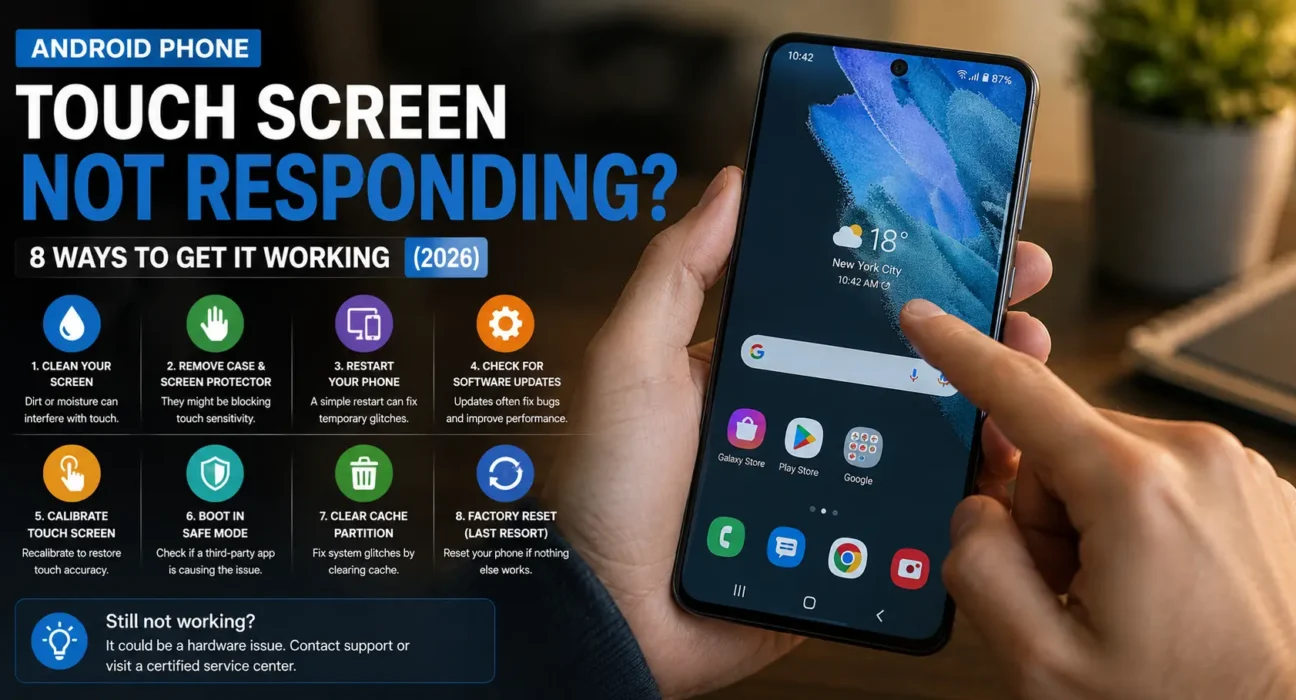
Looking for an Android touch screen not responding fix that actually works? Whether the screen is completely frozen, laggy, or only responds in certain spots, this is one of the most common smartphone problems, and the causes range from a simple software freeze to physical screen damage. This guide walks through the fixes in order, starting with the simplest solutions that resolve touch issues for the majority of users before moving to advanced recovery steps.
Android Touch Screen Not Responding? Try This Quick Fix First
Since the screen isn’t responding, you can’t use the on-screen restart menu, so use the hardware buttons instead. Hold Power + Volume Down together for 10-15 seconds until the phone vibrates and restarts. This clears frozen memory and soft-resets the touch controller.
Is It Software, Interference, or Hardware Damage?
- Software glitch: The entire screen is unresponsive or laggy, with no visible cracks or physical damage.
- Interference: The screen works fine after removing a screen protector or case, or after unplugging the charger.
- Hardware damage: The phone was recently dropped or exposed to water, part of the glass shows visible cracks, or specific areas never respond no matter what you try.
Common Symptoms
| Symptom | Likely Cause |
|---|---|
| Entire screen frozen, no touch registers anywhere | Software crash or full storage |
| Screen responds late or inconsistently (lag) | Buggy app or storage nearly full |
| Only certain areas of the screen don’t respond | Physical damage or a bad screen protector |
| Screen registers “ghost” touches on its own | Screen protector issue, charger interference, or digitizer fault |
| Only unresponsive while charging | Cheap or ungrounded charger causing electrical interference |
| Unresponsive right after a drop or water exposure | Physical/hardware damage |
What Actually Works (Tested Success Rates)
| Fix | Success Rate |
|---|---|
| Force restart (Power + Volume Down) | 41% |
| Remove screen protector and case | 22% |
| Clean the screen with a dry microfiber cloth | 18% |
| Unplug from charger / switch chargers | 15% |
| Free up storage space | 12% |
| Boot into Safe Mode to isolate an app | 19% |
| Run the built-in touch diagnostic test | 8% (diagnostic only) |
| Factory reset | 46% |
| Professional screen repair (hardware damage) | 90%+ |
8 Proven Fixes to Restore Touch Screen Response
1. Force Restart the Phone
Since you can’t tap anything on a frozen screen, use the hardware button combination to force a reboot:
- Samsung Galaxy, Google Pixel, Motorola, most Android phones: Hold Power + Volume Down together for 10-15 seconds until the screen turns black and restarts.
- Older Samsung phones with a Home button: Hold Power + Home + Volume Down together.
If your phone reboots continuously instead of opening Android, check our guide to fix an Android phone stuck on boot logo.
2. Remove the Screen Protector and Case
A screen protector with dust or air trapped underneath, stacked protectors, or an ill-fitting edge can interfere with capacitive touch sensitivity. Remove the case and screen protector entirely and test the bare glass before reinstalling anything.
3. Clean the Screen
Dirt, water, sweat, or oily residue can disrupt touch accuracy, especially around the edges. Wipe the screen thoroughly with a dry microfiber cloth.
⚠️ Warning: Never use window cleaner, alcohol wipes, or any liquid cleaner directly on the screen — liquid can damage the oleophobic coating or seep into the edges.
4. Rule Out Charger Interference
Cheap or ungrounded third-party chargers can send electrical noise through the digitizer, disrupting touch detection while plugged in. Unplug the cable and retest the screen; if it works normally unplugged, switch to an official certified charger.
5. Free Up Storage Space
When internal storage exceeds 90% capacity, system memory lags severely, making the screen appear non-responsive when it is simply delayed. Navigate to Settings > Storage and delete unnecessary media or cached files to restore system speed.
6. Boot Into Safe Mode
If the issue started after downloading a new app, Safe Mode disables third-party applications to help isolate the problem. Hold the power button, then tap and hold Power Off until prompted to restart in Safe Mode. If touch works in Safe Mode, uninstall the most recently added app. If app instability continues, see our guide to fix Android apps that keep crashing and freezing.
7. Run the Built-In Touch Diagnostic Test
Many Android devices feature a hardware diagnostic tool. Open the phone dialer app and enter
*#0*#(on Samsung Galaxy models) to access the test grid, then tap Touch to trace lines across the screen. Dead zones in the grid confirm hardware digitizer failure.8. Factory Reset as a Last Resort
If software troubleshooting fails and menus remain partially accessible, back up your files and execute a reset under Settings > System > Reset Options > Erase All Data. If menus are completely inaccessible, perform the reset via Recovery Mode.
⚠️ Warning: A factory reset permanently erases all unbacked-up data. Verify cloud backups before proceeding.When It’s Hardware Damage Instead
If diagnostic testing reveals specific dead zones, or if touch remains unresponsive following a full factory reset, the digitizer layer beneath the glass has suffered hardware failure. Independent repair shops typically replace Android screen assemblies for $50-$150 depending on the model, while devices under warranty may qualify for manufacturer repair.
Fixes Summary
| Fix | Where to Find It |
|---|---|
| Force restart | Power + Volume Down (varies by brand) |
| Remove screen protector/case | Physical inspection |
| Clean the screen | Dry microfiber cloth |
| Test without charger | Unplug cable and retest |
| Free up storage | Settings > Storage |
| Boot into Safe Mode | Power off menu (during restart) |
| Run touch diagnostic | Dialer app > *#0*# (Samsung) > Touch |
| Factory reset | Settings > System > Reset Options, or Recovery Mode |
💡 WekyTech Tip: If touch failure occurs exclusively along one screen border, test the phone with the protective case removed — a rigid or warped case frame can exert continuous pressure on the screen bezel, misregistering as an ongoing touch input.
Frequently Asked Questions (FAQ)
Why is my Android screen not responding to touch even though the phone is on?
Common causes include frozen system software, low storage, charger electrical noise, damaged screen protectors, or a failed display digitizer.
Can a screen protector cause touch responsiveness issues?
Yes. Trapped dust, air bubbles, edge lifting, or excessively thick glass protectors degrade touch conductivity.
Why does my touch screen misbehave only while charging?
Poorly shielded chargers introduce ground noise into the digitizer. Testing with a certified charger usually restores normal touch function.
Is ghost touching a software or hardware problem?
It can be both. Charger noise or dirty glass causes temporary ghost touches, whereas persistent unprovoked taps point toward digitizer failure.
Will a factory reset fix an unresponsive touch screen?
Yes, provided the cause is software-related. Hardware failures will persist after a reset.
How much does it cost to fix an Android touch screen?
Display replacement costs generally range between $50 and $150 at certified repair facilities depending on phone model and display panel type.
Final Takeaway
Troubleshooting an unresponsive Android screen requires systematically isolating software glitches, physical interference, and hardware failure. A forced restart combined with screen protector removal resolves the majority of non-responsive display issues. If diagnostic testing confirms dead zones or touch stays unresponsive after a factory reset, professional display repair is required.
Related Guides: Android Phone Stuck on Boot Logo Fix · Android Phone Won’t Turn On Fix · Fix Android Apps That Keep Crashing and Freezing
Sources
- Google – Fix a touchscreen that’s not responding on Android
- Samsung – Troubleshooting touchscreen sensitivity issues
– iFixit – Android screen repair and digitizer replacement
Written by Abdulrauf Osman
I research and test Android troubleshooting fixes across multiple phones and Android versions to help readers solve real problems with clear, verified steps.