
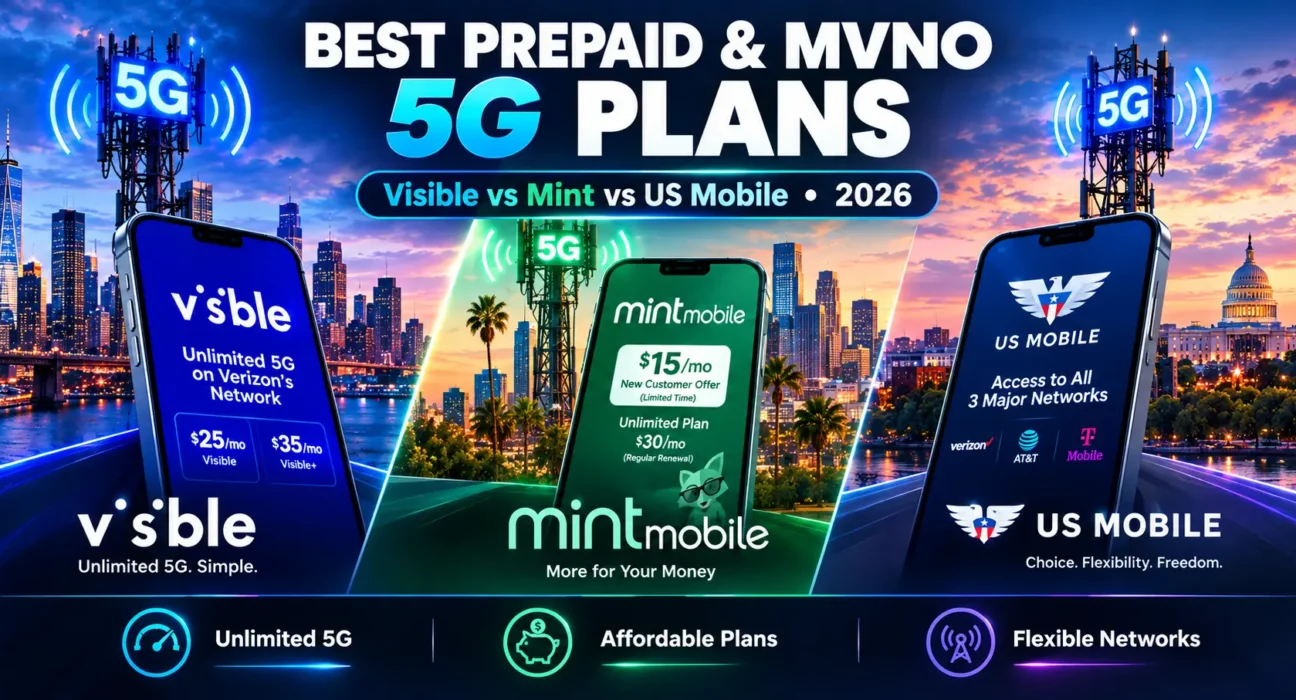
Finding the best prepaid 5G plans in the US comes down to network quality and overall value. Modern MVNOs run on the exact same towers as AT&T, Verizon, and T-Mobile—they just skip retail stores to pass 30-50% of the savings straight to you. Here is who earns a spot on your phone in 2026.
Pricing and features pulled directly from each carrier’s published plan pages and verified as of September 2026. Network and reliability claims are cited from Ookla, OpenSignal, and Consumer Reports.

Best Prepaid 5G Plans in the US — Comparison Table
| Carrier | Network | Starting Price | Best For |
|---|---|---|---|
| US Mobile | AT&T, Verizon, or T-Mobile (your choice) | $25/mo | Best overall, network flexibility |
| Mint Mobile | T-Mobile | $15/mo (12-mo prepay) | Cheapest unlimited plan |
| Visible | Verizon | $25/mo | Verizon coverage, no commitment |
| Cricket Wireless | AT&T | ~$30/mo | AT&T coverage with retail stores |
| Metro by T-Mobile | T-Mobile | ~$30/mo | T-Mobile coverage with retail stores |
| Tello | T-Mobile | $10/mo (2GB) | Backup line or kids’ line |
Our Top Picks for Best Prepaid 5G Plans in the US
1. US Mobile — Best Overall
Why we recommend it: Among the best prepaid 5G plans in the US, US Mobile is the only major MVNO that lets you pick AT&T, Verizon, or T-Mobile as your underlying network—and switch between them from the app if your needs change. At $25/month for Unlimited Starter (with a 20GB hotspot allowance included), it’s also a Consumer Reports Top Rated Cell Phone Service Provider for 2026, which is a genuinely rare distinction in this category.
Pros: Network flexibility across all three major carriers; 20GB hotspot included; strong customer satisfaction ratings.
Cons: Not the single cheapest option if you’re committed to one network already.
Who it’s for: Anyone who wants the safety net of network flexibility without paying postpaid prices.
2. Mint Mobile — Best Value
Why we recommend it: Mint’s headline $15/month rate requires a 12-month prepay, but it’s genuinely the lowest effective monthly cost of any option ranking among the best prepaid 5G plans in the US, running on T-Mobile’s network with its wide mid-band 5G coverage.
Pros: Lowest effective monthly price available; strong T-Mobile mid-band 5G coverage in cities and suburbs.
Cons: Requires paying for 3, 6, or 12 months upfront to hit the lowest rate; 3-month terms cost significantly more per month.
Who it’s for: Budget-focused users comfortable prepaying, in areas with solid T-Mobile coverage.
3. Visible — Best for Verizon Coverage
Why we recommend it: Visible is owned directly by Verizon and gives you unlimited high-speed data for $25/month with no annual commitment required. Step up to Visible+ at $35/month and you get access to Verizon’s Ultra Wideband 5G network plus 1080p streaming resolution.
Pros: Runs on Verizon’s network, including rural reach; no commitment required; Visible+ unlocks Ultra Wideband access.
Cons: Base plan doesn’t include Ultra Wideband access; single-network only.
Who it’s for: Anyone in an area with strong Verizon coverage who wants flexibility without prepaying a year.
4. Cricket Wireless — Best for AT&T With Retail Support
Why we recommend it: Cricket runs on AT&T’s network and backs it up with roughly 4,500 physical retail stores nationwide—a real advantage if you want in-person help with your phone or account rather than managing everything through an app.
Pros: AT&T network coverage; extensive retail store presence for in-person support.
Cons: Pricing sits closer to mid-range than budget compared to Mint or Visible.
Who it’s for: AT&T-area customers who value walking into a store when something goes wrong.
5. Metro by T-Mobile — Best for T-Mobile With Retail Support
Why we recommend it: Metro is T-Mobile’s own prepaid brand, backed by an even larger retail footprint—around 8,000 stores—making it the most accessible in-person option for T-Mobile network coverage specifically.
Pros: T-Mobile network including Ultra Capacity 5G; largest retail store network on this list.
Cons: Not the cheapest per-month option compared to Mint’s prepay rate.
Who it’s for: T-Mobile-area customers who want a physical store nearby for support or device purchases.
6. Tello — Best for a Backup or Kids’ Line
Why we recommend it: At $10/month for 2GB, Tello (also running on T-Mobile’s network) is built for light, secondary use—a kid’s first phone, an emergency backup line, or a device you rarely use for data.
Pros: Very low cost for light data users; flexible, customizable data amounts.
Cons: Not built for heavy data users or anyone wanting a primary unlimited line.
Who it’s for: Secondary lines, kids’ first phones, or anyone who barely uses mobile data.
Best Prepaid Plan for Every Need
| Need | Best Pick |
|---|---|
| Want to keep your network options open | US Mobile |
| Absolute lowest monthly cost | Mint Mobile (annual prepay) |
| Best coverage in rural areas | Visible (Verizon network) |
| Want a physical store to visit | Cricket Wireless or Metro by T-Mobile |
| Need a backup or kid’s line | Tello |
| Frequent international calling | Lycamobile, H2O Wireless, or Ultra Mobile |
What to Know Before You Switch
Every provider offering the best prepaid 5G plans in the US runs on the same physical towers as AT&T, Verizon, or T-Mobile—the actual signal reaching your phone is identical to what a full-price postpaid customer gets. The real difference is data deprioritization: during heavy network congestion, prepaid and MVNO traffic can be served after postpaid customers on premium tiers. In practice, most users in most places never notice a difference, and several premium MVNO tiers (Visible+, US Mobile’s higher plans) now include priority data that removes this gap entirely.
Before switching, check coverage at your specific address on the underlying network’s own coverage map—a plan’s price doesn’t matter if the signal doesn’t reach your house—and confirm your current phone is compatible with an eSIM or physical SIM from the new carrier. Most switches now take under 10 minutes.
How We Picked These Plans
We compared published pricing directly from each carrier’s plan pages, cross-referenced network and reliability claims against Ookla Speedtest data, OpenSignal reliability reports, and Consumer Reports ratings, and prioritized plans with transparent, all-in pricing that includes taxes and fees where advertised. We excluded plans with unclear or frequently changing promotional pricing that doesn’t reflect what most customers actually pay long-term.
❓ FAQ — Best Prepaid 5G Plans in the US
Q: What is the cheapest unlimited 5G plan in the US?
Mint Mobile offers the lowest effective monthly cost at $15/month, but only if you prepay for 12 months. For no-commitment pricing, Visible’s $25/month plan is among the most affordable.
Q: Is MVNO 5G the same quality as the Big Three carriers?
Yes, technically—MVNOs use the exact same towers and spectrum as their host network. The main difference is data deprioritization during network congestion, which most users rarely notice.
Q: Which prepaid carrier has the best coverage?
It depends entirely on which host network is strongest where you live. Mint (T-Mobile) tends to excel in cities and suburbs; Visible (Verizon) tends to hold an edge in rural areas.
Q: Can I switch networks if I choose an MVNO tied to one carrier?
Not with single-network MVNOs like Mint or Visible. US Mobile is the exception—it lets you choose and switch between AT&T, Verizon, and T-Mobile from within the same account.
Q: How much can I actually save by switching to an MVNO?
Most people save $360 to $1,800 per year compared to postpaid plans from AT&T, Verizon, or T-Mobile directly, since MVNO plans typically run $15-30/month versus $65-90/month postpaid for similar data.
Q: Do MVNO plans include 5G Ultra Wideband or Ultra Capacity access?
It varies by plan tier. Premium tiers like Visible+ and US Mobile’s higher plans now include access to the host network’s fastest 5G layer; base tiers often stick to the standard 5G layer only.
Final Verdict: Selecting the Best Prepaid 5G Plans in the US
When selecting from the best prepaid 5G plans in the US, US Mobile’s network flexibility makes it the safest starting point in 2026—you’re not locked into one carrier’s coverage map. If you’re confident T-Mobile covers your area well and you can commit to a year upfront, Mint Mobile’s price is hard to beat. And if Verizon is the strongest signal at your address, Visible gives you a genuinely good unlimited plan with zero commitment required.
👉 Read next: AT&T vs. Verizon 5G
👉 Also useful: Boost Infinite 5G Review