
Samsung Galaxy S25 vs iPhone 16: Which One Should You Actually Buy
Every year, the same question floods tech forums, Reddit threads, and group chats across the US and Canada: Samsung or iPhone?
In 2026, that question is harder than ever to answer — because both phones are genuinely excellent. The Galaxy S25 pushed Samsung’s AI features further than most people expected, and the iPhone 16 quietly became one of the most well-rounded iPhones Apple has ever made.
I’ve spent time with both phones — daily use, real-world camera tests, battery rundowns, and the kind of ordinary tasks that matter more than any benchmark. Here’s the honest comparison, with no brand loyalty involved.
⚡ Samsung Galaxy S25 vs iPhone 16? Quick Verdict (For Those Who Just Want the Answer)
Buy the Samsung Galaxy S25 if:
- You want a more customizable Android experience
- Camera versatility (especially zoom) is your top priority
- You prefer a smaller, lighter phone with more Google ecosystem integration
- Budget flexibility matters — S25 deals are often more aggressive
Buy the iPhone 16 if:
- You’re already in the Apple ecosystem (Mac, iPad, AirPods)
- You want the smoothest, most consistent software experience
- Long-term software support is important to you
- Video quality — especially in low light — is non-negotiable
✅ What Actually Works — Side-by-Side Comparison
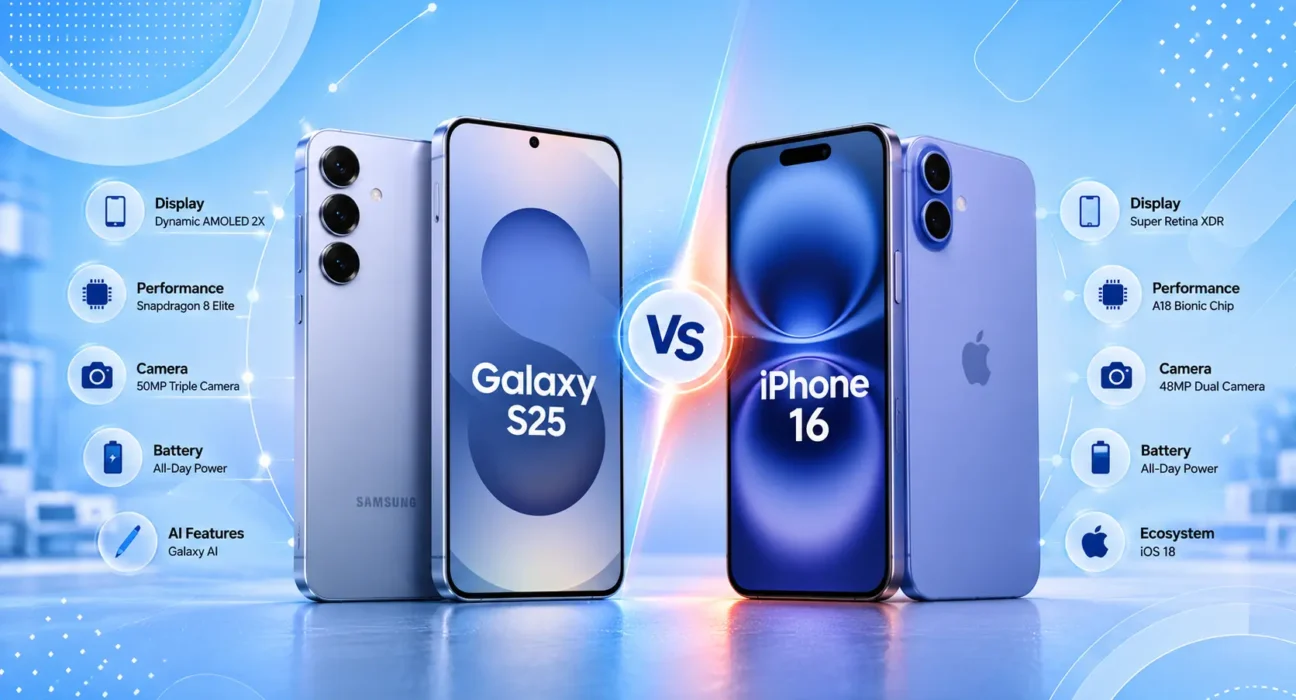
| Category | Samsung Galaxy S25 | iPhone 16 |
|---|---|---|
| Display | 6.2″ Dynamic AMOLED, 120Hz | 6.1″ Super Retina XDR, 60Hz |
| Processor | Snapdragon 8 Elite | Apple A18 |
| RAM | 12GB | 8GB |
| Main Camera | 50MP | 48MP |
| Zoom | 3x optical | 2x optical |
| Battery | 4,000 mAh | 3,561 mAh |
| Charging Speed | 25W wired | 20W wired |
| Starting Price (US) | $799 | $799 |
| Software Updates | 7 years | 5–6 years |
| 5G | Yes | Yes |
Same price. Very different experiences. Let’s break down what those numbers actually mean in daily use.
Display: A Small But Real Difference
The Galaxy S25 wins on paper — 120Hz adaptive refresh rate versus the iPhone 16’s 60Hz. In practice, that means scrolling and animations look noticeably smoother on the Samsung.
That said, Apple’s display calibration remains best-in-class. Colors are accurate, brightness in direct sunlight is exceptional, and text looks razor-sharp. Most users switching from an older iPhone won’t notice the 60Hz difference for everyday tasks like email, social media, or browsing.
If you watch a lot of video or play games on your phone, the S25’s 120Hz feels genuinely better. For everything else, both screens are excellent.
Winner: Samsung Galaxy S25 (for smoothness) | Draw (for real-world daily use)
Performance: Two Different Kinds of Fast
The Apple A18 chip in the iPhone 16 is one of the fastest mobile processors ever tested — it consistently outperforms competitors in raw CPU and GPU benchmarks. The Snapdragon 8 Elite in the Galaxy S25 is no slouch either, but Apple’s chip efficiency is in a different league.
What does that mean practically? Both phones handle everything you throw at them without hesitation — apps, multitasking, gaming, video editing. You won’t feel a performance difference during normal use. Where Apple pulls ahead is in sustained performance over 3–4 years. iPhones tend to age more gracefully than Android flagships in terms of speed and app responsiveness.
Winner: iPhone 16 (long-term) | Draw (day-to-day 2026 use)
Camera: The Most Important Category for Most People
This is where the real decision gets made for the majority of buyers.
Samsung Galaxy S25 — Strengths:
- More zoom range (3x vs 2x) — noticeably better for concerts, sports, distant subjects
- More processing flexibility with Google Photos and Samsung’s AI editing tools
- Slightly wider dynamic range in bright outdoor shots
iPhone 16 — Strengths:
- Video quality is class-leading — color science, stabilization, and audio capture are all ahead
- Cinematic mode and Action mode produce results Android can’t replicate
- Portraits and skin tones look more natural in mixed lighting
- Camera Control button (hardware shortcut) is genuinely useful day-to-day
Here’s the honest take: if you shoot mostly photos and want zoom capability, the S25 has an edge. If you shoot video — even casually on your Stories or Reels — the iPhone 16 produces better results with less effort.
Winner: Samsung for photos | iPhone 16 for video — pick based on how you actually shoot
Battery Life: Samsung Wins on Numbers, iPhone Wins on Optimization
The Galaxy S25 has a larger battery (4,000 mAh vs 3,561 mAh), and it also charges faster at 25W versus iPhone’s 20W. On paper, Samsung is the clear winner.
In real-world use, the gap is smaller than the specs suggest. Apple’s A18 chip is extremely power-efficient, and iOS is optimized in ways Android simply isn’t. Both phones will comfortably get most users through a full day. Heavy users — think six-plus hours of screen-on time — may find the S25 lasts slightly longer.
One genuine advantage for Samsung: wireless charging at 15W versus iPhone’s 12W MagSafe. Not a dealbreaker, but worth noting if you use wireless charging daily.
Winner: Samsung Galaxy S25 (slightly)
Software Experience: A Matter of Philosophy
This is the most personal category in any iPhone vs Android comparison.
iOS (iPhone 16):
Clean, consistent, and deeply integrated if you use other Apple products. Fewer customization options, but everything works exactly as expected. Handoff between iPhone, Mac, and iPad is genuinely seamless. Software updates are fast, simultaneous, and supported for years.
Android / One UI 7 (Galaxy S25):
More freedom to customize your home screen, default apps, and system behavior. Samsung’s AI features (Galaxy AI) are more extensive than Apple Intelligence in 2026 — translation, note summarization, and call assistance are all more capable. Seven years of software updates is a real commitment that beats Apple’s promise.
Neither is objectively better. If you’ve been on iPhone for years and your life runs on iMessage, FaceTime, and AirDrop — switching to Android has real friction. If you’re on Android already, Samsung’s ecosystem is polished and capable.
Winner: Depends entirely on your existing ecosystem
Price and Value in the US and Canada
Both phones start at $799 USD / ~$1,099 CAD for base storage. But here’s where it gets interesting:
- Samsung frequently runs aggressive trade-in deals and carrier promotions — it’s often possible to get the S25 for $599 or less with a trade-in
- Apple’s trade-in values are more conservative, but iPhone holds resale value significantly better over time
- For Canadian buyers: Samsung’s financing options through carriers like Rogers, Bell, and Telus are often more flexible
If upfront price matters most, Samsung usually wins at the point of sale. If you plan to sell or trade the phone in 2 years, the iPhone typically returns more of your investment.
Winner: Samsung S25 for upfront cost | iPhone 16 for resale value
Who Should Buy What — The Honest Breakdown
Get the Galaxy S25 if you:
- Are currently on Android and happy there
- Shoot more photos than videos
- Want 120Hz at this price point
- Care about AI-powered features and customization
Get the iPhone 16 if you:
- Own a Mac, iPad, or AirPods
- Shoot video regularly (even just for social media)
- Want a phone that ages well and stays fast for 4+ years
- Prefer a simpler, more consistent software experience
Consider waiting if:
- You can hold on until fall 2026 — iPhone 16s (or iPhone 17) and Galaxy S25 FE will both offer better value
- You want to see how Apple Intelligence evolves with the next iOS update
📋 Final Scorecard
| Category | Winner |
|---|---|
| Display Smoothness | Samsung Galaxy S25 |
| Raw Performance | iPhone 16 |
| Photo Camera | Samsung Galaxy S25 |
| Video Camera | iPhone 16 |
| Battery Life | Samsung Galaxy S25 |
| Software Longevity | Draw |
| Ecosystem Integration | Depends on your setup |
| Upfront Price | Draw ($799 both) |
| Resale Value | iPhone 16 |
Overall: It’s genuinely close. But if I had to pick one for someone starting fresh with no existing ecosystem ties — the Galaxy S25 offers slightly more hardware for the same price. If you’re in the Apple ecosystem, there’s no reason to leave.
❓ FAQ — Galaxy S25 vs iPhone 16
Q: Which has a better camera — Galaxy S25 or iPhone 16?
For photos, especially with zoom, the Galaxy S25 has an edge. For video quality and color consistency, the iPhone 16 leads. Both cameras are excellent — the right choice depends on how you shoot.
Q: Is the Galaxy S25 faster than the iPhone 16?
In raw benchmarks, the iPhone 16’s A18 chip scores higher. In everyday use, both phones are equally fast. The iPhone’s advantage shows more over time, as it tends to stay smooth for more years.
Q: Which phone has better battery life?
The Galaxy S25 has a larger battery and charges faster. In real-world use, both comfortably last a full day, but heavy users may get slightly more from the S25.
Q: Can I use the Galaxy S25 with a Mac or iPad?
You can use it alongside Apple devices, but the integration won’t be seamless. Features like AirDrop, Handoff, and Universal Clipboard only work between Apple devices. Android users who work heavily on Mac may find this friction annoying.
Q: Is the iPhone 16 worth it if I’m switching from Android?
If you’re switching, expect a learning curve of about a week. After that, most users who switch to iPhone stay on iPhone. iMessage and FaceTime adoption in the US and Canada is high enough that you likely won’t lose features moving over.
Q: Which phone gets updates longer — S25 or iPhone 16?
Samsung promises 7 years of OS updates for the S25 — which is actually more than Apple’s typical 5–6 year support window for recent iPhones. That said, Apple’s updates tend to land faster and cover more devices simultaneously.
Q: Should I wait for the iPhone 17 instead?
If you can wait until fall 2026, the iPhone 17 is expected to bring a 120Hz display and possible design changes — which would address the S25’s biggest advantages. If you need a phone now, the iPhone 16 is still an excellent buy.
Final Thoughts
Both the Galaxy S25 and iPhone 16 are exceptional phones at the same starting price. The honest answer is that neither is objectively better — the right choice depends on your ecosystem, how you use your camera, and whether you’re already invested in Apple or Google’s world.
Pick Samsung if hardware versatility matters most. Pick iPhone if seamless integration and long-term software quality are your priorities.
Either way, you’re getting one of the best smartphones available in 2026.
Related articles:
- iPhone WiFi Keeps Disconnecting? 7 Fixes That Actually Work
- Best Phone Plans in the US and Canada — Compared for 2026
- Samsung Galaxy S25 Ultra vs iPhone 16 Pro Max — Is the Price Worth It?
Author Bio Placeholder: [Raouf Osman] is a consumer tech writer covering smartphones, tablets, and mobile networks for readers across North America. He/she tests devices hands-on before writing a single word of a review.