
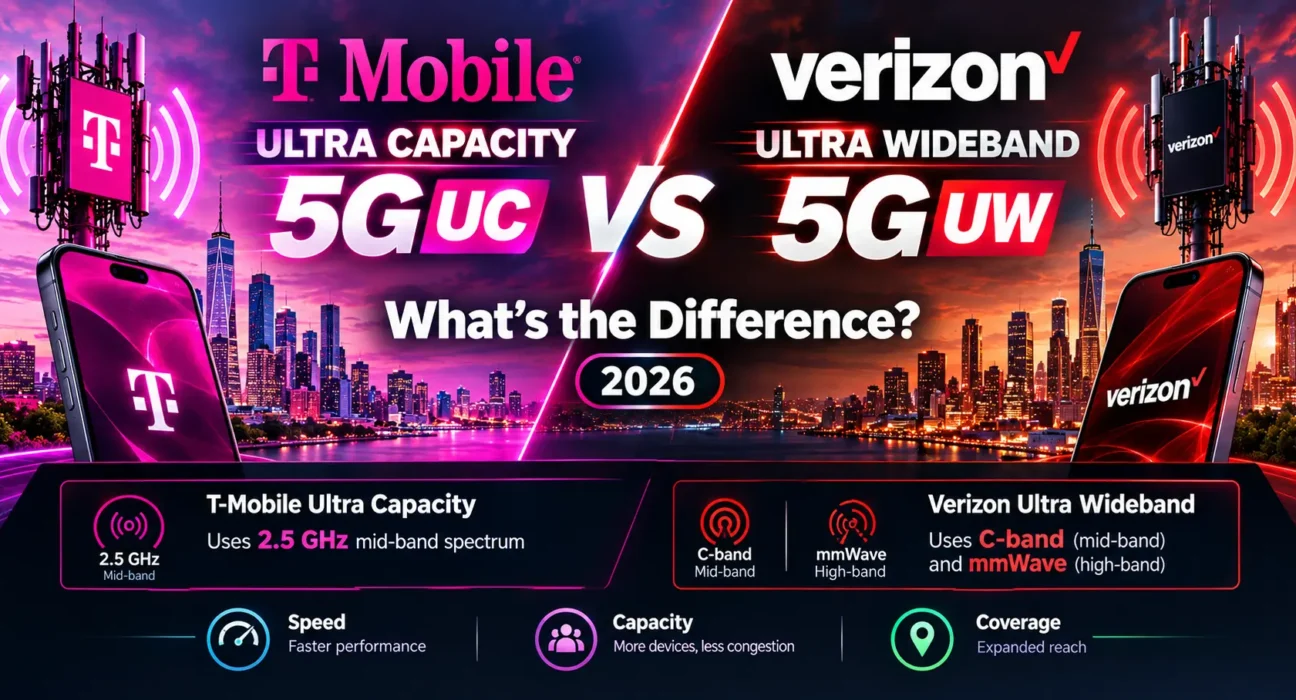
T-Mobile Ultra Capacity vs Verizon Ultra Wideband – if you’ve ever glanced at your status bar and wondered what “5G UC” or “5G UW” actually means versus plain “5G,” you’re not alone. Both labels mark the same basic idea: you’ve stepped up from the carrier’s slow, wide-reaching basic 5G into its faster premium tier. The details of how each carrier gets there, though, are genuinely different.
Explanation based on published spectrum data from T-Mobile and Verizon, plus Ookla and OpenSignal speed testing across mid-band and high-band 5G deployments in 2026.

T-Mobile Ultra Capacity vs Verizon Ultra Wideband: Head-to-Head
| Category | T-Mobile Ultra Capacity (5G UC) | Verizon Ultra Wideband (5G UW) |
|---|---|---|
| Spectrum Used | Mid-band (2.5GHz), some mmWave | Mid-band C-band + high-band mmWave |
| Population Covered | 300M+ people | 200M+ people (C-band) |
| Typical Real-World Speed | 200-300+ Mbps, fairly consistent | Varies widely by location |
| Peak Speed (best conditions) | 500-700+ Mbps reported | Over 1 Gbps, up to multi-Gbps in ideal spots |
| Range Per Tower | Covers whole neighborhoods | A few blocks, especially for mmWave |
| Plan Requirement | Included on all current plans | Gated to Unlimited Plus/Ultimate tiers on legacy plans |
| Where You’ll See It Most | Cities, suburbs, and along highways | Downtown cores, stadiums, dense urban blocks |
What “Ultra Capacity” and “Ultra Wideband” Actually Mean
Every major US carrier splits its 5G network into two rough tiers: a basic, low-band layer that covers huge distances but isn’t much faster than good 4G LTE, and a premium tier built on higher-frequency spectrum that trades some range for real speed gains. When comparing T-Mobile Ultra Capacity vs Verizon Ultra Wideband, both labels represent this premium tier when connected to your phone – the basic layer just shows as plain “5G” or “5G Extended Range.”
T-Mobile’s premium tier is called Ultra Capacity, and it leans heavily on mid-band spectrum in the 2.5GHz range – a huge chunk of airwaves T-Mobile picked up through its Sprint acquisition. That mid-band sweet spot is exactly why T-Mobile’s premium network covers so much ground: mid-band signals travel far enough to blanket entire neighborhoods while still delivering a real speed jump over basic 5G.
Verizon’s premium tier, Ultra Wideband, takes a different mix. It originally referred only to Verizon’s mmWave network – extremely high-frequency spectrum with blazing speed but a tiny coverage radius, often just one city block. In 2022, Verizon folded its growing C-band mid-band network into the same “UW” label, so today when your phone shows 5G UW, you could be on either the fast-but-tiny mmWave layer or the more moderate, wider-reaching C-band layer, without an easy way to tell which just from the icon.
Speed: Consistency vs. Ceiling
This is really the heart of the T-Mobile Ultra Capacity vs Verizon Ultra Wideband performance debate. T-Mobile’s Ultra Capacity network is built for consistency – you’re likely to see something in the 200-300 Mbps range across a wide area, with some users reporting 500-700+ Mbps in strong-signal conditions. It’s the network you can generally count on performing similarly whether you’re at home, at work, or driving between the two.
Verizon’s Ultra Wideband is built for ceiling. Within range of a C-band or mmWave tower – especially mmWave, mounted on streetlights and building facades in places like stadiums, airports, and dense downtown blocks – speeds can blow past 1 Gbps, with some testers reporting multi-gigabit results in ideal, uncongested conditions. Walk a few blocks away from that tower, though, and your phone drops back to Verizon’s basic 5G or LTE, which feels like a much bigger cliff than anything on T-Mobile’s more evenly distributed network.
How to Check Which One You’re Actually On
Look at your phone’s status bar next to the signal bars. If you’re on T-Mobile and see 5G UC, you’re on Ultra Capacity. If you see plain 5G or 5G E, you’re on the basic Extended Range layer instead. On Verizon, 5G UW means Ultra Wideband (either C-band or mmWave); plain 5G means you’re on the basic Nationwide layer. AT&T customers will see 5G+ for the premium mid/high-band tier, and plain 5G for its wider-reaching low-band layer. For an exact read on your address specifically rather than just the icon, check each carrier’s published coverage map.
Which Is Better?
| Your Situation | Better Fit |
|---|---|
| You want consistent speed across a whole neighborhood | T-Mobile Ultra Capacity |
| You’re regularly in a stadium, airport, or dense downtown core | Verizon Ultra Wideband (mmWave) |
| You want premium 5G included without an expensive plan tier | T-Mobile Ultra Capacity |
| You want the single highest peak speed possible, sometimes | Verizon Ultra Wideband |
| You move around a lot within one metro area | T-Mobile Ultra Capacity (steadier handoffs) |
For the full picture on how these two carriers stack up beyond just spectrum labels – pricing, overall coverage, and reliability – see our complete T-Mobile vs. Verizon 5G comparison.
❓ FAQ — Ultra Capacity vs. Ultra Wideband
Q: Is T-Mobile 5G UC the same as Verizon 5G UW?
They’re the same basic concept – each carrier’s premium, faster 5G tier – but built on different spectrum mixes. T-Mobile UC leans on mid-band for wide, consistent coverage; Verizon UW blends mid-band and mmWave for a wider speed range.
Q: What does 5G+ mean on AT&T?
It’s AT&T’s equivalent premium tier, using mid-band and high-band spectrum the same way T-Mobile’s UC and Verizon’s UW do. Plain “5G” on AT&T means you’re on its wider-reaching low-band layer instead.
Q: Why does my Verizon phone show 5G UW but speeds still feel average?
You’re likely connected to Verizon’s C-band layer rather than mmWave. Both show the same “UW” icon, but C-band delivers more moderate speeds over a wider area, while mmWave delivers the headline-grabbing multi-gigabit numbers only within a very short range.
Q: Do I need an expensive plan to get 5G UC or 5G UW?
It depends on the carrier. T-Mobile includes Ultra Capacity on all its current plans at no extra cost. Verizon has historically gated full Ultra Wideband access behind its higher-tier Unlimited Plus and Unlimited Ultimate plans, though this varies by current plan and promotion.
Q: Which network covers more people with its premium 5G tier?
T-Mobile’s Ultra Capacity reaches over 300 million people, noticeably ahead of Verizon’s C-band Ultra Wideband footprint of over 200 million – a direct result of T-Mobile’s mid-band spectrum advantage from the Sprint merger.
Q: Can I tell mmWave and C-band apart just by looking at my phone?
Not directly – both show as “5G UW” on Verizon. As a rough guide, if you’re in a stadium, airport, or dense downtown block and seeing extremely high speeds, you’re likely on mmWave; steady moderate-to-fast speeds in a regular neighborhood point to C-band instead.
Final Takeaway: T-Mobile Ultra Capacity vs Verizon Ultra Wideband
In the final breakdown of T-Mobile Ultra Capacity vs Verizon Ultra Wideband, both technologies solve the same problem – getting you faster-than-basic 5G – with genuinely different engineering bets. T-Mobile chose breadth: consistent, strong speeds across a huge footprint. Verizon chose peaks: the fastest numbers you’ll find anywhere, concentrated in a smaller set of locations. Neither label guarantees a specific speed on its own, so the real answer to “which is better” still comes down to whether your daily life happens inside T-Mobile’s wide mid-band blanket or within a few blocks of one of Verizon’s high-band towers.
👉 Read next: What Is 5G C-Band?
👉 Also useful: mmWave vs. Sub-6GHz 5G