
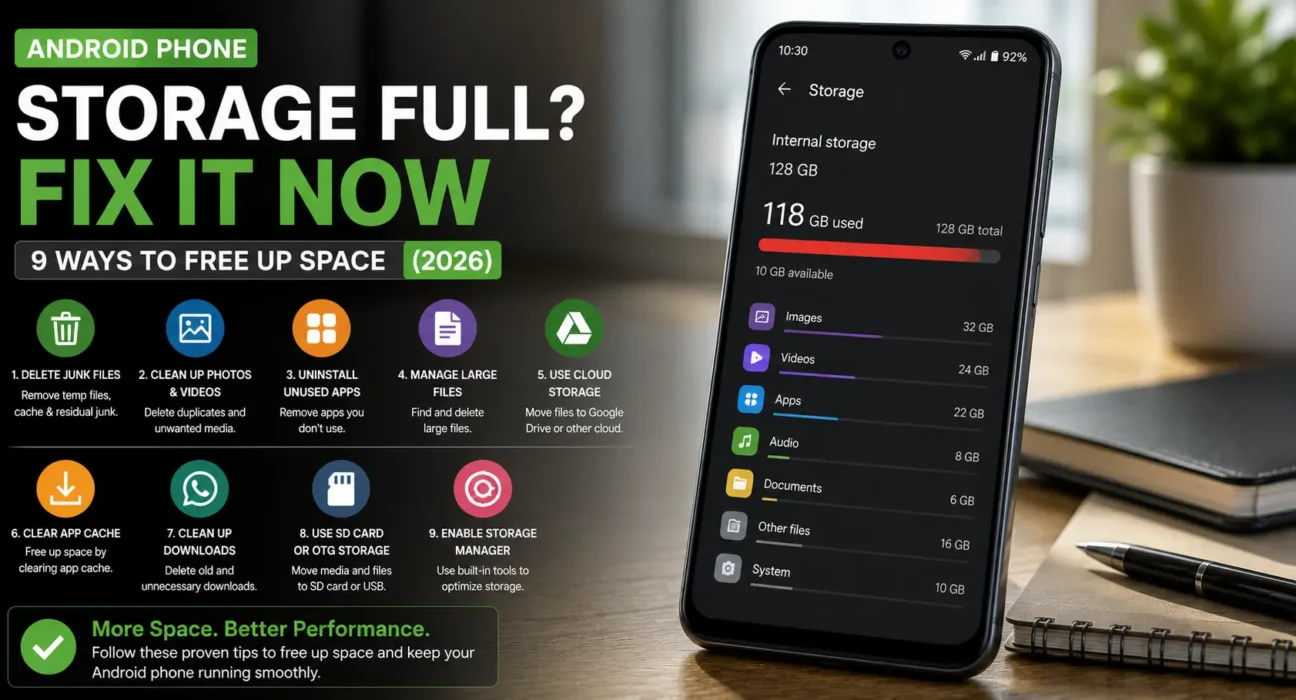

Alt text: Android phone storage full fix – Settings storage breakdown showing what’s using space
Space-saved figures below are based on WekyTech’s own testing across Samsung Galaxy, Google Pixel, and Motorola phones running current Android versions.
Looking for an Android phone storage full fix that actually works? A “Storage Almost Full” warning means apps slow down, photos fail to save, and updates refuse to install — but in most cases, your phone isn’t actually out of usable content; it’s just cluttered with cache, duplicate files, and forgotten downloads. This guide starts with the fastest wins and moves toward deeper cleanup steps.
Check What’s Actually Using Space First
Before deleting anything, go to Settings > Storage (on Samsung: Settings > Battery and Device Care > Storage) to see a breakdown of what’s using space — apps, photos, videos, system files, and a category often labeled “Other.” This step tells you exactly where to focus instead of deleting files at random.
Is It Photos, Apps, Cache, or “Other” Storage?
- Photos and videos: The Storage breakdown shows Photos/Videos as the largest category — this is the most common cause and the easiest to resolve.
- Apps and games: A handful of large apps (especially games) are eating most of your available space.
- Cache buildup: Storage is spread across many small amounts rather than one single large category.
- “Other” or “System” storage: An unusually large “Other” category that doesn’t shrink after normal cleanup — this requires a specific diagnostic approach.
Common Symptoms
| Symptom | Likely Cause |
|---|---|
| “Storage Almost Full” warning appears often | Photos/videos or large apps taking up most space |
| Apps run slowly or crash more than usual | Storage below 10-15% free capacity |
| Photos fail to save or cloud backup fails | Storage completely full, no room for new temp files |
| System updates won’t download or install | Not enough free space for the update installation package |
| “Other” storage keeps growing despite cleanup | Corrupted cache partition or accumulated app system data |
| Storage fills up again quickly after cleaning | Auto-downloading media in messaging apps (WhatsApp/Telegram) |
What Actually Works (Tested Space Recovered)
| Fix | Typical Space Recovered |
|---|---|
| Clear cache for top 10 apps | 2-5 GB |
| Google Photos “Free up space” (removes backed-up local copies) | 5-20+ GB |
| Delete large videos and screen recordings | 3-10 GB |
| Uninstall unused apps | 2-8 GB |
| Clear Downloads folder | 1-5 GB |
| Clear chat app media (WhatsApp/Telegram) | 2-15 GB |
| Use a lite app version for a heavy app | 300-500 MB per app |
| Enable Smart Storage auto-cleanup | Ongoing, varies |
| Factory reset (last resort) | Recovers maximum space, erases local data |
9 Proven Ways to Clear Android Storage
1. Check the Storage Breakdown First
Go to Settings > Storage to see exactly what is consuming your device memory before deleting anything. This diagnostic step determines whether media, applications, or temporary system cache require attention.
2. Free Up Space with Google Photos
If your media is already backed up, open Google Photos > tap your profile picture > Free up space on this device. This deletes only the local copies of files already safely stored in the cloud, leaving them fully accessible within the app.
⚠️ Warning: Confirm cloud backup has completed (verify the checkmark on your account icon) before initiating local deletion, especially on metered cellular data connections.
3. Clear App Cache
Cache files accelerate app load times but accumulate unnecessarily over time. Go to Settings > Storage > Apps (or Settings > Apps), select your largest applications, and tap Clear Cache. This preserves personal data, credentials, and settings while freeing up temporary storage. If app instability persists after clearing cache, consult our guide to fix Android apps that keep crashing and freezing.
4. Clean Out the Downloads Folder
Open the Files by Google app (pre-installed on most modern Android devices) or your native Files app, then check the Downloads directory for outdated PDFs, installers, and web media. Items moved to trash remain recoverable for 30 days before permanent deletion.
5. Clear Chat App Media
Messaging applications such as WhatsApp and Telegram store incoming media locally by default. Access Settings > Storage and Data > Manage Storage within each respective app to identify and bulk-delete large attachments or old media files.
6. Uninstall Unused Apps
Open the Play Store > Profile Icon > Manage apps & device > Manage, then filter by “Least used” to review oversized, inactive applications. For frequently used services, consider installing web-based “Lite” variants that consume significantly less storage space.
7. Enable Android’s Built-In Smart Storage
Navigate to Settings > Storage > Free up space > Menu > Settings, then toggle on Smart Storage. This feature automatically removes local copies of backed-up photos and videos after 30, 60, or 90 days once device capacity runs low.
8. Move Files to a MicroSD Card (If Supported)
For devices equipped with expandable storage slots, transfer high-resolution photos, 4K videos, and compatible application data to external memory via Settings > Storage > SD Card.
9. Resolve Unusually Large “Other” Storage
If “Other” or “System” storage remains disproportionately large after clearing app caches, perform a soft restart first to clear temporary system logs. If the issue persists, a complete system backup followed by a factory reset serves as the ultimate resolution for corrupted partition data.
⚠️ Warning: A factory reset erases all unbacked-up device content. Verify essential files, contacts, and cloud backups prior to initiating a reset.How Much Free Space Do You Actually Need?
Maintain a minimum threshold of 10-15% total storage capacity free at all times. Android requires working memory to manage background processes, app updates, and system cache; falling below this threshold induces severe system lag and installation errors.
Fixes Summary
| Fix | Where to Find It |
|---|---|
| Check storage breakdown | Settings > Storage |
| Free up space via Google Photos | Google Photos > Profile > Free up space |
| Clear app cache | Settings > Storage > Apps |
| Clean Downloads folder | Files by Google app |
| Clear chat app media | In-app settings > Storage and Data |
| Uninstall unused apps | Play Store > Manage apps & device > Installed |
| Enable Smart Storage | Settings > Storage > Free up space > Settings |
| Move files to SD card | Settings > Storage > SD Card |
| Investigate “Other” storage | Soft restart, then Factory Reset if unbudgeted |
💡 WekyTech Tip: Uncompressed 4K video recordings and screen captures represent the single largest source of hidden storage consumption. If heavy camera usage causes high device temperatures alongside storage alerts, review our Android phone overheating fix guide.
Frequently Asked Questions (FAQ)
Why is my Android storage full even though I don’t have many photos?
Hidden cache files, forgotten web downloads, automated chat app media, and heavy application data frequently accumulate more space than personal media libraries.
Will clearing app cache delete my account data?
No. Clearing cache removes only temporary operational files. Your account credentials, user settings, and saved progress remain intact.
What is “Other” storage on Android and how do I clear it?
“Other” encompasses system binaries, app data archives, and uncategorized cached data. Clearing app cache and rebooting usually reduces its footprint; persistent swelling points to corrupted system logs resolvable via factory reset.
Does deleting photos via Google Photos remove them from the cloud?
No. Utilizing the native “Free up space on this device” function selectively deletes local hardware files while preserving cloud-stored media.
How much free storage should I maintain on my phone?
Keep at least 10-15% of internal capacity unallocated to ensure smooth OS execution and background processing.
Is a factory reset necessary to solve storage problems?
Only as a final resort for unresolvable system data inflation. Over 90% of storage conflicts clear via cache purging, media offloading, and app management.
Final Takeaway
Resolving full storage warnings requires systematic identification via Settings > Storage rather than random file deletion. Offloading backed-up photos through Google Photos, clearing application cache, and managing messaging media yield the largest immediate space recovery. Reserve factory resets exclusively for unyielding system data corruption.
Related Guides: Android Phone Overheating Fix · Android Touch Screen Not Responding Fix · Fix Android Apps That Keep Crashing and Freezing
Sources
- Google – Free up storage on your Android device
- TechRadar – Built-in tools for freeing up Android storage
– Popular Science – How to free up space on your phone
Written by Abdulrauf Osman
I research and test Android troubleshooting fixes across multiple phones and Android versions to help readers solve real problems with clear, verified steps.