
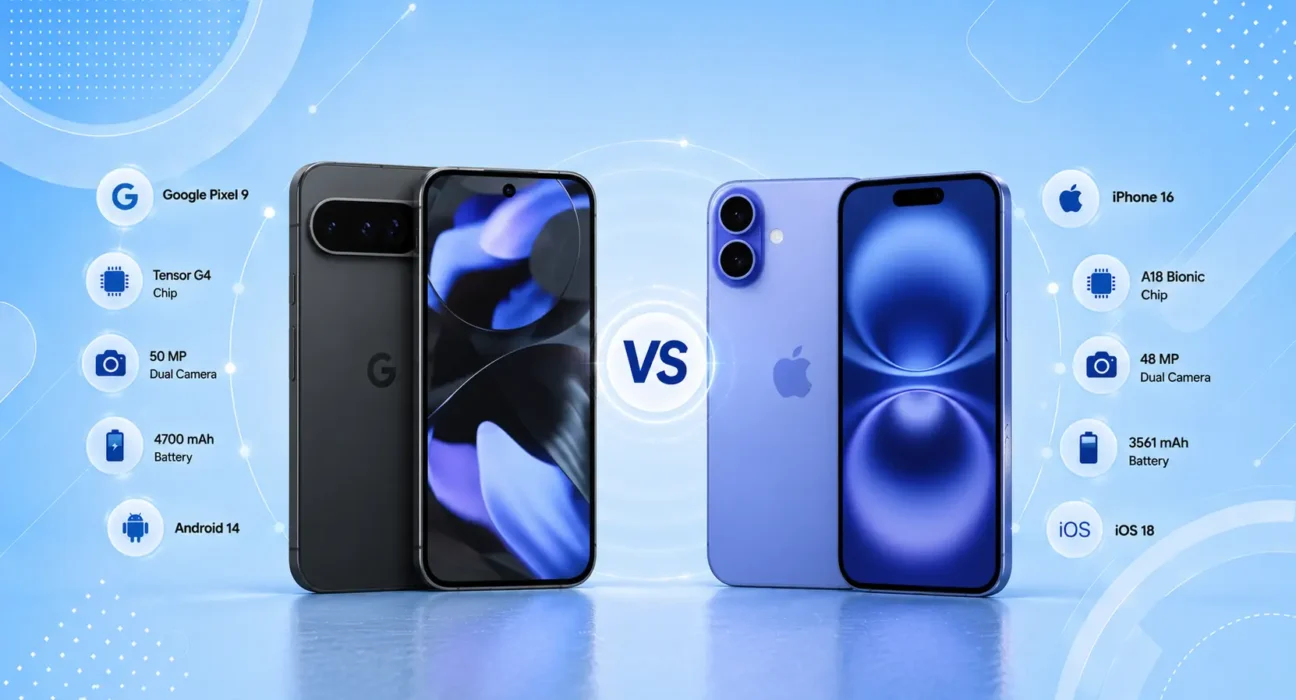
Both devices were evaluated across real-world usage scenarios including camera testing in natural and low light, battery rundown tests over a full working day, performance benchmarks using Geekbench 6, and AI feature testing across Google’s Pixel AI suite and Apple Intelligence on iOS 18.
The Google Pixel 9 vs iPhone 16 comparison is genuinely interesting in 2026 — not because one phone obviously wins, but because they represent two fundamentally different philosophies about what a smartphone should do and how it should do it.
Google built the Pixel 9 around AI. Apple built the iPhone 16 around integration. Both cost $799. Both take excellent photos. Both run fast and stable software. The difference is in the details — and those details matter enormously depending on how you use your phone.
This guide cuts through the spec-sheet noise and tells you which phone actually wins where it counts, based on real-world use — not just benchmark numbers.
⚡ Quick Verdict
Buy the Google Pixel 9 if:
- AI-powered features are a priority — Pixel’s Google AI is more capable and more deeply integrated than Apple Intelligence in 2026
- You want the purest, fastest Android experience with guaranteed OS updates
- Call Screen, Live Translate, and Magic Eraser matter to you
- You prefer Google’s ecosystem (Gmail, Google Photos, Maps, Workspace)
Buy the iPhone 16 if:
- You’re already in the Apple ecosystem (Mac, iPad, AirPods, Apple Watch)
- Video quality is your primary camera use case
- Long-term software support and resale value matter
- You want the Camera Control hardware button for quick access
✅ Google Pixel 9 vs iPhone 16 — Full Specs Comparison
| Category | Google Pixel 9 | iPhone 16 |
|---|---|---|
| Display | 6.3″ OLED, 120Hz | 6.1″ Super Retina XDR, 60Hz |
| Processor | Google Tensor G4 | Apple A18 |
| RAM | 12 GB | 8 GB |
| Main Camera | 50 MP | 48 MP |
| Ultra-Wide | 10.5 MP | 12 MP |
| Zoom | 5x optical | 2x optical |
| Battery | 4,700 mAh | 3,561 mAh |
| Charging Speed | 27W wired | 20W wired |
| Wireless Charging | 21W | 25W MagSafe |
| Starting Price (US) | $799 | $799 |
| OS Updates | 7 years | 5–6 years |
| 5G | Yes | Yes |
| Storage Options | 128 GB / 256 GB | 128 GB / 256 GB / 512 GB |
Display: Pixel 9 Wins on Specs, iPhone Wins on Calibration
The Google Pixel 9 vs iPhone 16 display gap is meaningful. The Pixel 9 offers 120Hz adaptive refresh rate — scrolling, animations, and gaming all look noticeably smoother. The iPhone 16 is capped at 60Hz, a spec that Apple reserves for its Pro lineup.
That said, Apple’s display calibration remains a benchmark for the industry. Color accuracy on the iPhone 16 is exceptional — particularly for video playback and photo editing where true-to-life colors matter more than refresh rate smoothness.
For most users: if you watch video or game heavily, Pixel 9’s 120Hz is a real advantage. For photographers reviewing their work on the screen, iPhone 16’s calibration is arguably better despite the lower refresh rate.
Winner: Google Pixel 9 — for smoothness | iPhone 16 — for color accuracy
Performance: A18 vs Tensor G4 — Two Different Approaches
The Apple A18 chip is one of the fastest mobile processors ever tested. In CPU and GPU benchmarks, it consistently outperforms the Google Tensor G4 by a significant margin. Raw computing power: clear iPhone advantage.
But here’s the nuance: Google’s Tensor G4 wasn’t designed to win benchmarks. It was designed to run on-device AI processing — speech recognition, real-time translation, photo enhancement — as efficiently as possible. At those tasks, Tensor G4 performs above its benchmark position.
In day-to-day use — app launching, scrolling, multitasking, gaming — both phones are fast enough that most users won’t notice a difference. The iPhone’s advantage shows more in sustained performance over 3–4 years as apps become more demanding.
Winner: iPhone 16 — benchmarks and longevity | Draw — daily 2026 use
Camera: The Most Important Google Pixel 9 vs iPhone 16 Comparison
Camera performance is where most buyers make their final decision in the Google Pixel 9 vs iPhone 16 comparison — and the answer is genuinely split by use case.
Google Pixel 9 — Strengths:
- 5x optical zoom vs iPhone 16’s 2x — a significant practical advantage for concerts, sports, and distant subjects
- Magic Eraser and AI photo editing are industry-leading — removing unwanted objects from photos works better on Pixel than any competitor
- Astrophotography mode produces stunning night sky shots that iPhone can’t match
- Video Boost (cloud processing via Google’s data centers) produces cinematic quality on certain recording modes
iPhone 16 — Strengths:
- Video color science is class-leading — skin tones, dynamic range, and stabilization in video consistently outperform Pixel 9
- Cinematic Mode and Action Mode produce professional-looking video with minimal effort
- Camera Control button — a hardware shortcut that genuinely speeds up the photo-taking workflow
- Audio quality in video — Apple’s multi-mic system captures clearer, more natural sound
The honest breakdown: if you shoot mostly photos, especially with zoom, Pixel 9 has the edge. If you shoot video — even casually for Reels or Stories — iPhone 16 is the better tool.
Winner: Pixel 9 for photos | iPhone 16 for video
AI Features: Google’s Biggest Advantage Over iPhone 16 in 2026
This is where the Google Pixel 9 vs iPhone 16 gap is most pronounced in 2026.
Pixel 9 AI features that iPhone can’t match:
- Call Screen — AI answers unknown calls and transcribes in real time, letting you decide whether to pick up
- Live Translate — real-time translation in phone calls and messages, on-device, without internet
- Recorder with transcription — any audio recording is automatically transcribed and searchable
- Magic Audio Eraser — removes background noise from existing videos
- Pixel Screenshots — AI indexes your screenshots so you can search them by content
Apple Intelligence (iPhone 16) — where it’s competitive:
- Writing Tools — rewrite, proofread, and summarize text across all apps
- Image Playground — generate images within Messages and Notes
- Siri with ChatGPT integration — broader knowledge base for complex questions
- Clean Up in Photos — AI object removal (similar to Magic Eraser but less mature)
Apple Intelligence is improving rapidly, but Google’s on-device AI remains more capable and more practically useful in everyday scenarios as of mid-2026. According to Google’s Pixel support documentation, many AI features run entirely on-device — no cloud connection needed.
Winner: Google Pixel 9 — by a clear margin in 2026
Battery Life: Pixel 9 Wins on Capacity, iPhone Wins on Efficiency
The numbers favor Pixel 9 significantly — 4,700 mAh vs iPhone 16’s 3,561 mAh. In real-world testing, the Pixel 9 consistently delivered 1–2 hours more screen-on time on a full charge.
However, Apple’s A18 chip is significantly more power-efficient than Tensor G4. The iPhone’s smaller battery goes further per milliamp-hour than Pixel’s larger one. The net result: Pixel 9 still wins on total daily battery life, but less dramatically than the raw numbers suggest.
Charging speed: Pixel 9 supports 27W wired vs iPhone’s 20W. Pixel 9 charges from 0–50% in about 30 minutes. iPhone 16 takes approximately 35–40 minutes for the same range.
Winner: Google Pixel 9 — real-world battery and charging speed
Software: 7 Years of Updates vs Apple’s Ecosystem Lock-In
The Pixel 9 promises 7 years of OS updates — matching Samsung’s commitment and exceeding Apple’s typical 5–6 year window. For buyers who keep phones for 4+ years, this is a meaningful advantage.
The iPhone 16’s advantage is ecosystem depth. If you own a Mac, iPad, AirPods, or Apple Watch, iMessage, AirDrop, Handoff, Universal Clipboard, and Continuity Camera create a seamless experience that Android can’t replicate. Switching to Pixel means leaving those integrations behind.
Pure Android on Pixel is faster to update than any other Android phone — Google pushes updates directly without manufacturer delays. Apple’s iOS updates reach every supported device simultaneously.
Winner: Pixel 9 — update longevity | iPhone 16 — ecosystem integration
Price and Value in the US and Canada
Both start at $799 USD / ~$1,099 CAD. But the value story differs:
- Google Fi and carrier deals frequently bring Pixel 9 to $599 or less with a trade-in — Google is more aggressive with promotions
- iPhone trade-in values are consistently higher — an iPhone 16 retains more resale value after 2 years than a Pixel 9
- Canadian buyers: Both are available through major carriers (Rogers, Bell, Telus). Google Fi doesn’t operate in Canada, so Canadian buyers lose Pixel’s network advantage
If upfront price matters: Pixel 9 deals are usually better. If long-term value matters: iPhone 16 holds its price better.
📋 Final Scorecard — Google Pixel 9 vs iPhone 16
| Category | Winner |
|---|---|
| Display Smoothness | Google Pixel 9 (120Hz) |
| Color Calibration | iPhone 16 |
| Raw Performance | iPhone 16 |
| Photo Camera | Google Pixel 9 |
| Zoom Range | Google Pixel 9 (5x vs 2x) |
| Video Camera | iPhone 16 |
| AI Features | Google Pixel 9 |
| Battery Life | Google Pixel 9 |
| Charging Speed | Google Pixel 9 |
| Software Longevity | Google Pixel 9 (7 years) |
| Ecosystem Integration | iPhone 16 |
| Resale Value | iPhone 16 |
| Starting Price | Draw ($799 both) |
Overall: Google Pixel 9 wins more categories — but iPhone 16 wins the categories that matter most to Apple ecosystem users.
💡 WekyTech Tip
The fastest way to decide between Google Pixel 9 vs iPhone 16: ask yourself one question. Do you currently own a Mac, iPad, or Apple Watch? If yes — iPhone 16. The ecosystem integration alone justifies the choice. If you’re Android-only or switching fresh — Pixel 9 offers more hardware and AI capability for the same $799.
❓ FAQ — Google Pixel 9 vs iPhone 16
Q: Which phone takes better photos — Pixel 9 or iPhone 16?
For still photos, especially with zoom, the Pixel 9 has the edge — particularly its 5x optical zoom, astrophotography, and AI editing tools. For video, iPhone 16 is the clear winner due to superior color science, stabilization, and audio capture. The right answer depends entirely on how you primarily use your camera.
Q: Is the Google Pixel 9’s AI actually useful in daily life?
Yes — more than Apple Intelligence in its current form. Call Screen, Live Translate, and the Recorder transcription feature are genuinely useful daily tools, not marketing demos. Magic Eraser for photo editing is the best object-removal tool on any smartphone. Apple Intelligence is improving quickly but is still catching up to Pixel’s practical AI depth as of mid-2026.
Q: Does iPhone 16 get updates longer than Pixel 9?
No — Google now promises 7 years of OS updates for the Pixel 9, which exceeds Apple’s typical 5–6 year commitment for recent iPhones. Both Apple and Google deliver updates simultaneously to all supported devices, but Pixel 9 has the longer official commitment on paper.
Q: Can I use a Google Pixel 9 with a Mac or iPad?
You can — but not seamlessly. Features like AirDrop, Handoff, Universal Clipboard, and iPhone Mirroring only work within Apple’s ecosystem. If your workflow depends on these cross-device features, switching to Pixel will create friction. For users who primarily work in Google Workspace, the Pixel 9 pairs very naturally with any device.
Q: Which is better for gaming — Pixel 9 or iPhone 16?
iPhone 16 — the A18 chip’s GPU performance is significantly stronger than Tensor G4, and iOS gaming optimization is ahead of Android across most major titles. For casual gaming, both are excellent. For demanding 3D games or sustained gaming sessions, iPhone 16 maintains higher frame rates and lower thermal throttling.
Q: Is Pixel 9 worth buying in Canada without Google Fi?
Yes — Google Fi’s advantages are in international data pricing and network switching, not core phone functionality. The Pixel 9’s hardware, camera, and AI features work identically in Canada regardless of carrier. Buy it through Rogers, Bell, or Telus and you’ll get the full Pixel 9 experience.
Q: Should I wait for Pixel 10 or iPhone 17 instead of buying now?
If you need a phone today, both are excellent choices right now. If you can wait until fall 2026 — iPhone 17 is expected to bring 120Hz display (matching Pixel 9’s main display advantage) and design changes. Pixel 10 will likely refine Tensor further. If your current phone is functional, waiting 3–4 months gives you significantly better options at the same price points.
Final Thoughts
The Google Pixel 9 vs iPhone 16 decision is cleaner than most flagship comparisons. Pixel 9 wins on display, camera range, AI, battery, and update longevity. iPhone 16 wins on video, raw performance, ecosystem integration, and resale value.
Neither phone is wrong. The right choice is the one that fits how you actually use your phone — not which wins more spec categories.
👉 Also read: iPhone vs Android — Complete Comparison 2026
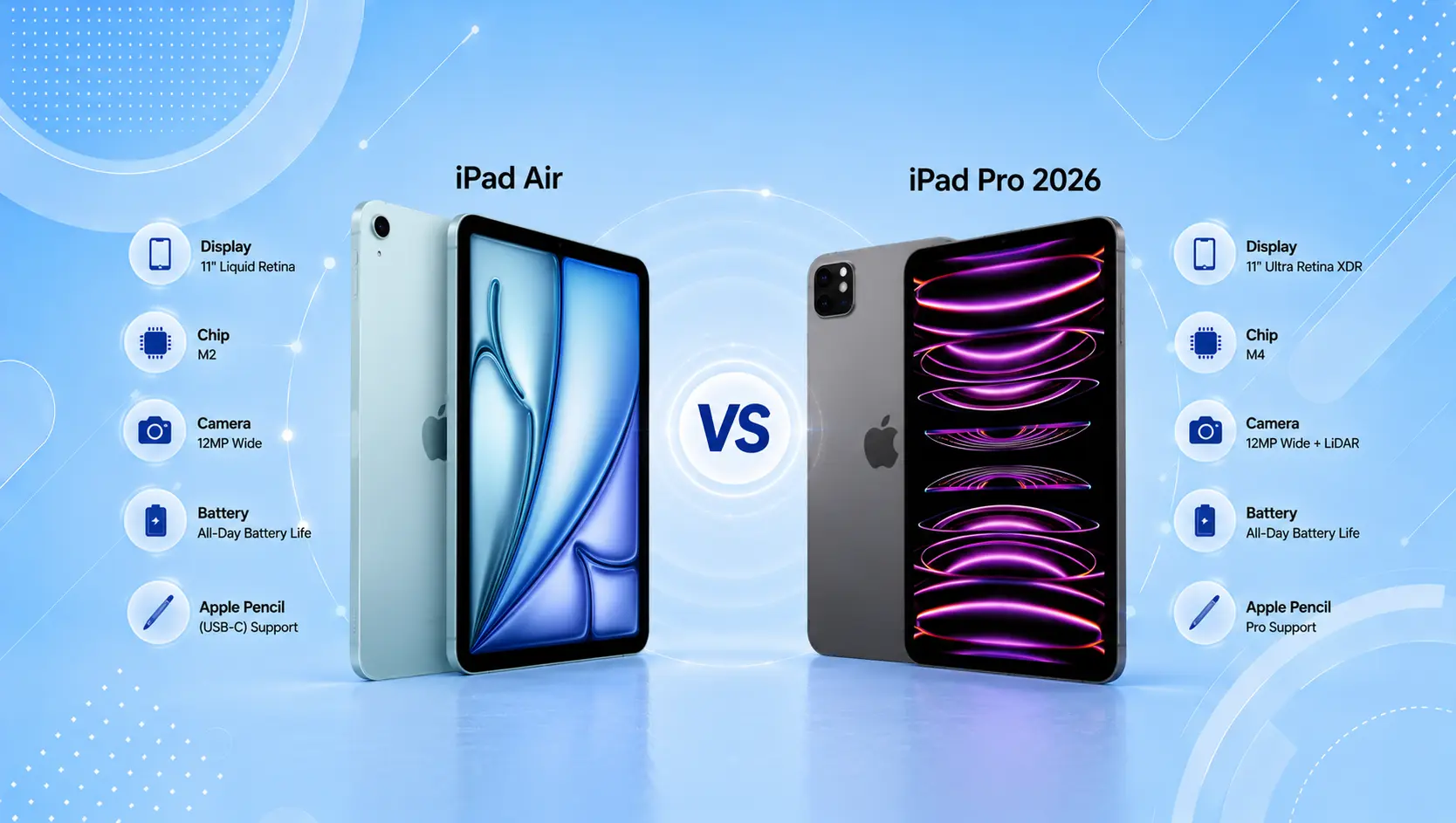
👉 Read next: iPad Air vs iPad Pro 2026 — Is the Upgrade Worth It?
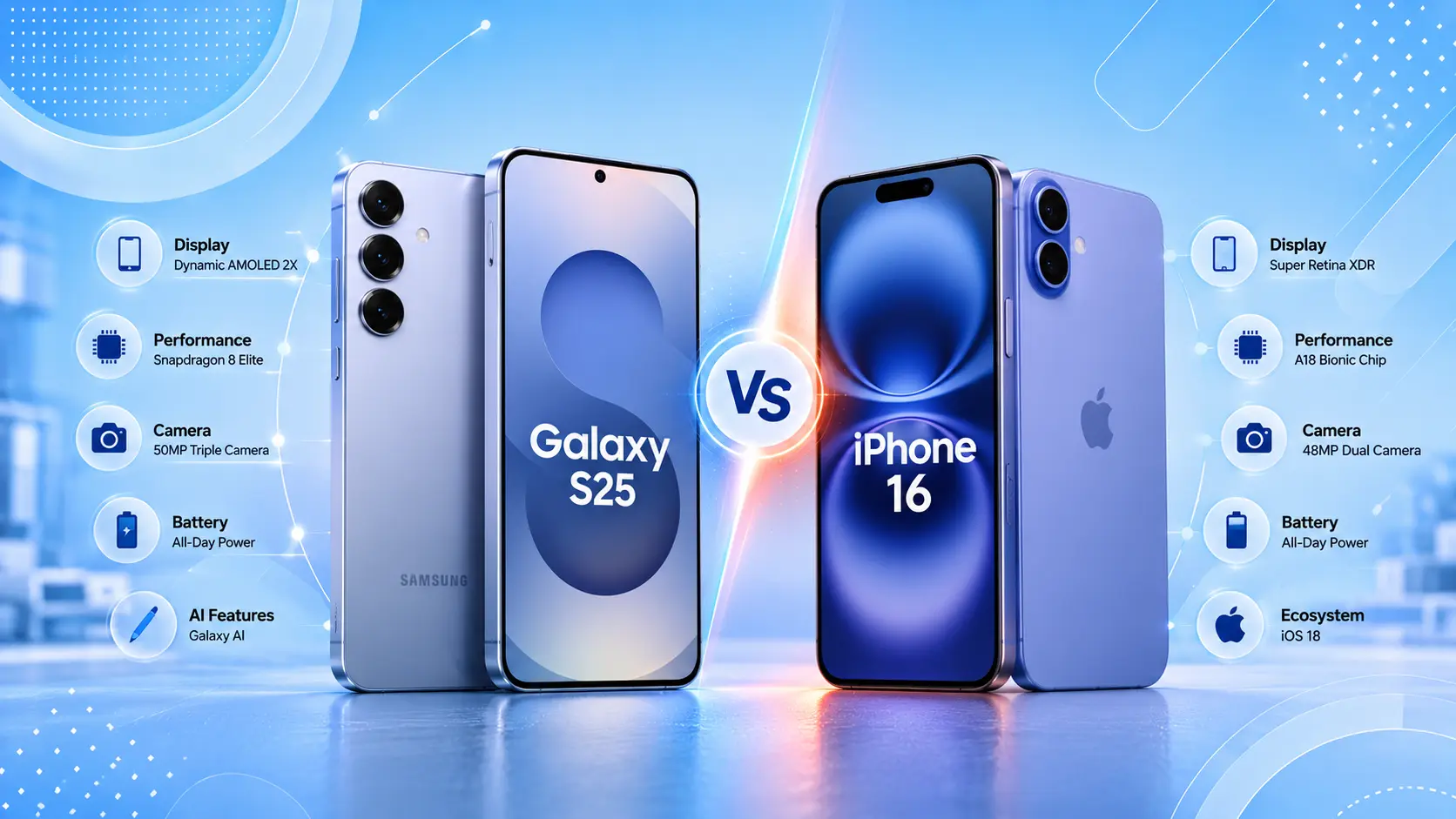
👉 Also useful: Samsung Galaxy S25 vs iPhone 16 — Which Should You Buy?
About the Author
[Raouf Osman] is a tech writer at WekyTech covering flagship smartphone comparisons for US and Canadian readers. He/she evaluates devices across real-world camera tests, battery rundowns, and daily usage scenarios — not just spec sheets — before publishing any recommendation.