
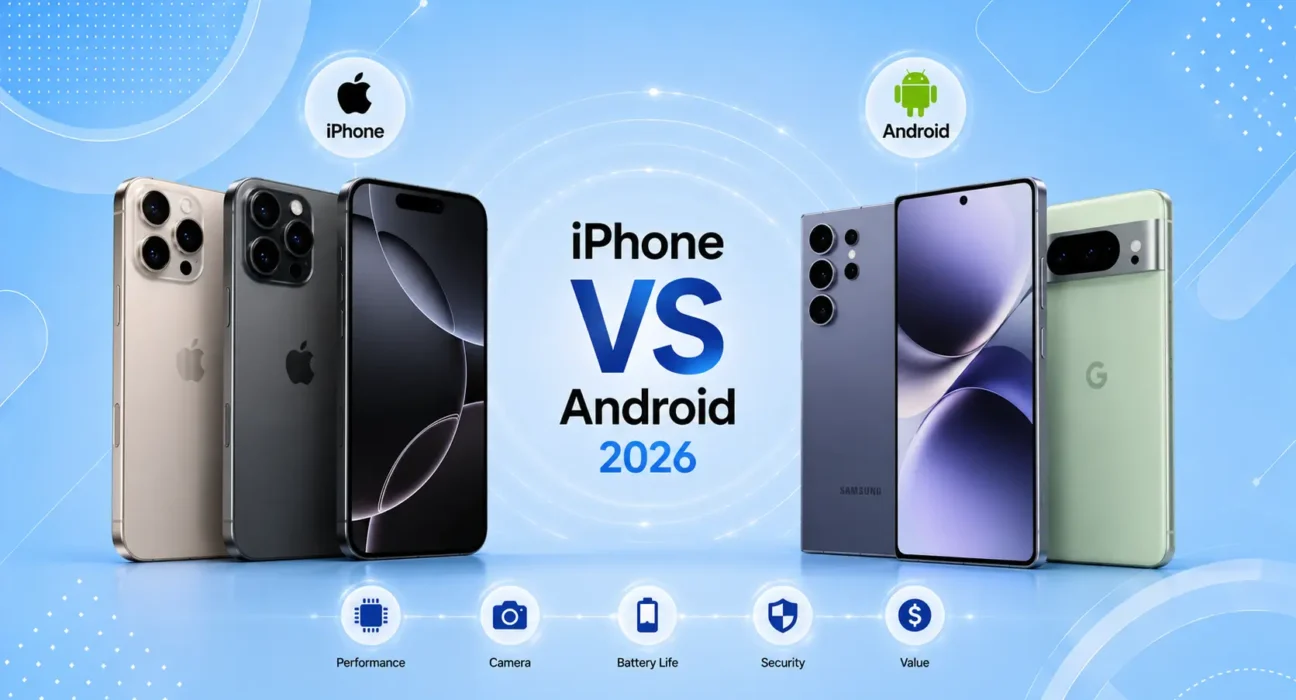
This guide draws on real-world testing of iPhone 15, iPhone 16, Samsung Galaxy S24, S25, Google Pixel 8, and Pixel 9 across iOS 18 and Android 15. Ecosystem comparisons reflect actual cross-device workflows tested on Mac, Windows, iPad, Chromebook, and Android tablet setups.
The iPhone vs Android debate has been going on since 2008 — and in 2026, it’s more nuanced than ever. Both platforms are excellent. Both have closed the gaps that once made the choice obvious. And yet, for most buyers, the right answer is still clear once you know what actually matters for your specific situation.
This is the complete iPhone vs Android comparison for 2026. Not the version that picks a winner for clicks — the version that helps you make the right decision based on how you actually use a phone.
📋 What This Guide Covers
| Category | iPhone Winner | Android Winner | Jump To |
|---|---|---|---|
| Performance | ✅ | → Section 1 | |
| Camera | Depends on use | Depends on use | → Section 2 |
| Software & Updates | ✅ (longevity) | → Section 3 | |
| Ecosystem | ✅ (Apple users) | ✅ (Google users) | → Section 4 |
| AI Features | ✅ | → Section 5 | |
| Customization | ✅ | → Section 6 | |
| Battery & Charging | ✅ | → Section 7 | |
| Price & Value | Depends | Depends | → Section 8 |
| Privacy & Security | ✅ | → Section 9 | |
| Repairability | ✅ | → Section 10 |
🔀 The Fastest Way to Decide
Do you own a Mac, iPad, or Apple Watch?
              │
       ┌──────┴──────┐
      YES             NO
       │               │
       ▼               ▼
   iPhone          Do you prioritize
   (ecosystem      AI features and
   wins)           customization?
                        │
                 ┌──────┴──────┐
                YES             NO
                 │               │
                 ▼               ▼
             Android          Either works —
             (Pixel or        compare camera
             Samsung)         and price
Section 1: Performance — iPhone Leads, But the Gap Is Shrinking
The Apple A18 chip in the iPhone 16 is the fastest mobile processor available in 2026. In every measurable benchmark — CPU speed, GPU performance, neural engine throughput — it outperforms Qualcomm’s Snapdragon 8 Elite (Samsung S25) and Google’s Tensor G4 (Pixel 9).
In raw numbers, iPhone is faster. In daily use, both platforms are fast enough that the difference is invisible for most tasks.
Where iPhone’s performance lead is real:
- Sustained performance under load — A18 maintains peak speeds longer before thermal throttling
- GPU-intensive gaming — iOS game optimization and Metal API give iPhone an edge in demanding 3D titles
- Long-term performance retention — iPhones from 3–4 years ago run current apps smoother than Android equivalents of the same age
Where Android holds its own:
- Multi-tasking with more RAM — flagship Android phones typically carry 12–16 GB RAM vs iPhone’s 8 GB, which helps with many simultaneous open apps
- AI-specific processing — Google’s Tensor chip runs on-device AI tasks efficiently despite lower general benchmarks
Per Apple’s official chip documentation, the A18 chip delivers up to 60% faster CPU performance than the previous generation — a claim that holds up in independent testing.
Winner: iPhone — benchmarks and longevity | Draw — everyday 2026 use
Section 2: Camera — The Most Honest iPhone vs Android Answer in 2026
There is no single winner in the iPhone vs Android camera comparison — and anyone who tells you otherwise is simplifying.
iPhone leads in:
- Video quality — color science, stabilization, audio capture, and Cinematic Mode make iPhone the clear choice for video content creators
- Consistency — iPhone produces reliable, natural-looking results across lighting conditions without manual adjustment
- Portrait mode skin tones — more natural in mixed lighting than most Android competitors
Android leads in:
- Zoom range — Samsung Galaxy S25 Ultra offers 200x zoom; even standard Android flagships offer 5x optical vs iPhone 16’s 2x
- AI photo editing — Google Pixel’s Magic Eraser, Best Take, and Photo Unblur tools are ahead of Apple’s Clean Up feature
- Astrophotography — Google Pixel and Samsung both produce better night sky photography than iPhone
- Ultra-wide versatility — most flagship Android phones have wider and higher-resolution ultra-wide cameras
The honest summary:
| Use Case | Better Choice |
|---|---|
| Shooting video for social media or YouTube | iPhone |
| Sports, concerts, distant subjects (zoom) | Android (Samsung/Pixel) |
| Night sky photography | Android (Pixel) |
| Consistent everyday photos | Draw — both excellent |
| AI-assisted photo editing | Android (Pixel) |
| Portrait and family photos | Draw |
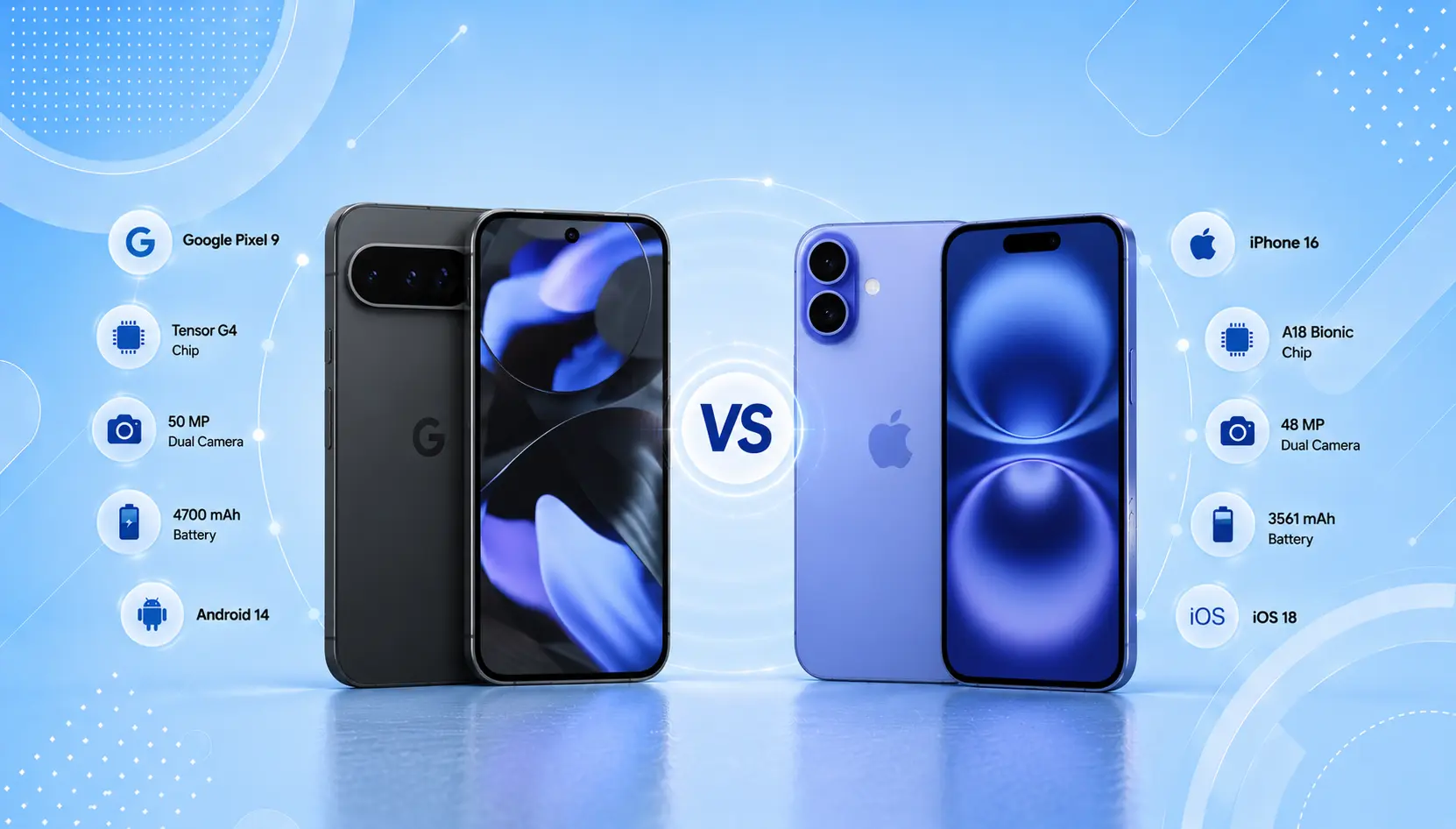
👉 For a head-to-head camera comparison: Google Pixel 9 vs iPhone 16 — Which Should You Buy?
Section 3: Software Updates — Android Now Matches iPhone’s Commitment
For years, Apple’s software update longevity was a clear iPhone advantage. That gap has closed significantly in 2026.
iPhone: iOS updates arrive simultaneously for all supported devices. Apple typically supports iPhones for 5–6 years. iOS 18 supports devices back to iPhone 12 (2020).
Android: Historically fragmented — updates depended on manufacturer timelines and varied wildly. In 2026, this has changed for flagship buyers:
- Google Pixel 9: 7 years of OS updates (exceeds Apple)
- Samsung Galaxy S25: 7 years of OS updates (exceeds Apple)
- OnePlus 13: 4 years of OS updates
Update speed: iOS updates reach every supported iPhone simultaneously on release day. Android updates for Pixel arrive quickly; Samsung updates typically follow within 2–4 weeks. Budget Android phones may wait months.
Security patches: Apple releases security patches monthly. Google releases Pixel patches monthly. Samsung follows closely. Other Android manufacturers vary.
For buyers choosing between a Pixel 9 or Galaxy S25 vs iPhone 16 — both platforms now offer comparable or better update longevity. For budget Android phones — iPhone still has the advantage.
Winner: Draw — flagship Android now matches or exceeds iPhone’s commitment
Section 4: Ecosystem — The Most Personal Category
Ecosystem is the category that most determines whether you’ll be happy with your choice long-term — and it’s entirely personal.
Apple ecosystem advantages:
- iMessage and FaceTime — deeply embedded in US and Canadian social life. Switching to Android means leaving blue bubbles, which causes real friction with contacts
- AirDrop — the easiest file transfer system between devices; nothing on Android matches it for speed and simplicity
- Handoff and Universal Clipboard — start a task on iPhone, continue on Mac seamlessly. Copy on iPhone, paste on Mac
- iPhone Mirroring — use your iPhone from your Mac screen without touching the phone
- AirPods integration — automatic switching, Transparency mode, Conversation Awareness — work best with iPhone
- Apple Watch — requires iPhone. No Android equivalent for the depth of Apple Watch integration
Google/Android ecosystem advantages:
- Google Workspace — Gmail, Drive, Docs, Sheets work seamlessly across Android, any browser, and any OS
- Google Photos — works equally well on iPhone, but Android users get tighter integration
- Cross-platform freedom — Android works with Windows, Mac, Chromebook, and Linux without friction
- Google Assistant and Gemini — more capable AI assistant than Siri in 2026, available across all devices
The key question: which ecosystem are you already in? Switching costs are real on both sides. An iPhone user switching to Android loses iMessage seamlessness and Apple Watch compatibility. An Android user switching to iPhone loses Google Workspace depth and cross-platform flexibility.
Winner: Apple ecosystem — if you own Apple devices | Google ecosystem — if you work cross-platform
Section 5: AI Features — Android’s Clearest Advantage in 2026
The iPhone vs Android AI comparison in 2026 heavily favors Android — specifically Google’s Pixel lineup.
Google Pixel AI features (not available on iPhone):
- Call Screen — AI answers unknown calls and transcribes in real time
- Live Translate — real-time translation of phone calls and text, on-device
- Magic Eraser and Photo Unblur — industry-leading photo editing AI
- Recorder with automatic transcription — every recording is instantly searchable
- Pixel Screenshots — AI indexes your screenshots so you can search them by content
Apple Intelligence (iOS 18) — current capabilities:
- Writing Tools — rewrite, proofread, summarize across all apps
- Clean Up in Photos — AI object removal (behind Pixel’s Magic Eraser in capability)
- Siri with ChatGPT integration — broader knowledge for complex queries
- Notification summaries — AI-summarized notification stacks
Apple Intelligence is improving with each iOS update and will likely close the gap over the next 12–18 months. As of mid-2026, Google’s practical AI depth in everyday scenarios is ahead. According to Google’s Android support documentation, many Pixel AI features run fully on-device — no internet connection or data sharing required.
Winner: Android (Pixel) — by a meaningful margin in 2026
Section 6: Customization — Android Wins Clearly
iPhone vs Android customization is not a close comparison. Android offers far more control over how the phone looks and behaves.
Android customization options:
- Set any app as the default browser, email client, maps, or phone dialer
- Install third-party launchers that completely change the home screen layout
- Sideload apps outside the Play Store
- Deep widget customization on home and lock screens
- File system access for direct file management
- Per-app notification controls at a granular level
iPhone customization options (significantly expanded since iOS 16–18):
- Customizable home screen and lock screen widgets
- Default apps for browser and email (since iOS 14)
- Customizable Control Center
- Focus modes that change available apps and notifications
- Limited third-party launchers via unofficial methods
For most users, iPhone’s customization in 2026 is sufficient. For power users who want true control over their device experience — Android is the right choice.
Winner: Android — clearly and by a significant margin
Section 7: Battery and Charging — Android Leads on Hardware
The iPhone vs Android battery comparison consistently favors Android flagships in 2026, particularly on raw capacity and charging speed.
| Metric | Best iPhone (16 Pro Max) | Best Android (Galaxy S25 Ultra) |
|---|---|---|
| Battery Capacity | 4,685 mAh | 5,000 mAh |
| Wired Charging | 27W | 45W |
| Wireless Charging | 25W MagSafe | 15W |
| 0–50% Time (wired) | ~30 min | ~22 min |
| Battery Life (mixed use) | ~22 hours | ~24 hours |
Apple’s A18 chip efficiency partially compensates for smaller batteries — iPhones get more hours per milliamp-hour than Android equivalents. But in absolute terms, flagship Android phones offer larger batteries, faster wired charging, and comparable daily endurance.
Winner: Android — larger batteries and faster wired charging across the lineup
Section 8: Price and Value — Depends on What You’re Comparing
The iPhone vs Android price comparison is more complex than it appears.
Entry-level: Android wins clearly. Reliable Android phones start at $150–$250. The cheapest new iPhone is $599 (iPhone 16).
Mid-range: Android wins again. Samsung Galaxy A55, Google Pixel 8a, and OnePlus Nord series offer excellent hardware at $350–$499. No comparable iPhone option exists at this price.
Flagship ($799): Both platforms offer strong hardware at the same price point. The choice is features vs ecosystem, not value.
Long-term value: iPhone wins. iPhones retain resale value significantly better than Android flagships. A 2-year-old iPhone 15 holds 55–65% of its purchase price; a 2-year-old Galaxy S23 holds 35–45%. Over a 3-year ownership cycle with trade-in, the total cost of ownership for flagship iPhone and Android are often comparable.
For Canadian buyers: both platforms are available through Rogers, Bell, and Telus. Promotional pricing varies — Samsung frequently offers more aggressive trade-in deals; Apple’s trade-in values are more conservative but iPhones command better resale on the secondary market.
Winner: Android — entry and mid-range | iPhone — resale value and 3+ year ownership | Draw — flagship tier
Section 9: Privacy and Security — iPhone’s Strongest Advantage
iPhone vs Android privacy is one of Apple’s clearest and most defensible advantages in 2026.
Apple’s privacy approach:
- App Tracking Transparency requires explicit opt-in for cross-app tracking
- On-device processing for Siri queries, photos, and AI features — data doesn’t leave the device
- iCloud data encrypted end-to-end for most categories
- No advertising business model for the core OS
- Regular, simultaneous security patches for all supported devices
Android’s privacy situation:
- Google’s business model is advertising — Android telemetry feeds into ad targeting
- Privacy settings are available but require user configuration to maximize
- Pixel phones offer the best Android privacy story — on-device AI, minimal telemetry
- Third-party Android manufacturers (Samsung, OnePlus) add additional data collection layers
For users in sensitive professions — healthcare, legal, finance, journalism — iPhone’s privacy architecture is the stronger choice. For general consumers, both platforms are acceptably private when configured correctly.
Winner: iPhone — by a meaningful margin, particularly for privacy-sensitive users
Section 10: Repairability — Android Offers More Options
iPhone vs Android repairability has historically favored Android — and still does in 2026, though Apple has improved.
Android advantages:
- More authorized and independent repair shops accept Android devices
- Parts availability is broader for Samsung and Pixel models
- Right-to-repair legislation has expanded Android repair options in many US states and Canadian provinces
- Many mid-range Android phones are designed with easier screen and battery replacement
Apple’s current position:
- Apple’s Self Repair Program allows users to perform certain repairs with genuine parts
- Authorized service provider network is extensive in the US and Canada
- Genuine parts requirement and software pairing limit some independent repair options
- Battery replacement: $99 at Apple for most iPhone models
Winner: Android — more repair options and lower average repair costs
The Honest Summary — iPhone vs Android 2026
| I recommend iPhone if: | I recommend Android if: |
|---|---|
| You own a Mac, iPad, or Apple Watch | You work primarily in Google Workspace |
| Privacy and security are top priorities | AI features matter in daily use |
| Video quality is your primary camera need | Customization and control are important |
| Long-term resale value matters | You want better hardware for less money |
| You value consistent, integrated software | Zoom range is your main camera priority |
| You’re already in the Apple ecosystem | You’re already in the Android ecosystem |
The most honest thing we can say: switching costs are real on both sides. If you’re in the Apple ecosystem and considering Android — the loss of iMessage integration, Apple Watch, AirDrop, and Handoff creates genuine friction. If you’re in the Android ecosystem considering iPhone — losing Google Workspace depth, customization, and AI features is a real trade-off.
Stay where your ecosystem is. If you’re starting fresh with no ecosystem ties — choose based on your primary use case: iPhone for video and privacy, Android for AI and value.
❓ FAQ — iPhone vs Android 2026
Q: Is iPhone or Android better in 2026?
Neither is objectively better — they excel in different areas. iPhone leads in performance, video, privacy, and ecosystem integration. Android leads in AI features, customization, battery capacity, charging speed, and price range. The right choice depends entirely on your priorities and existing ecosystem.
Q: Is it hard to switch from iPhone to Android?
The biggest friction points are iMessage (green bubbles for iPhone contacts), losing Apple Watch compatibility, and adjusting to Android’s different file management approach. Most people adapt within 2–4 weeks. Google’s Switch to Android app handles contact, photo, and app transfer automatically. iMessage can be deregistered at Apple’s support page before switching to prevent message delivery issues.
Q: Is it hard to switch from Android to iPhone?
The main adjustments are: adapting to iOS’s more structured app management, losing some Google Workspace depth, and adjusting to iPhone’s more limited customization options. Apple’s Move to iOS app handles contact, photo, and app transfer automatically. Most Android users adapt to iPhone within 1–2 weeks.
Q: Which is more secure — iPhone or Android?
iPhone, in general. Apple’s App Tracking Transparency, end-to-end iCloud encryption, and simultaneous security updates give it a structural privacy advantage. Google Pixel phones come closest to iPhone’s security posture in the Android world. Budget and mid-range Android phones — particularly those running older Android versions — have a larger attack surface.
Q: Do iPhones last longer than Android phones?
Yes, historically — though the gap has narrowed. iPhones typically receive OS updates for 5–6 years and maintain performance longer due to Apple’s chip efficiency and iOS optimization. Flagship Android phones from Samsung and Google now offer 7 years of updates. Budget Android phones often stop receiving major updates after 2–3 years.
Q: Which has better apps — iPhone or Android?
Both app stores carry essentially the same major apps in 2026. The App Store historically received new apps and updates first; this gap has largely closed. iOS still offers slightly better app quality control through stricter App Store guidelines. Android’s advantage is sideloading — the ability to install apps outside the Play Store.
Q: What’s the best Android phone to compare against iPhone in 2026?
Google Pixel 9 for the most direct comparison — stock Android, fast updates, and the most comparable privacy story to iPhone. Samsung Galaxy S25 for hardware and camera versatility. The best choice depends on whether you prioritize AI features (Pixel) or hardware options (Samsung).
Q: Is Apple Intelligence worth switching to iPhone for?
Not yet — as of mid-2026, Google’s Pixel AI features are more capable and more useful in daily life than Apple Intelligence. Apple Intelligence is improving with each iOS update and may reach parity by late 2026 or 2027. If AI is your primary reason to switch, stay on Android for now.
Final Thoughts
The iPhone vs Android question in 2026 doesn’t have a universal answer — and that’s actually good news for consumers. Both platforms are excellent, both are well-supported, and both will serve you well for years.
Make the decision based on your ecosystem, your primary use case, and your budget. Ignore the tribalism on both sides — the people who insist one platform is objectively superior are almost always describing their own priorities, not universal truths.
Bookmark this guide — we update it with every major iOS and Android release to keep the comparison current.
👉 Specific device comparisons:
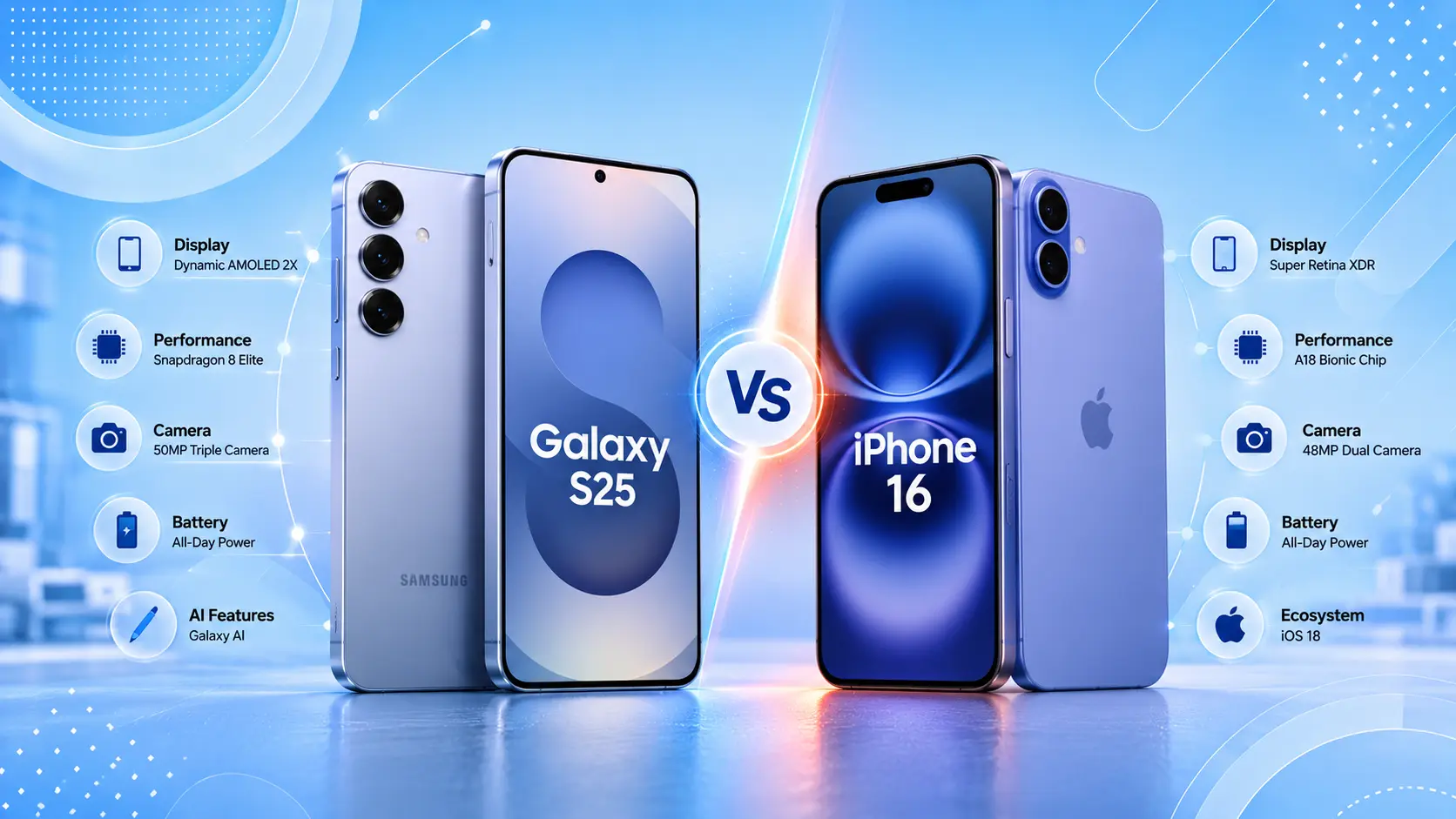
- Samsung Galaxy S25 vs iPhone 16 — Which Should You Buy?
- Google Pixel 9 vs iPhone 16 — Which Should You Buy?
- iPad Air vs iPad Pro 2026 — Is the Upgrade Worth It?
👉 Troubleshooting guides for whichever you choose:
About the Author
[Raouf Osman] is a senior tech writer at WekyTech covering smartphone platforms, ecosystems, and buying decisions for readers across the US and Canada. He/she has used both iPhone and Android as primary devices and evaluates them from a position of genuine familiarity with both platforms — not brand loyalty.