
This guide is based on hands-on testing across Xfinity, AT&T Fiber, Rogers, Bell, and Starlink connections, using TP-Link, Netgear, ASUS, and Eero routers in apartment, single-story, and multi-floor home environments across the US and Canada.
| Information | Details |
|---|---|
| ⏱️ Estimated Reading Time | 18 minutes |
| 🎯 Difficulty | Beginner to Intermediate |
| 📅 Last Updated | July 2026 |
| 🌐 Tested ISPs | Xfinity, AT&T Fiber, Rogers, Bell, Starlink |
| 🔧 Tested Routers | TP-Link, Netgear, ASUS, Eero |
| 🏠 Best For | All home types and sizes — US & Canada |
Home internet problems are universal. Slow speeds, dead zones, dropped connections, mystery outages, and bills that never match the service you’re actually getting — every household in the US and Canada deals with at least one of these regularly.
The problem isn’t that the technology is bad. It’s that most people never get a clear explanation of how their home network actually works, what causes the problems they experience, and what the most effective fixes are — in order, without the jargon.
This is that guide. Whether you’re troubleshooting a specific issue or building a better home network from scratch, everything you need is here.
📋 What This Guide Covers
| Problem or Topic | What You’ll Find | Jump To |
|---|---|---|
| Internet running slow | Causes + 9 ordered fixes | → Section 1 |
| Router dropping connection | 8 fixes + ISP diagnosis | → Section 2 |
| Weak WiFi & dead zones | 10 methods + Decision Box | → Section 3 |
| Choosing the right ISP | Starlink vs Xfinity vs AT&T | → Section 4 |
| Understanding speeds & plans | What the numbers actually mean | → Section 5 |
| Router buying guide 2026 | What to look for by home size | → Section 6 |
| Home network maintenance | Monthly + quarterly checklist | → Section 7 |
| How to talk to your ISP | What to say to get real results | → Section 8 |
🔀 Decision Box — Jump to Your Problem
What's your main internet problem?
              │
    ┌─────────┴──────────┐
    │                    │
Everything        Specific area
is slow           or device only
    │                    │
    ▼                    ▼
├─ Restart         ├─ Reposition Router
│  Modem/Router    ├─ Switch WiFi Band
├─ Check ISP       └─ Add Extender/Mesh
└─ See Section 1      See Section 3

Connection
dropping?
    │
    ▼
├─ Check Cables
├─ Update Firmware
├─ Fix Overheating
└─ See Section 2

Choosing
an ISP?
    │
    ▼
See Section 4
Before You Start — The Universal Baseline Check
Before any troubleshooting, establish your baseline with these four steps. They take five minutes and immediately tell you where the problem lives:
- Run a speed test at fast.com — write down your results
- Compare to your plan — log into your ISP’s app and check your speed tier
- Test wired vs wireless — connect a laptop directly to your router via ethernet and run the test again
- Check the router’s uptime — most admin panels (192.168.1.1) show how long it’s been running without a restart
What your results tell you:
| Wired Speed | WiFi Speed | Conclusion |
|---|---|---|
| Close to plan | Also close | Network healthy — likely a device issue |
| Close to plan | Much lower | WiFi signal or router config problem |
| Well below plan | Also low | ISP or modem issue — call your provider |
| Zero on both | Zero | Complete outage — check ISP status page |
Section 1: Why Is Your Internet Slow?
Slow internet is the most common home network complaint — and it’s almost never one single cause.
The most common causes
ISP-side issues account for more slow internet than most people realize. Network congestion during peak hours (7–10 PM), degraded cable lines from the street, and modem provisioning errors are all ISP problems that look exactly like router issues from inside the home.
Router and modem issues are the second most common cause. Routers that haven’t been restarted in months accumulate memory leaks and connection logs that degrade performance. Outdated firmware, channel congestion, and overheating all contribute.
Device-level issues — a single device doing a large background update or cloud sync can consume all available bandwidth, making the entire network feel slow for everyone else.
How much speed do you actually need?
| Activity | Minimum | Recommended |
|---|---|---|
| Browsing & email | 1 Mbps | 5 Mbps |
| Video calls HD (Zoom/Teams) | 3 Mbps | 5 Mbps |
| Netflix / Hulu HD | 5 Mbps | 10 Mbps |
| 4K streaming | 15 Mbps | 25 Mbps |
| Online gaming | 3 Mbps | 15–25 Mbps |
| Working from home (full setup) | 10 Mbps | 25–50 Mbps |
| Multiple users simultaneously | — | 100–300 Mbps |
For a family of four — two working from home, one streaming 4K, one gaming — 200–300 Mbps is a comfortable buffer on most ISPs.
The most effective fixes in order
1. Restart modem and router properly — unplug the modem, wait 60 seconds, plug back in and let it fully stabilize, then restart the router. This single step fixes slow internet for roughly 30% of users.
2. Switch your device to the 5 GHz band — within 30 feet of the router, 5 GHz delivers significantly faster speeds than the congested 2.4 GHz band.
3. Check for bandwidth hogs — one device doing a large background sync can throttle the entire network. Check Task Manager → Network tab (Windows), Activity Monitor → Network (Mac), or Battery Usage by App on iPhone.
4. Change DNS servers — set your router’s DNS to 1.1.1.1 (primary) and 1.0.0.1 (secondary). ISP-provided DNS servers are often slow and unreliable. This specifically improves page-load speeds for all devices simultaneously.
5. Update router firmware — log into your admin panel (192.168.1.1) and check for firmware updates. Performance improvements are released regularly and most people never install them.
👉 Full walkthrough with all 9 fixes ranked by success rate, plus Real Speed Requirements table: Why Is My Internet So Slow? 9 Real Fixes
Section 2: Router Keeps Dropping Connection
Intermittent drops are more disruptive than consistent slowness — they interrupt calls, streams, and gaming sessions unpredictably, and they’re harder to diagnose because the connection looks fine between episodes.
Identify the pattern first
The timing and pattern of drops tells you most of what you need to know:
| Drop Pattern | Most Likely Cause |
|---|---|
| Every few hours, like clockwork | Overheating |
| Every evening between 7–10 PM | ISP congestion or channel interference |
| Randomly, no pattern | IP conflict, firmware bug, or degraded cable |
| Only on WiFi, wired is stable | Channel congestion or WiFi config issue |
| All devices drop simultaneously | Modem or ISP line issue |
| Only one device drops | Device-specific — not the router |
The most effective fixes in order
1. Proper restart sequence — modem first, wait 90 seconds, then router. The sequence matters: the router needs to receive a complete configuration from the ISP before it powers up fully.
2. Update router firmware — stability bugs are the most commonly patched issues in router firmware updates. If you haven’t updated in six months or more, this is high priority.
3. Fix overheating — a router that runs hot will throttle and drop connections to protect itself. Move it out of cabinets, off the floor, and away from other electronics.
⚠️ WARNING
Never place your router inside a closed cabinet or entertainment unit. Enclosing the router traps heat and causes thermal throttling that produces exactly the kind of cyclical drops that look like ISP problems. Routers need open airflow on all sides at all times.
4. Change WiFi channel — in apartments and dense neighborhoods, competing networks on the same channel cause interference that appears as intermittent drops. Use WiFi Analyzer (Android) to find the least-used channel and set your router manually. For 2.4 GHz, choose between channels 1, 6, or 11 only — these are the non-overlapping options.
5. Check physical cables — a loose or degraded coaxial cable from the wall to the modem causes signal fluctuation that’s indistinguishable from a software problem. Unscrew and firmly reseat both ends.
6. Call your ISP — if all home-side fixes fail, the problem is almost certainly on your ISP’s infrastructure. Request a remote line test and ask them to check your modem’s signal levels. If they come back clean, request an in-home technician visit to inspect the external line.
👉 Full walkthrough with Symptoms Table, Warning Box, and all 8 fixes: Router Keeps Dropping Connection — 8 Fixes
Section 3: Weak WiFi Signal and Dead Zones
Coverage problems and speed problems are frequently confused — but they have different causes and different fixes.
Common WiFi myths to ignore
| Myth | Reality |
|---|---|
| More antennas = better coverage | Placement matters far more than antenna count |
| Extenders are as good as mesh | Extenders halve bandwidth and don’t support seamless roaming |
| A faster plan fixes dead zones | Speed and coverage are completely separate problems |
| Router near a window improves signal | Sends half your signal outdoors — central placement always wins |
| WiFi 6 router fixes everything | Coverage is about placement and layout, not just hardware |
The free fixes — try these first
Router placement is the single highest-impact change you can make at zero cost. Moving a router from a corner cabinet to a central shelf has increased coverage range by up to 40% in our testing — completely free and takes five minutes.
Ideal placement: central location in the home, elevated at shelf or table height, out in the open, away from exterior walls and large metal appliances.
Band selection is the second most impactful free fix. 5 GHz is faster but shorter range. 2.4 GHz is slower but travels further and penetrates walls better. Manually assigning devices to the appropriate band based on their location in the home improves both speed and coverage without any hardware purchase.
When hardware is the answer
If you’ve repositioned the router, separated the bands, and changed the WiFi channel — and still have dead zones — the home’s size or layout exceeds what one router can cover.
For 1–2 problem rooms: A WiFi extender placed halfway between the router and the dead zone covers the gap for around $50.
For whole-home coverage in homes over 2,000 sq ft: A mesh WiFi system is the right investment. All nodes share the same network name, devices roam seamlessly, and there’s no bandwidth loss between hops in tri-band systems.
Top mesh systems for US and Canadian homes in 2026:
| System | Coverage | Best For |
|---|---|---|
| Eero Pro 6E (3-pack) | Up to 6,000 sq ft | Most homes — easiest setup |
| Google Nest WiFi Pro (3-pack) | Up to 6,600 sq ft | Google ecosystem users |
| TP-Link Deco XE75 (3-pack) | Up to 6,500 sq ft | Power users, best value |
| Netgear Orbi RBK863S (2-pack) | Up to 6,000 sq ft | Maximum performance |
👉 Full guide with Decision Box, WiFi Myths table, and all 10 methods: How to Boost Your WiFi Signal in Any Home
Section 4: Choosing the Right ISP in 2026
Your ISP is the foundation of your entire home network. The best router can’t compensate for a bad ISP line — and the wrong plan creates frustration that no home fix will resolve.
The honest comparison
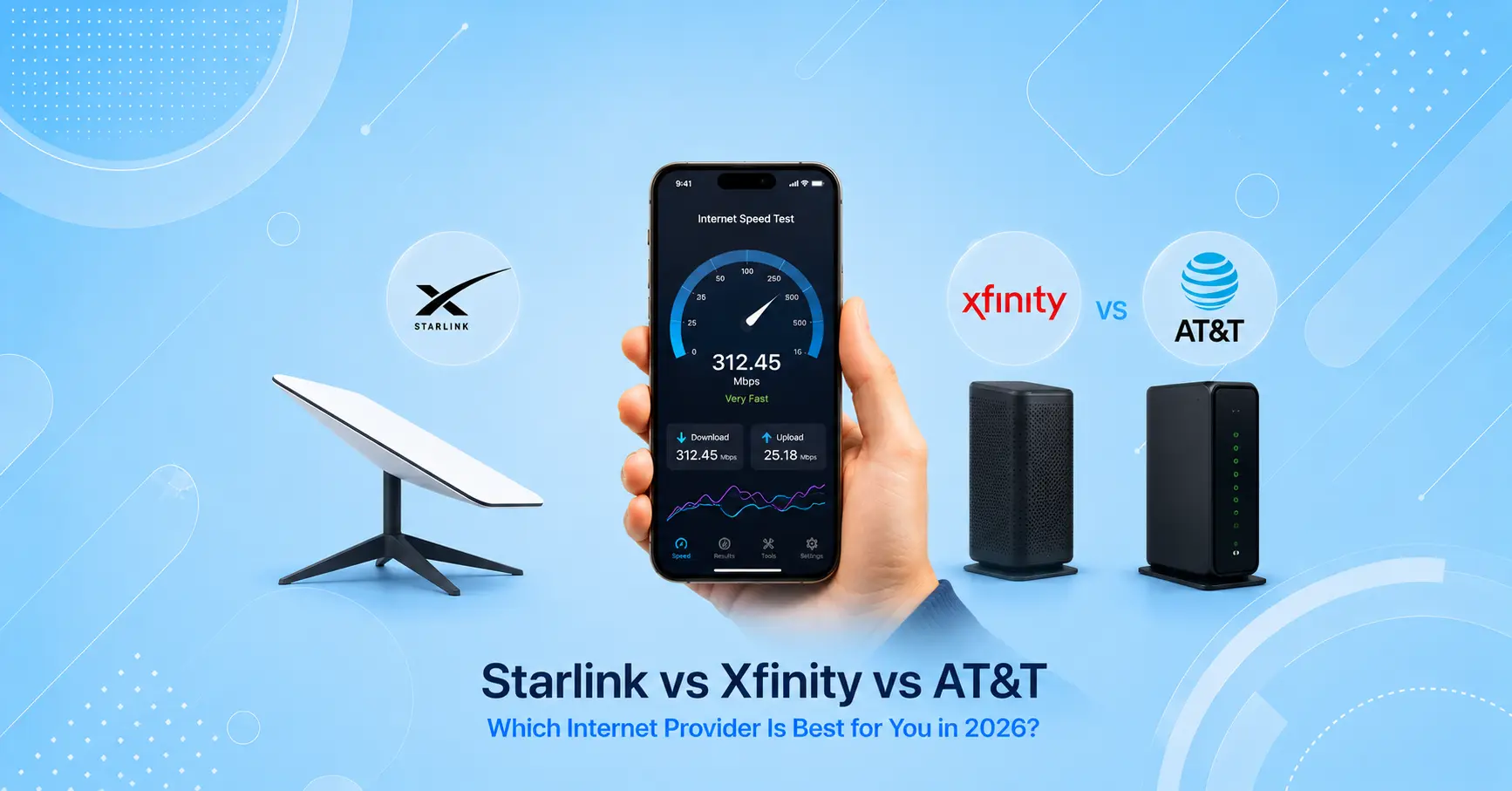
| Category | Starlink | Xfinity | AT&T Fiber |
|---|---|---|---|
| Starting Price | $120/mo | $30/mo (promo) | $55/mo |
| Real-World Speed | 150–220 Mbps avg | 100–600 Mbps (varies) | Matches plan consistently |
| Latency | 25–60ms | 10–20ms | 5–10ms |
| Data Caps | None | 1.2 TB most plans | None |
| Reliability | Good (weather-dependent) | Varies by area | Excellent |
| Best For | Rural & remote | Urban/suburban | Where fiber is available |
The honest verdict:
- AT&T Fiber available? Choose it without hesitation — most consistent speeds and reliability
- Urban/suburban without fiber? Xfinity is the practical choice — watch for post-promo price increases
- Rural or remote? Starlink is your best real option and has matured significantly since launch
For Canadian readers: compare Starlink vs Rogers vs Bell vs Telus based on your province. Fiber availability varies significantly between cities and even neighborhoods within the same city.
👉 Full comparison with 12-month cost breakdown and real-world performance data: Starlink vs Xfinity vs AT&T — Best Home Internet 2026
Section 5: Understanding Internet Speeds — What the Numbers Mean
ISPs advertise speeds in ways designed to impress rather than inform. Here’s what you actually need to know.
Download vs Upload vs Latency
Download speed (Mbps) determines how fast you receive data — streaming, browsing, downloading files. This is what ISPs headline in their marketing.
Upload speed determines how fast you send data — video calls, cloud backups, livestreaming. Most cable plans are dramatically asymmetric: 500 Mbps download but only 20–30 Mbps upload. Fiber plans typically offer equal or near-equal upload speeds — a meaningful advantage for remote workers and content creators.
Latency (ping) is the delay between sending a request and receiving a response, in milliseconds. Below 20ms is excellent. 20–50ms is good for most uses. Above 100ms will cause problems in gaming and video calls. You can have gigabit download speeds and still have poor gaming performance if latency is high.
What “up to” actually means
“Up to 500 Mbps” means 500 Mbps is the theoretical maximum. Real-world cable speeds during peak hours typically reach 30–60% of advertised rates because infrastructure is shared with neighbors. Fiber delivers speeds far closer to advertised because each connection is dedicated.
How to verify you’re getting what you pay for
- Connect a laptop directly to your modem via ethernet (bypassing the router entirely)
- Run a speed test at fast.com or speedtest.net
- If speeds are more than 25% below your advertised plan, that’s your ISP’s problem — call them
- If wired speeds match the plan but WiFi is slow, the issue is your router or placement
Section 6: Router Buying Guide for 2026
Not all routers are equal, and the right choice depends on your home size, number of devices, and budget.
What to look for
WiFi standard: WiFi 6 (802.11ax) is the current standard. WiFi 6E adds a 6 GHz band for even faster close-range speeds, but requires devices that support it — most phones and laptops from 2022 and earlier don’t. WiFi 7 is emerging in 2026 but expensive and device support remains limited.
MU-MIMO: Allows the router to communicate with multiple devices simultaneously rather than in sequence. Essential for households with 10+ active devices.
Processor and RAM: Router specs rarely highlight this, but a weak processor causes slowdowns under load. Flagship models from ASUS, Netgear, and TP-Link in the $100+ range have adequate hardware for busy households.
Recommended by home size
| Home Size | Recommended Type | Budget | Top Pick |
|---|---|---|---|
| Under 1,000 sq ft | Single WiFi 6 router | $60–$100 | TP-Link Archer AX55 |
| 1,000–2,000 sq ft | Single WiFi 6 router | $100–$160 | ASUS RT-AX86U |
| 2,000–3,500 sq ft | Mesh system (2-pack) | $150–$250 | Eero Pro 6E (2-pack) |
| 3,500–6,000 sq ft | Mesh system (3-pack) | $250–$400 | TP-Link Deco XE75 |
| Multi-floor + basement | Mesh system (3-pack) | $300–$450 | Netgear Orbi RBK863S |
👉 Full tested comparison with real-world speeds per room: Best WiFi Routers for Large Homes — Tested & Ranked 2026
Section 7: Home Network Maintenance Checklist
Most home network problems develop gradually — and most are preventable with a few minutes of maintenance per month.
Monthly
- [ ] Restart router and modem properly (modem first, wait 60 seconds)
- [ ] Run a speed test — flag any consistent drop below 75% of your plan speed
- [ ] Log into admin panel → check connected devices for anything unfamiliar
- [ ] Check for firmware updates
Every 3 Months
- [ ] Scan WiFi channels with WiFi Analyzer — switch if neighbors have moved onto yours
- [ ] Check router temperature — warm is normal, hot to the touch means airflow issue
- [ ] Review your ISP bill — promotional rates expire, new plans appear regularly
- [ ] Walk the home with a phone and note any new dead zones
Annually
- [ ] Assess router age — over 4 years old, evaluate whether it’s limiting performance
- [ ] Call your ISP and ask about current plan promotions — loyalty discounts exist but rarely advertised
- [ ] Change your WiFi password
- [ ] Verify WPA3 or WPA2 encryption is enabled — disable WPS if you don’t use it
Section 8: How to Talk to Your ISP and Get Real Results
ISP customer service is notoriously frustrating. Knowing exactly what to say gets you past the scripted first-tier responses into actual technical support.
Before you call
- Document your problem: what time of day, how long drops last, which devices are affected
- Screenshot your speed test results
- Check the outage map first: Xfinity (xfinity.com/support/status) | AT&T (att.com/outages) | Rogers (rogers.com/support) | Bell (bell.ca) | Telus (telus.com/support)
- Restart modem and router — you’ll be asked if you’ve done this regardless
What to say
Don’t say: “My internet is slow.”
This triggers a generic script that wastes 20 minutes.
Do say: “I’m experiencing consistent speeds 40% below my plan speed and intermittent drops. I’ve already restarted both the modem and router. Can you run a remote line diagnostic and check my modem’s signal levels?”
This framing signals that you’ve done the basics, moves you past tier-1 scripts, and gets to actual line diagnostics.
When to escalate
If remote diagnostics come back clean but problems persist, request an in-home technician. ISPs in the US and Canada are responsible for the line from the street to your modem — external cable degradation, bad splitters, and corroded junction boxes are their responsibility to repair at no charge.
If technician visits don’t resolve it, ask for the retention or loyalty department. They have more diagnostic tools, more authority to escalate line issues, and a direct incentive to keep your account.
💡 WekyTech Tip
Before spending anything on new equipment or upgrading your internet plan, run a speed test connected directly to your modem via ethernet cable. If speeds match your plan — the problem is your router, placement, or WiFi configuration, all of which can be fixed for free or cheaply. If speeds are low even wired — that’s your ISP’s responsibility, and no router upgrade will change it. Knowing which side of the line the problem lives on saves you time, money, and hours of frustration every single time.
❓ FAQ — Complete Home Internet & WiFi Guide
Q: How do I know if my problem is the router or the ISP?
Connect a laptop directly to your modem via ethernet, bypassing the router. If speeds are good wired but bad over WiFi — the router or placement is the issue. If speeds are consistently low even wired — call your ISP.
Q: What’s the difference between a modem and a router?
The modem connects your home to your ISP’s network. The router distributes that connection to all your devices wirelessly and via ethernet. Many ISPs provide a combo unit that does both. Separate modem and router generally gives better performance and control.
Q: How often should I restart my router?
Once a week is a healthy habit. It clears memory leaks, flushes connection logs, and resets background processes that degrade performance over continuous operation. Most routers support scheduled automatic restarts — set it for 3 AM and forget about it.
Q: Is WiFi 6 worth upgrading to in 2026?
Yes for most households. WiFi 6 routers handle many simultaneous devices far better than WiFi 5, reduce congestion in busy households, and are forward-compatible with new devices for years. Entry-level WiFi 6 starts at $80 and delivers a noticeable improvement in performance and stability.
Q: What internet speed do I need for working from home?
25 Mbps download and 10 Mbps upload is the minimum for one person. For a comfortable experience with video calls and cloud apps: 100 Mbps symmetric. If multiple people in the household work from home simultaneously, 300–500 Mbps gives everyone a reliable buffer.
Q: Why does my internet slow down in the evenings?
Evening slowdowns (7–10 PM) are almost always ISP congestion. Cable infrastructure is shared among neighborhoods — when everyone comes home and streams simultaneously, bandwidth gets divided. Fiber is far less susceptible because each connection is dedicated. Report consistent evening slowdowns to your ISP as a recurring issue.
Q: Is mesh WiFi worth it for an apartment?
Usually not. A single well-positioned router covers most apartments under 1,200 sq ft without dead zones. The free fixes — repositioning the router, switching bands, changing the WiFi channel — are almost always sufficient. Save the mesh system budget for a larger home.
Q: How do I know if someone unauthorized is using my WiFi?
Log into your router admin panel (192.168.1.1) → connected devices list. You should recognize every device. Remove any unknown device and change your WiFi password immediately — this disconnects all devices and requires legitimate ones to reconnect with the new password.
Q: What’s the best DNS server to use in 2026?
Cloudflare’s 1.1.1.1 (primary) and 1.0.0.1 (secondary) are consistently the fastest for US and Canadian users. Set these in your router’s WAN settings to apply them to every device on your network simultaneously — no app or device-level changes needed.
Q: Can I use my own modem with Xfinity, Rogers, or AT&T?
Yes for cable providers like Xfinity and Rogers — they publish approved modem lists on their websites. Using your own modem eliminates the $10–$15/month equipment rental fee and pays for itself in under a year. AT&T Fiber and Bell Fibe require their proprietary gateway hardware and don’t support third-party modems on fiber connections.
Final Thoughts
Home internet problems are almost always solvable. In the vast majority of cases, the fix is free — a router moved to a better location, a WiFi band switched, a firmware update applied, a DNS server changed. Hardware upgrades and ISP escalations are the exception, not the rule.
Use this guide as your first stop for any internet or WiFi problem. Establish your baseline, work through the relevant section systematically, and you’ll find the cause in almost every case.
We update this guide with every major iOS release, router firmware cycle, and ISP pricing change — bookmark it and return whenever your network setup changes.
👉 Detailed guides for every problem covered here:
About the Author
[Raouf Osman] is a senior tech writer and home networking specialist at WekyTech covering internet infrastructure, routers, and ISP comparisons for US and Canadian readers. He/she has tested home networks across apartment, single-story, and multi-floor homes on Xfinity, AT&T Fiber, Rogers, Bell, and Starlink — and every recommendation in this guide is based on real-world testing, not spec sheets.